Overview
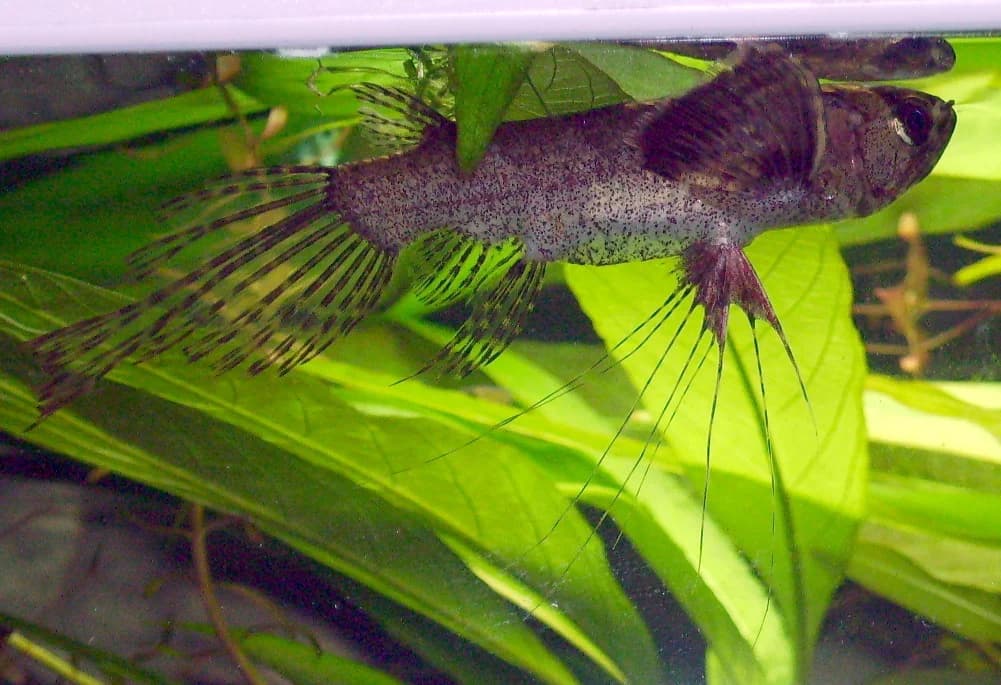
Pantodon buchholzi, commonly known as the African Butterflyfish, is one of the most extraordinary inhabitants of freshwater aquariums. This species is the only living representative of the family Pantodontidae, making it truly unique from a taxonomic standpoint. First described in 1876, it has captivated aquarists ever since with its striking appearance and remarkable behavior.
In the wild, Pantodon buchholzi inhabits slow-moving and still waters across West and Central Africa — vegetation-choked river backwaters, swamps, and lakes in Nigeria, Cameroon, the Congo, and other countries of the region. The fish is predominantly nocturnal: during daylight hours, it hovers motionless at the water surface among floating plants, becoming an active hunter as dusk falls.
Growing to 10–12 cm, the African Butterflyfish has a dorsally flattened body and large, fan-shaped pectoral fins that resemble butterfly wings. These fins enable the fish to perform short gliding leaps above the water surface — a unique ability rarely seen among aquarium fish. The fish uses these jumps both to catch insects and to escape predators. Its elongated pelvic fins resemble thin filaments and serve as tactile sensory organs.
Tank Requirements
Keeping Pantodon buchholzi requires an aquarium of at least 100 liters with a large water surface area, as this is the fish's primary living zone. Long, shallow tanks are preferable to tall, narrow ones.
Optimal water parameters include a temperature of 24–28 °C, pH of 6.0–7.5, and general hardness (GH) of 5–15. Water flow should be minimal or absent — in nature, the fish lives in virtually still water. Filtration is necessary, but the outflow should be directed toward a wall or diffused using a spray bar.
Floating plants (water lettuce, salvinia, riccia) are an essential part of the setup, creating shaded areas on the surface. Given the fish's nocturnal lifestyle, subdued lighting will help it feel at ease. The tank lid must be tightly fitted with no gaps — Pantodon buchholzi is capable of leaping out of the water to a considerable height.
Feeding and Diet
The African Butterflyfish is a specialized surface predator. In the wild, its diet consists of insects that have fallen onto the water, larvae, and small fish. The same approach should be maintained in the aquarium.
The staple diet should consist of live and frozen foods: bloodworms, small crickets, fruit flies, mosquito larvae, and brine shrimp. Food must remain at the water surface — the fish is extremely reluctant to take food from the water column and virtually never picks it up from the bottom. Dry floating pellets and flakes may be accepted but should not form the basis of the diet.
Feeding is best done during evening hours when the fish is most active. One to two small feedings per day are sufficient, ensuring that all food is consumed within a few minutes.
Care and Maintenance
Keeping Pantodon buchholzi demands attention to environmental stability. Weekly water changes of 20–25% are necessary to maintain water quality. It is important that fresh water closely matches the temperature and parameters of the tank water, as the fish is sensitive to sudden changes.
The water surface should be kept free of oily film — a surface skimmer or gentle surface agitation can help with this. Floating plants should be thinned periodically so the fish retains enough open space for hunting.
Given the species' nocturnal activity, it is advisable to set up a lighting cycle with a gradual transition from light to dark. The most fascinating behaviors — hunting and gliding leaps — are best observed under dim blue or moonlight illumination in the evening hours.
Compatibility
Pantodon buchholzi is a moderately territorial species that occupies the upper layer of the aquarium and may clash with other surface-dwelling fish. It should not be kept with small species (under 3–4 cm) that will be viewed as prey.
The best tank mates are peaceful fish that inhabit the middle and lower water layers. Excellent compatibility is demonstrated with Congo tetras, Corydoras and other bottom-dwelling catfish, as well as kuhli loaches. Among African species, leopard bush fish and elephantnose fish make fine companions, creating a natural West African biotope.
Avoid keeping this fish with active, fast-moving species that create disturbance at the water surface, as well as aggressive fish that could damage the delicate fins of the butterflyfish. Housing several Pantodon buchholzi together is possible in a spacious aquarium with plenty of cover and floating plants.
Breeding
Breeding Pantodon buchholzi in the aquarium is a task for experienced fishkeepers. Sexual dimorphism is subtle: males have a convex rear edge on the anal fin, while in females it is straight. Females are generally slightly larger and fuller-bodied than males.
To stimulate spawning, gradually raise the temperature to 27–28 °C and lower the water level to 15–20 cm. Generous feeding with live foods over two to three weeks helps condition the breeders. Simulating the rainy season — a slight reduction in water hardness and more frequent water changes with soft water — can also trigger spawning.
The female releases dark, buoyant eggs in batches at the water surface among floating plants. The eggs have positive buoyancy and remain near the surface. The parents are prone to eating their own eggs, so the eggs should be carefully collected and transferred to a separate rearing tank.
Incubation lasts approximately 36–48 hours. The larvae feed on their yolk sacs for the first few days before transitioning to the finest live foods — brine shrimp nauplii and microworms. Fry grow slowly and require meticulous care, stable water parameters, and regular feeding with small live foods.