Overview
Trigonostigma hengeli is one of the most elegant small cyprinids to reach our tanks from Southeast Asia. In the wild it inhabits peat swamp forests and forest streams of Sumatra, Borneo and peninsular Malaysia — classic blackwater: very soft, acidic, stained tea-brown by tannins and shaded by the forest canopy.
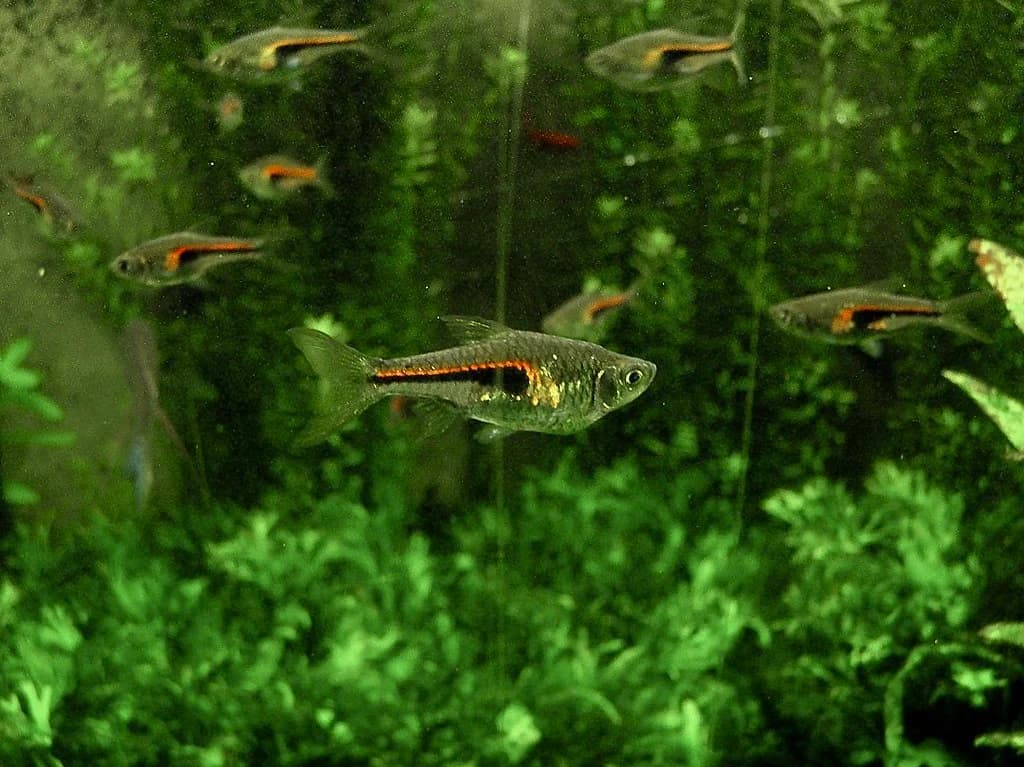
Adults reach just 2-3 cm and live 3-5 years. The body is translucent and pinkish-glassy, with the genus's signature black wedge on the rear half. The key identifying feature of the species is the narrow, almost fluorescent orange stripe lying precisely along the top edge of that wedge. This is what separates T. hengeli from its close relatives: the Harlequin Rasbora carries a massive wedge covering nearly half the body, with no orange trim at all.
The trade confusion deserves a mention of its own: fish sold as "Lambchop Rasbora" (T. espei) are very often T. hengeli, and vice versa. Judge by two features — Hengel's is noticeably slimmer and more transparent, and its orange stripe is thinner and brighter.
This is an utterly peaceful, diurnal shoaling fish that demands minimal experience — an excellent candidate for a first nano tank. The one thing that genuinely matters is group size: kept singly or in threes, these rasboras go pale, huddle in corners and show almost nothing of themselves.
Tank Requirements
The formal minimum for a shoal of 8-10 fish is 30 litres, but the species only truly comes into its own in a tank of 50-60 litres and 60 cm long, where the group can move as one. Fewer than eight is pointless: 10-15 is the sweet spot, and the larger the shoal, the better the colour and the more interesting the behaviour.
Water parameters: temperature 24-28 °C, pH 6.0-7.0, general hardness (GH) 5-12 dGH. The species adapts to neutral water, but the best colour and spawning readiness come from a soft, slightly acidic environment — closer to pH 6.0-6.5 and GH 5-8.
Build the layout around live plants: dense thickets along the sides and back wall (cryptocorynes, rotala, ferns, java moss) with an open swimming corridor down the middle. A dark substrate and floating plants (water lettuce, frogbit, riccia) soften the light — against that backdrop the orange stripe practically glows, whereas in a bare, brightly lit tank the fish looks washed out. Driftwood and a handful of dried almond or oak leaves release tannins and recreate the natural blackwater setting.
Flow should be gentle, so a small external filter or an air-driven sponge filter suits well. The latter is especially appropriate if shrimp or fry are planned. Always cover the tank: a startled shoal will jump.
Feeding and Diet
In nature T. hengeli picks off small aquatic invertebrates, fallen insects and zooplankton. Its mouth is tiny, so food size matters more than composition: it simply cannot swallow pellets larger than 0.5 mm.
The staple should be quality micro-pellets or finely crushed flakes intended for small characins and cyprinids. Two or three times a week offer live or frozen foods of the right size: brine shrimp, small daphnia, cyclops, microworms, nauplii. This supplement noticeably intensifies the orange pigment — on dry food alone the fish fades within a few months.
Feed twice a day in small portions consumed within a minute or two. Hengel's Rasboras feed mainly in the middle layers and rarely pick from the bottom, so leftovers sink into the substrate and spoil the water — overfeeding is more dangerous here than underfeeding. One fasting day a week is beneficial.
Care and Maintenance
Change 20-25% of the water weekly, always pre-conditioned and matched for temperature: sudden parameter swings are the leading cause of death in small rasboras. If your tap water is hard, dilute it with RO water down to GH 5-8.
Vacuum the substrate gently and only in open areas, without disturbing plant roots. Rinse filter media in old tank water every three to four weeks, never more than half of it at a time, so the biofiltration does not collapse — in a small volume it is particularly fragile. Ammonia and nitrite tests should read a steady zero, nitrate up to 20 mg/l.
Assessing the shoal is easy: healthy fish stay together, swim actively in the middle layer and show a saturated orange stripe. Warning signs are a shoal breaking up, hanging at the surface, a fading wedge, or clamped fins. The most common problems are ich following a chill during a water change, and bacterial fin infections in an overstocked tank. Quarantine new arrivals for two to three weeks: rasboras reach the shops after long transport and are often weakened.
Compatibility
Trigonostigma hengeli is peaceful to a fault, bothering nobody — fry and shrimp included. The aquarist's job here is exactly one thing: not to add anyone who will bother it.
Excellent tank mates are small, calm fish of the same size class: Chili Rasbora, Dwarf Rasbora, Celestial Pearl Danio, Ember Tetra, Cherry Barb and Sparkling Gourami. The bottom level is well covered by Pygmy Corydoras, Half-Banded Loach and Dwarf Suckers. In a shrimp tank Hengel's Rasbora is one of the few genuinely safe choices: it ignores adult neocaridina entirely, though it will take the smallest newborn shrimplets given the chance.
Unsuitable: the Tiger Barb and other notorious fin nippers; any cichlid or large predator, to which a three-centimetre fish is simply food; and overly boisterous, fast species that crowd the rasboras out at feeding time. Housing with a Betta is possible, but the outcome depends on the individual male's temperament, so have a backup tank ready.
Breeding
Breeding T. hengeli is not difficult, but raising fry in a community tank is close to impossible: the eggs and larvae will be eaten by the parents and the neighbours alike. A separate 10-20 litre breeding tank is required.
Set it up as follows: soft water (GH 2-5, pH 5.5-6.5), temperature 27-28 °C, dim diffused lighting, no substrate. Add a few broad-leaved cryptocorynes or anubias — the female glues her eggs to the underside of a leaf, turning belly-up to do it. An air-driven sponge filter on minimal flow is all the equipment needed.
Condition the breeders — one female and two males — separately for a week beforehand on generous live foods. The female is easily recognised by her fuller, rounder belly. Introduce them in the evening; spawning usually takes place the following morning. Across several passes the female lays 30 to 80 eggs, after which the adults must be removed at once: they eat the eggs readily.
Incubation takes 24-36 hours, and the larvae then hang on the glass and leaves for another three to four days, living off their yolk sacs. Free-swimming fry are fed infusoria or a liquid starter food four to five times a day for the first week, then moved on to brine shrimp nauplii and microworms. The fry are minute and very sensitive to water quality, so siphon leftover food off the bottom daily and change 10% of the water. The adult colouration with its orange stripe develops by two to three months.