Overview
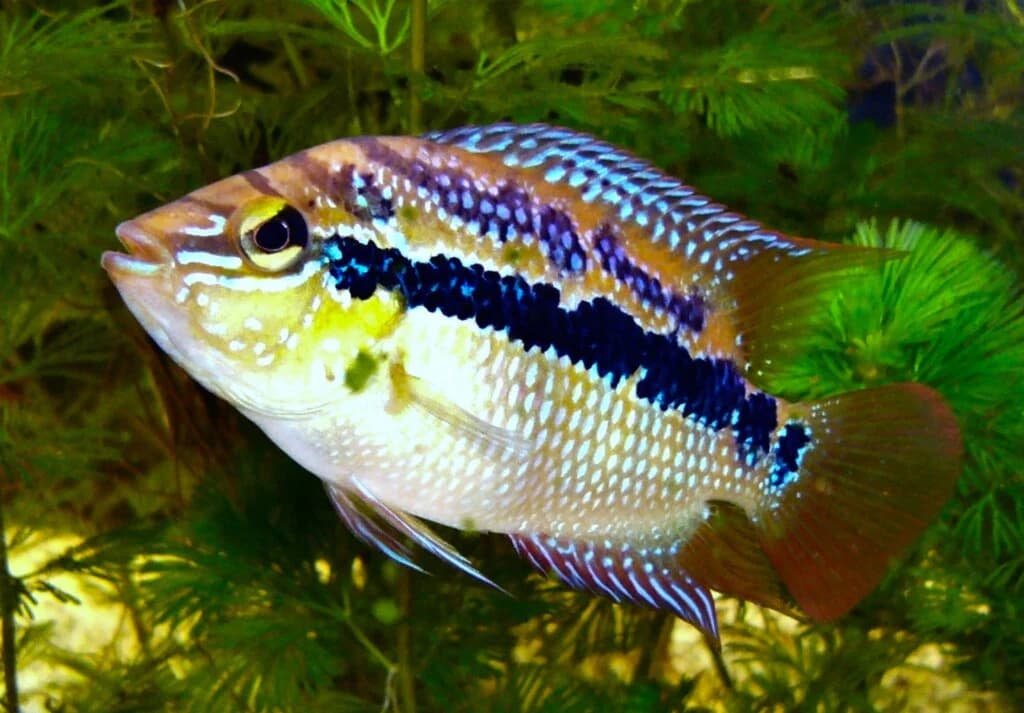
Trichromis salvini (formerly Cichlasoma salvini) is arguably the most colourful of the medium-sized Central American cichlids. In the wild it inhabits Atlantic-slope rivers of southern Mexico, Guatemala and Belize — primarily the Grijalva and Usumacinta basins — where it favours stretches with moderate current, sandy bottoms, driftwood and dense marginal vegetation.
The adult colouration is impossible to ignore: a golden-yellow body crossed by two dark longitudinal stripes — a solid mid-lateral band and a broken upper one — with the belly and lower flanks flushing red-orange, and turquoise spangles scattered across the gill covers and unpaired fins. It is this combination of three colours that gave the genus its name Trichromis ("three-coloured").
Males reach 15-20 cm and carry noticeably more elongated dorsal and anal fins. Females stay smaller (12-15 cm) but outshine the males in spawning dress: their bellies turn deep crimson and black blotches appear on the dorsal fin and gill cover. Life expectancy in the aquarium is 10-13 years.
In temperament T. salvini is a classic Central American hothead — a diurnal, highly active and territorial fish that preys on fry and aquatic insects in nature. It is distinctly more aggressive than the Firemouth Cichlid or the Convict Cichlid, so the species is best left to aquarists who have already kept large cichlids.
Tank Requirements
A pair of Trichromis salvini needs a tank of at least 250 litres and no less than 120 cm long — length matters more than volume here, because the fish divide the bottom into territories. For a community tank shared with other cichlids, plan on 400 litres or more.
Optimal water parameters: temperature 24-28 °C, pH 6.5-8.0, general hardness (GH) 8-15 dGH. The species tolerates moderately hard, slightly alkaline water without trouble, but it will not put up with accumulating organics — nitrates above 40 mg/l quickly show in faded colour and a weakened immune system.
Use fine river sand or rounded 2-3 mm gravel as substrate, since these fish constantly sift the bottom for food. Build the layout around large stones, driftwood and ceramic caves arranged to break the tank into several visually isolated zones — this is the only reliable way to reduce conflict. Live plants are possible, but only tough-leaved species attached to the hardscape: anubias, java fern, microsorum. Anything rooted in the substrate will be dug up.
Filtration must be powerful — an external filter turning over 5-6 tank volumes per hour. A lid is mandatory: a startled Salvini Cichlid jumps readily.
Feeding and Diet
In the wild T. salvini is a pronounced micropredator, living on fish fry, insect larvae and small crustaceans. In the aquarium the staple should be a quality sinking pellet for large cichlids with 40-45% protein.
Two or three times a week supplement the menu with frozen foods: bloodworms, glassworms, brine shrimp, mysis, or pieces of prawn and mussel. Feeder livebearers are neither necessary nor safe — they are a direct route to introducing parasites. A small vegetable component once a week (blanched courgette, spirulina-based food) supports digestion.
Feed adults twice a day in portions consumed within 2-3 minutes, and juveniles three to four times a day. Include one fasting day per week: Salvini Cichlids are prone to obesity and intestinal bloat when overfed on fatty foods.
Care and Maintenance
A weekly 25-30% water change with substrate vacuuming is non-negotiable. Pay particular attention to the pockets behind rocks and driftwood where leftover food collects. Rinse the filter media in old tank water every two to three weeks.
Monitor parameters with test kits: ammonia and nitrite strictly at 0, nitrate no higher than 30 mg/l. Sudden swings in temperature or hardness during water changes are unacceptable — prepare replacement water in advance.
Watch behaviour daily. A healthy fish is brightly coloured, active, and the first to come out at feeding time. Fading colour, darkening of the lateral stripes, refusal of food, clamped fins or breathing at the surface all signal trouble. The characteristic problems of this species are ich, hexamitiasis (head and lateral line erosion, often the result of a monotonous fatty diet and poor water management), and bacterial fin rot following fights. Keep a quarantine tank ready: treating an isolated fish is both easier and safer for the rest of the stock.
The relationship within the pair deserves separate attention. If the male starts systematically chasing the female and she hides in a corner with torn fins, the pair needs a divider or must be separated.
Compatibility
Trichromis salvini is territorial and aggressive, especially while spawning, when the pair claims and defends a substantial share of the tank. Stock it by a simple rule: tank mates should be of comparable size and tough enough to stand their ground, yet not so aggressive that they bully the Salvini themselves.
Good choices include the Firemouth Cichlid, Gold Firemouth Cichlid, Convict Cichlid, Jack Dempsey and Pearlscale Cichlid. As a peaceful bottom-level cleaner, the Sailfin Pleco works well.
Unsuitable: any small fish (neons, guppies, tetras, small rasboras) — they will be eaten; veiled and slow-moving species — their fins will be nipped; and small bottom catfish such as Bronze Corydoras, which get driven off their territory. At the other extreme, large predators like the Jaguar Cichlid or the Oscar will turn the Salvini into the victim instead.
The best arrangement is a species tank with a single settled pair. Keeping several adults together in less than 400 litres almost inevitably ends with the weakest fish dead.
Breeding
Breeding Trichromis salvini is not difficult — the real challenge is not getting them to spawn but forming a compatible pair. The most reliable approach is to raise a group of 6-8 juveniles, let them pair off on their own, and then remove the surplus fish.
Spawning is triggered by raising the temperature to 27-28 °C, replacing 30% of the water with softer water, and feeding generously on live and frozen foods for one to two weeks. The species is an open substrate spawner: the pair carefully cleans a flat stone, a ceramic tile or the wall of a cave, after which the female deposits 300-500 eggs that the male fertilises immediately.
Parental duties are strictly divided: the female fans the clutch and removes eggs that have gone white, while the male patrols the borders of the territory and drives off anything that approaches. Incubation takes 3-4 days at 27 °C, and the larvae then spend another 4-5 days in a pit dug by the parents, living off their yolk sacs.
Free-swimming fry are fed brine shrimp nauplii and microworms, moving on to finely crushed pellets after two to three weeks. Growth is fast but uneven, so the young must be graded by size regularly — otherwise the larger fry will start nipping the fins of the smaller ones. The parents shepherd the brood for four to six weeks, after which they prepare for the next spawning and the juveniles are best removed.