Overview
Toxotes jaculatrix is one of the most unusual fish available for the home aquarium. This species from the family Toxotidae inhabits mangrove swamps, estuaries, and coastal waters of Southeast Asia and Northern Australia. The archerfish's signature trait is its unique hunting technique: the fish forms a tube-like channel in its mouth and shoots a powerful jet of water, knocking insects off overhanging vegetation from distances of up to two meters.
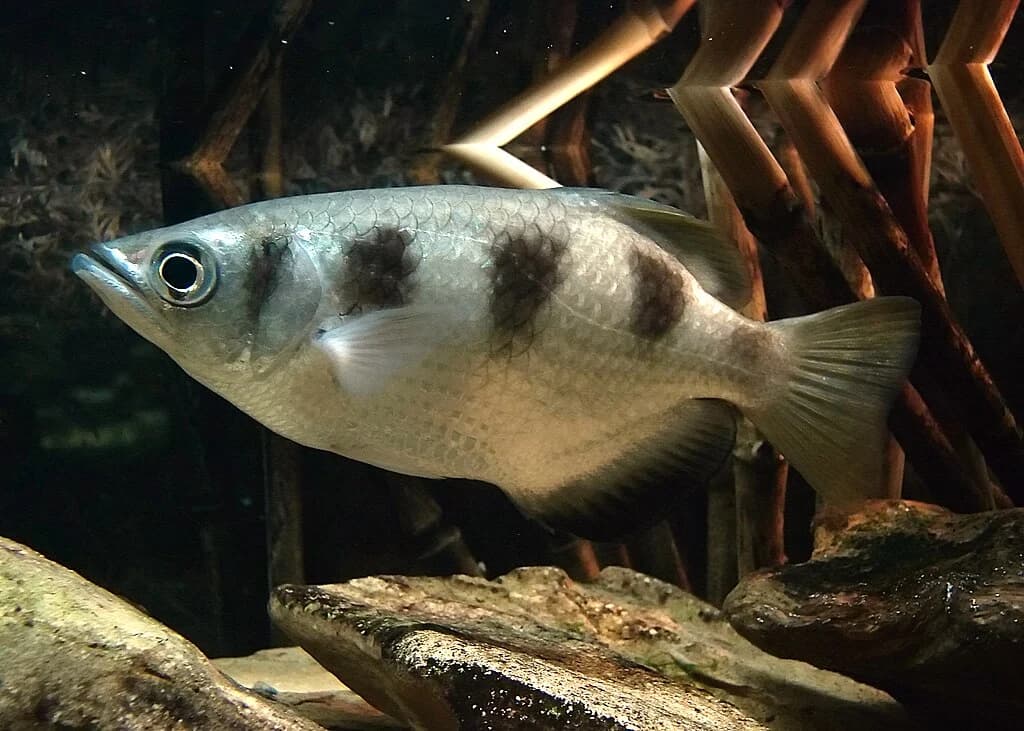
Adults reach 15–20 cm in length and live 5–10 years with proper care. The body is tall and laterally compressed, silvery white with 4–6 broad black vertical bands. The dorsal fin is set far back toward the tail, and large eyes provide excellent binocular vision essential for accurate hunting. This is a diurnal species, most active during daylight hours.
Tank Requirements
Toxotes jaculatrix requires a spacious aquarium of at least 200 liters. These fish are active swimmers that need plenty of open space in the upper and middle water layers. The optimal temperature is 24–30°C, pH 7.0–8.5, and general hardness (GH) 10–20.
The key consideration is brackish water. In the wild, archerfish live where freshwater mixes with seawater. Adding marine salt at 5–15 g per liter is recommended, using aquarium-grade salt formulated for brackish setups rather than table salt. Juveniles can adapt to freshwater, but adults thrive best in brackish conditions.
The tank must be fitted with a tight-fitting lid — archerfish are excellent jumpers. Leave 10–15 cm of air space between the water surface and the lid. Placing overhanging plants or driftwood above the water allows you to observe their natural hunting behavior. Filtration should be powerful but without strong surface current.
Feeding and Diet
In the wild, Toxotes jaculatrix is an opportunistic predator feeding primarily on insects, small crustaceans, and invertebrates that fall into the water. In the aquarium, the diet should be as varied as possible.
The staple diet consists of live and frozen foods: crickets, flies, mealworms, bloodworms, brine shrimp, and daphnia. Live insects placed on overhanging leaves or attached to the glass above the water line stimulate natural hunting behavior and keep the fish mentally engaged. Over time, archerfish will accept floating pellets and flakes, but dry food should not be the sole food source.
Feed 1–2 times daily in small portions. Monitor feeding to ensure all tank inhabitants receive their share, as archerfish can become assertive during feeding and push aside slower tankmates.
Care and Maintenance
Keeping archerfish requires attention to water quality and parameter stability. Weekly water changes of 20–25% are essential, and replacement water must be prepared with the same salinity level. Use a refractometer or hydrometer to monitor water density.
A powerful external canister filter is the best choice for an archerfish tank. Brackish water accumulates nitrates more quickly, so regular testing is mandatory. Nitrate levels should be kept below 20 mg/l.
Choose moderate lighting, avoiding overly bright light that can cause stress. Driftwood and rock decorations provide shelter, while floating plants (water lettuce, salvinia) shade the surface and create a natural atmosphere. Avoid delicate plants that cannot tolerate brackish water.
Compatibility
Toxotes jaculatrix is a moderately aggressive species that does best in groups of 4–6 individuals. Solitary keeping leads to stress, and in too small a group, a dominant individual may suppress the others.
Suitable tankmates include other brackish water inhabitants of comparable size. Good companions are the knight goby and other brackish water gobies, monos, and scats. Cohabitation with the figure eight puffer is possible given sufficient tank volume.
Avoid small fish — any fish that fits in the archerfish's mouth will be seen as prey. Slow-moving species with long fins are also unsuitable. Freshwater species that cannot tolerate salt are completely incompatible.
Breeding
Breeding Toxotes jaculatrix in captivity is extremely difficult, with only isolated successes reported. Sexual dimorphism is minimal: females are generally slightly larger and fuller than males, but reliably determining sex by visual inspection alone is challenging.
In nature, spawning occurs during the rainy season when water salinity drops and food availability increases. To stimulate breeding in the aquarium, you can try replicating these conditions: gradually reduce salinity, increase the frequency of live food feedings, and slightly lower the temperature before raising it again.
Females can lay up to 3,000 small eggs on the water surface among floating vegetation. Larvae hatch within 12–14 hours and begin feeding after 2–3 days. Starter food includes brine shrimp nauplii and infusoria. Due to the difficulty of replicating natural conditions, most fish available in the trade are wild-caught specimens.