Overview
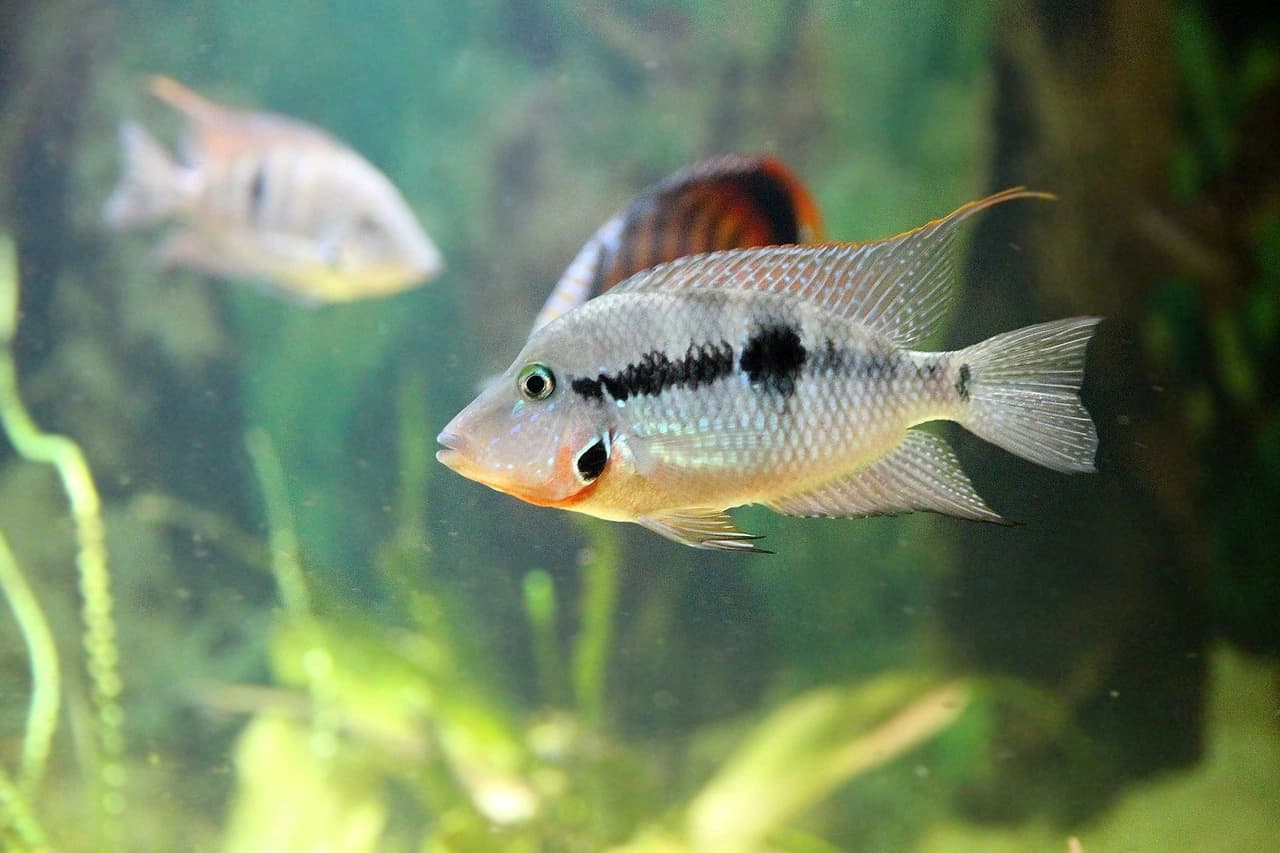
Thorichthys meeki is one of the most recognizable Central American cichlids, unmistakable thanks to its signature feature: a brilliant red-orange throat pouch. In the wild, this fish inhabits rivers and lakes of the Yucatan Peninsula (Mexico, Guatemala, and Belize), favoring areas with slow currents, sandy or silty bottoms, and abundant shelter among roots and rocks.
Adults reach a size of 10-12 cm, and their lifespan in captivity is 8-10 years with proper care. Males are larger than females, with more elongated dorsal and anal fins and significantly brighter throat coloration. Females are smaller and more modestly colored but also develop vivid tones during spawning. Their closest relative is the Blue Flash Cichlid, which is distinguished by predominantly yellow hues.
The Firemouth Cichlid is an active diurnal fish with a moderately territorial temperament. It displays fascinating behavior: when threatened, it flares its gill covers to expose the bright red membrane, visually enlarging its head size and deterring rivals. This distinctive trait is what earned the species its common name, Firemouth.
Tank Requirements
The minimum tank volume for a pair of Thorichthys meeki is 200 liters. For group housing or a community tank with other species, a tank of 300 liters or more is recommended. Optimal water parameters: temperature 24-28 °C, pH 6.5-7.5, general hardness (GH) 10-15 dGH.
Fine river sand works best as a substrate, since Firemouths love to sift through the bottom while foraging, and sharp gravel can damage their gills. Be sure to create shelter zones in the aquarium using rock formations, driftwood, and ceramic caves. Each fish (or pair) will claim its own territory, so it is important to break up the space into visually distinct areas.
Plants can be used, but choose tough-leaved species (Anubias, Cryptocoryne) attached to rocks or driftwood, as the fish may dig up roots. Filtration should be robust, turning over at least 5-6 tank volumes per hour. Regular water changes (25-30% weekly) are essential for maintaining stable parameters.
Feeding and Diet
Thorichthys meeki is an omnivorous species that feeds on small invertebrates, insect larvae, detritus, and some plant matter in the wild. In the aquarium, the core diet should consist of high-quality granulated food designed for medium-sized cichlids.
Be sure to supplement the menu with live or frozen foods: bloodworms, glassworms, brine shrimp, and daphnia. A vegetable component is also important — offer blanched spinach leaves, zucchini slices, or specialized spirulina-based foods. This variety promotes vibrant coloration and strengthens the immune system.
Feed adults twice a day in portions that will be consumed within 2-3 minutes. Juveniles should be fed 3-4 times daily in small portions. Once a week, skip feeding for a fasting day — this benefits digestion and helps prevent the obesity that cichlids are prone to when overfed.
Care and Maintenance
A weekly 25-30% water change is the foundation of successful Thorichthys meeki care. Use a gravel vacuum to clean the substrate of leftover food and waste, paying special attention to areas around decorations where debris accumulates.
Regularly test water parameters: ammonia and nitrites should be at zero, and nitrate levels should not exceed 20-30 mg/L. Rinse filter media in removed tank water every 2-3 weeks to prevent a drop in filter performance.
Observe the fish's behavior daily. A healthy Firemouth Cichlid is active, displays vivid coloration, and has a good appetite. Faded colors, refusal to eat, rapid breathing, or clamped fins are signals of stress or the onset of illness. The most common issues are ich (white spot disease), bacterial fin infections, and intestinal parasites. At the first signs of disease, isolate the fish in a quarantine tank and begin treatment with appropriate medications.
Compatibility
Thorichthys meeki has a moderate temperament — it is less aggressive than many Central American cichlids but is still capable of defending its territory. The key rule: avoid tankmates that are significantly smaller (they will be seen as prey) or significantly more aggressive (they will dominate the Firemouth).
Good companions include other Central American cichlids of comparable size and temperament: Convict Cichlid, Blue Flash Cichlid. Among larger species, Jack Dempsey can work, but only in a spacious tank with sufficient hiding places.
Suitable tankmates from other families include large barbs, medium to large rainbowfish, as well as Synodontis catfish and large Corydoras. Small tetras, guppies, neons, and other small fish are completely unsuitable — they will be eaten. It is also inadvisable to combine T. meeki with large aggressive species like the Salvin's Cichlid, which may bully them.
During spawning, Firemouth aggression increases dramatically. The pair will fiercely defend their clutch and fry, attacking any fish that approaches their territory. Keep this in mind when planning your tank's community.
Breeding
Breeding Thorichthys meeki is not particularly difficult and is quite accessible even for beginning cichlid keepers. The fish form stable pairs that can last a lifetime.
To stimulate spawning, raise the water temperature slightly (to 27-28 °C) and increase the proportion of live food in the diet. The pair selects a flat surface — a smooth rock, ceramic tile, or cave wall — and meticulously cleans it. The female lays 100-500 eggs, which the male fertilizes immediately.
Both parents exhibit pronounced brood care. They fan the clutch with their fins to ensure a flow of fresh water and remove unfertilized or dead eggs. Incubation lasts 3-4 days at 26-27 °C. After hatching, the larvae remain on the substrate for another 4-5 days, feeding on their yolk sacs.
Once the fry become free-swimming, they can be fed newly hatched brine shrimp and finely crushed dry food. The parents continue guarding the young for several weeks, leading the school out to feed and gathering them back at night. This is one of the most impressive spectacles in fishkeeping. As the fry grow, gradually transition them to larger foods and separate them into individual tanks if crowding occurs.