Overview
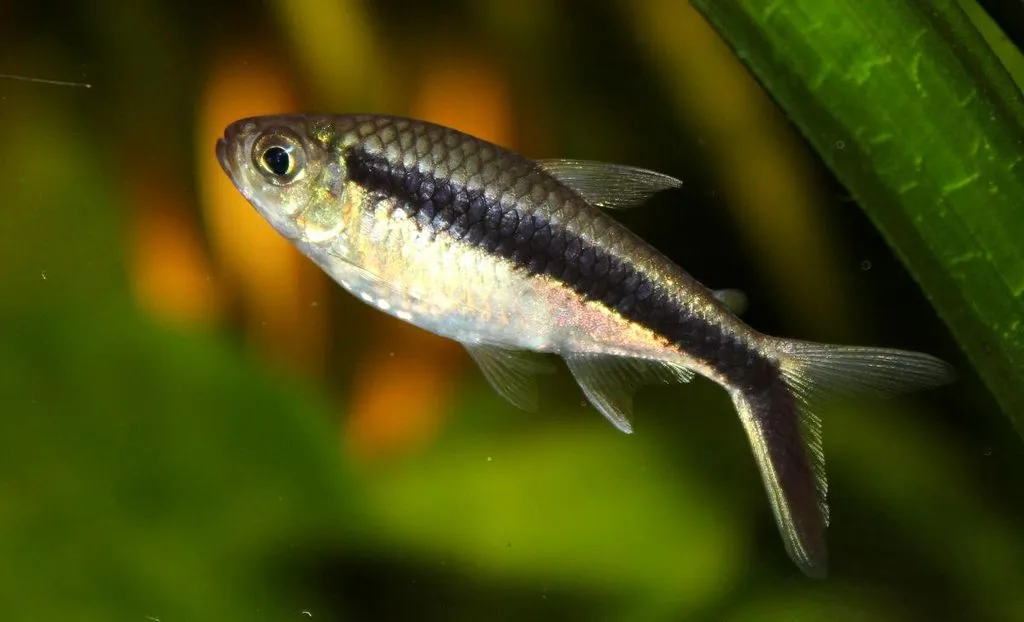
Thayeria boehlkei is a small characin native to the Amazon basin, specifically the Araguaia and Tocantins river systems in Brazil. It earned the common name "Penguin Tetra" due to its characteristic swimming posture — the body is held at an angle with the head tilted upward, reminiscent of a penguin's stance. A bold black stripe running from the mid-body down to the lower lobe of the caudal fin makes this species instantly recognizable among other tetras.
Adults reach 5–6 cm in length. The body is elongated and slightly compressed laterally, with a silvery base color and an olive tint along the back. In a school, Thayeria boehlkei create a mesmerizing display as they sway in unison at their characteristic angle. With proper care, they live for 5–6 years. Thanks to their hardiness and peaceful temperament, this species is an excellent choice for beginner aquarists.
Tank Requirements
A school of 8–10 Thayeria boehlkei requires an aquarium of at least 70 liters. These fish are active swimmers, so it is important to leave ample open space in the middle and upper water column.
Optimal water parameters:
- Temperature: 22–28 °C
- pH: 6.0–7.5
- General hardness (GH): 5–15 dGH
Fine dark sand or gravel works well as a substrate — it brings out the fishes' colors beautifully. Plant the perimeter and background with vegetation, leaving the central area open for swimming. Vallisneria, Echinodorus, and Cryptocoryne species are all suitable choices. Floating plants will help create subdued lighting that closely mimics their natural habitat.
Filtration should be efficient but without a strong current — a moderate flow is sufficient. A tight-fitting lid or cover glass is essential: Penguin Tetras are prone to jumping, especially during the acclimatization period.
Feeding and Diet
Thayeria boehlkei are omnivorous fish with hearty appetites. In the wild, they feed on small insects, larvae, and plant particles. In the aquarium, they readily accept most types of food.
A staple diet of quality flakes or small granules for tropical fish works well. To maintain vibrant coloration and good health, regularly supplement with live or frozen foods: daphnia, brine shrimp, bloodworms, and cyclops. Vegetable supplements such as spirulina or blanched spinach leaves are also beneficial.
Feed twice daily in small portions that the fish consume within 2–3 minutes. Overfeeding is one of the most common mistakes — it leads to obesity and deteriorating water quality. A weekly fasting day is a good practice.
Care and Maintenance
The Penguin Tetra is an undemanding fish, but stability of water conditions is essential. Weekly water changes of 20–25% will help maintain cleanliness and a stable chemical balance.
Test water parameters regularly: ammonia and nitrite should always read zero, and nitrate levels should remain below 20–30 mg/l. Vacuum the substrate during water changes and remove any dead plant leaves.
Keep Thayeria boehlkei in groups of at least 6–8 individuals — in solitude or small groups, these fish become timid and lose their color. In a properly sized school, they display natural behavior and vivid coloration. Moderate lighting is preferred, as overly bright light causes stress.
Among common diseases, ich (white spot disease) is the most notable concern; tetras are susceptible to it during sudden temperature fluctuations and periods of stress. Quarantining new fish before adding them to the main tank is a mandatory precaution.
Compatibility
Thayeria boehlkei is one of the most peaceful tetras, making it an excellent candidate for a community aquarium. It coexists beautifully with other calm species of similar size.
Suitable tank mates:
- Small tetras: neon tetra, cardinal tetra, glowlight tetra, flame tetra
- Rasboras: harlequin rasbora, Hengel's rasbora
- Danios: zebra danio, celestial pearl danio
- Catfish: panda corydoras, Sterbai corydoras, pygmy corydoras
Avoid housing Thayeria boehlkei with large or aggressive cichlids, as well as fish with long, flowing fins that the tetras may occasionally nip. Larger predatory species will view these small tetras as food.
Breeding
Breeding Thayeria boehlkei at home requires some preparation but is entirely achievable. Set up a separate breeding tank of 20–30 liters with soft, slightly acidic water (pH 6.0–6.5, GH 4–8) and a temperature of 25–27 °C.
Place fine-leaved plants (Java moss, Cabomba) or a synthetic spawning mop on the bottom. A mesh screen on the tank floor will help protect the eggs from being eaten by the parents. Lighting should be minimal — these fish spawn in dim conditions.
Select a well-fed female with a rounded belly and the most vibrantly colored male. Feed them generously with live foods for a week before spawning. The female scatters 300–500 small eggs among the plants. Remove the adults immediately after spawning.
The fry hatch within 24–36 hours and become free-swimming on days 3–4. Initial food should be infusoria or liquid fry food. After about a week, they can be transitioned to baby brine shrimp. The fry grow relatively quickly, and by 2–3 months of age they develop the characteristic stripe and angled swimming posture of adults.