Overview
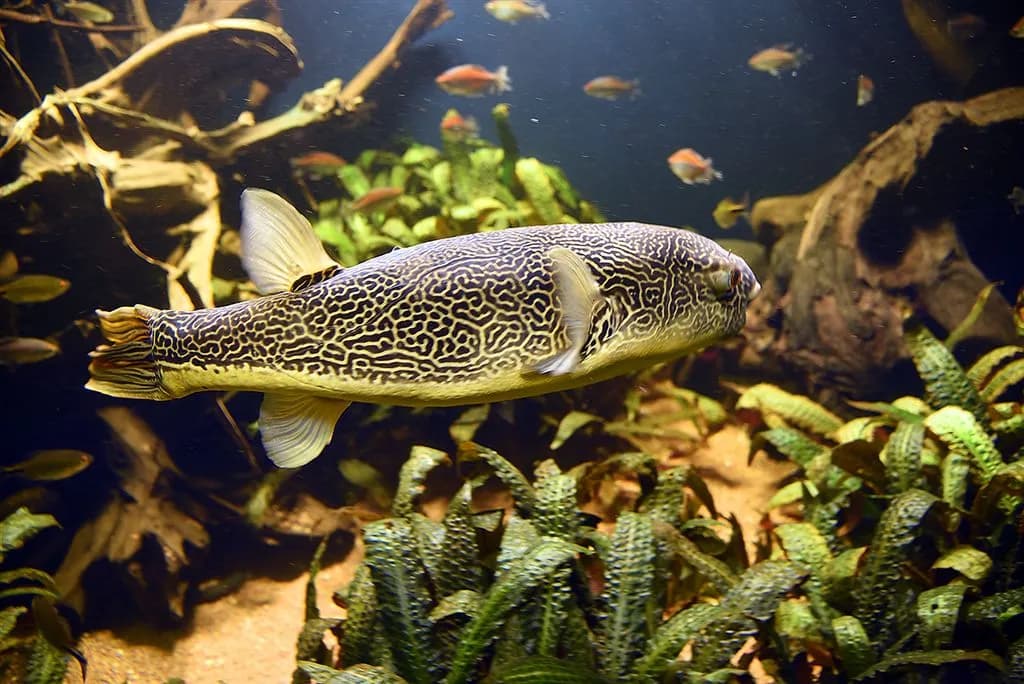
Tetraodon mbu is the largest freshwater representative of the family Tetraodontidae, capable of reaching 60–75 cm in aquarium conditions. In the wild, this impressive pufferfish inhabits the Congo River Basin and Lake Tanganyika, preferring areas with moderate current and plenty of cover among driftwood and rocks.
The Mbu Puffer is deservedly considered one of the most "intelligent" aquarium fish. It quickly becomes accustomed to its owner, recognizes them among other people, and will swim up to the glass to beg for food when a familiar face approaches. Each individual possesses a distinct personality — ranging from relatively calm to openly feisty specimens. The body coloration consists of an intricate pattern of dark spots and swirls on a yellow-green background that only becomes more striking with age.
This species is categorically unsuitable for beginners. Keeping Tetraodon mbu requires serious experience, significant financial investment, and a willingness to provide proper care for 10–15 years.
Tank Requirements
The minimum tank volume for an adult Tetraodon mbu is 1000 liters, though an optimal setup would be 1500 liters or more. A juvenile can initially be raised in a 300–400 liter aquarium, but you must plan ahead for the move to a spacious tank, as the fish grows quite rapidly.
Optimal water parameters: temperature 24–28 °C, pH 7.0–8.0, general hardness (GH) 8–15. The Mbu Puffer produces an enormous amount of waste, so filtration must be as powerful as possible — multiple external canister filters with a combined turnover of at least 8–10 tank volumes per hour are recommended. Water aeration is essential.
Fine river sand works best as substrate — pufferfish enjoy burrowing and can injure their delicate belly skin on coarse substrates. Decorations must be securely anchored, as a large puffer will easily topple any unsecured element. Live plants typically do not survive in a Mbu tank — the fish destroys them. The aquarium must be tightly covered with a lid: despite its size, the Mbu is capable of jumping out of the water.
Feeding and Diet
Tetraodon mbu is an obligate carnivore with powerful dental plates that grow continuously. The diet should primarily consist of hard-shelled foods that help wear down the teeth: snails (apple snails, ramshorns, bladder snails), mussels in the shell, crayfish, crabs, and shell-on shrimp.
Additional foods include: squid, white fish fillets, earthworms, bloodworms (for juveniles), and krill. Under no circumstances should the Mbu Puffer be fed mammalian meat — it is poorly digested and leads to obesity and liver problems.
Adults should be fed 2–3 times per week, juveniles every other day. Overfeeding is one of the main problems in pufferfish keeping, leading to obesity and reduced lifespan. If the teeth do grow excessively long despite a proper diet, they must be filed down manually — a procedure that requires skill and care.
Care and Maintenance
The key to caring for Tetraodon mbu is maintaining impeccable water quality. Weekly water changes should be at least 30–50% of the tank volume. Regularly test ammonia and nitrite levels — both should be at zero. Nitrate levels should ideally be kept below 20 mg/L.
The Mbu Puffer is sensitive to copper-based medications — this is important to consider when treating diseases. Pufferfish lack scales, making them vulnerable to skin infections when water quality deteriorates. At the first signs of illness, it is best to start with raising the temperature and performing frequent water changes, resorting to medications at half doses and only when absolutely necessary.
Filter maintenance should be done in rotation to avoid disrupting the biological balance. It is wise to keep a backup filter on hand in case the primary one fails — for a fish of this size, even a brief filtration outage can be critical.
Compatibility
Tetraodon mbu is a territorial and potentially aggressive fish. The optimal approach is a species-only tank with a single specimen. The Mbu Puffer is capable of killing or seriously injuring virtually any tankmate, even those significantly larger than itself.
If desired, you can attempt to house it with large, fast-moving fish: polypterids, buffalohead cichlids, or large synodontis catfish, but success depends on the individual temperament of the specific fish and the tank volume. Small fish are viewed by the Mbu exclusively as food.
Under no circumstances should the Mbu Puffer be kept with other pufferfish — territorial conflicts are inevitable. Slow fish with long fins should also be avoided — they will be the first victims.
Breeding
Breeding Tetraodon mbu in aquariums is virtually undocumented to this day. Sex determination presents a significant challenge, as external sexual differences in this species are minimal. According to some observations, females may be slightly fuller than males, but this trait is unreliable.
An attempted breeding setup would require a tank of at least 3000–4000 liters with conditions closely resembling the natural habitat: soft sandy substrate, abundant hiding places, and simulation of seasonal changes in water parameters. In the wild, spawning is presumably linked to the rainy season and fluctuating water levels.
Currently, all specimens available for sale are wild-caught. Keeping the Mbu Puffer is rewarding in itself due to the unique personality and intelligence of these remarkable fish.