Overview
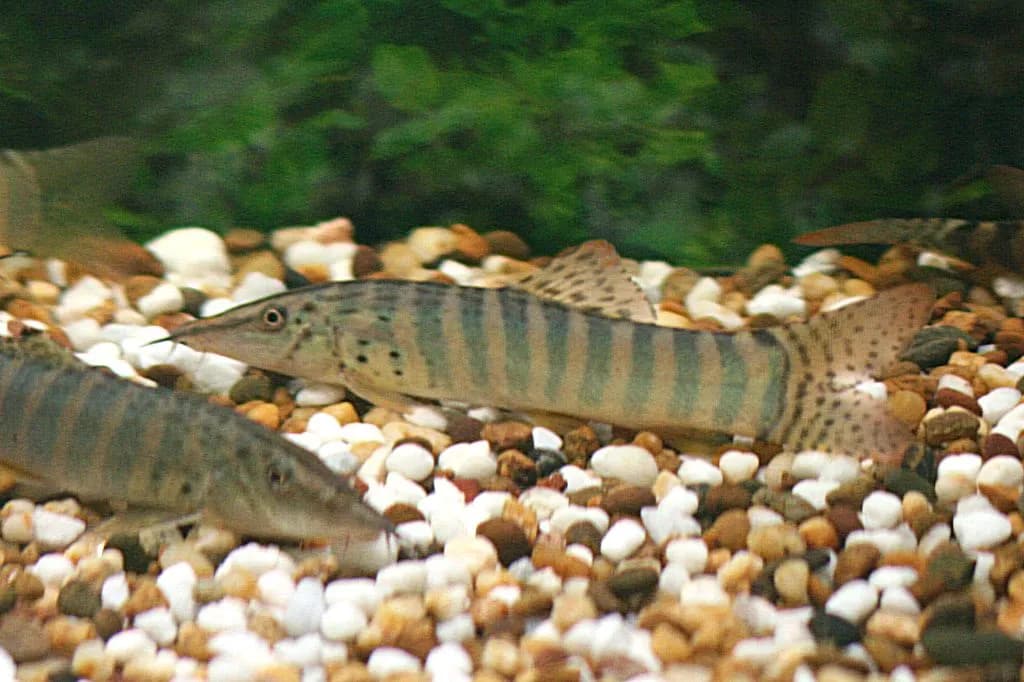
Berdmore's Loach (Syncrossus berdmorei) is one of the most visually striking members of the Botiidae family, captivating aquarists with its bold, tiger-like striped pattern. This species originates from rivers and streams of Myanmar, Thailand, and adjacent regions of Southeast Asia, where it inhabits areas with moderate current, rocky substrates, and abundant shelter.
In the wild, Syncrossus berdmorei reaches 15–20 cm in length, making it one of the larger botia species. The body is elongated and laterally compressed, adorned with alternating dark and light vertical bands that earned the fish its "tiger" nickname. Beneath the eyes lie the characteristic bifid suborbital spines typical of botias, which the fish can erect when stressed or agitated. With proper care, this species can live 8–10 years in captivity.
This is a schooling yet territorial fish with a well-defined hierarchy within the group. It is not suitable for beginners: the care level is rated as high, and behavior is semi-aggressive. However, for an experienced aquarist, Syncrossus berdmorei makes a truly spectacular centerpiece in a large species or community tank.
Tank Requirements
The minimum tank volume for a group of 3–5 individuals is 200 liters, though providing even more space is advisable to reduce territorial conflicts. Water temperature should be maintained at 24–28 °C, pH at 6.5–7.5, and general hardness (GH) at 5–15.
Choose a fine, rounded substrate — sand or small smooth gravel works best. Botias love to dig in the substrate, and sharp particles can damage their sensitive barbels. Be sure to provide plenty of hiding places: driftwood, rock formations, ceramic tubes, and caves. Each fish should be able to claim its own retreat — this significantly reduces aggression levels.
Moderate current is beneficial: use an internal powerhead or direct the filter outlet along the tank wall. Subdued lighting is preferred, and floating plants help create shaded areas where the fish feel more secure.
Feeding and Diet
Syncrossus berdmorei is an omnivore with a preference for protein-rich foods. In the wild, the diet consists of small invertebrates, insect larvae, worms, and a small amount of plant matter.
In the aquarium, the staple diet should include high-quality sinking granules and tablets formulated for bottom-dwelling fish. Regularly supplement with frozen or live foods: bloodworms, brine shrimp, daphnia, and tubifex worms. Once a week, offer blanched slices of zucchini, cucumber, or spinach — vegetable matter supports healthy digestion.
Feed 1–2 times daily in small portions that the fish consume within 3–5 minutes. Botias are most active feeders at dusk, so evening feeding sessions often prove more productive than morning ones. A varied diet is key to vibrant coloration and a strong immune system.
Care and Maintenance
The cardinal rule when keeping Syncrossus berdmorei is maintaining stable water parameters. Perform weekly water changes of 25–30%, using dechlorinated water matched closely to the tank temperature. Filtration should be robust: an external canister filter rated at 4–5 times the tank volume per hour is the optimal choice.
Regularly test ammonia, nitrite, and nitrate levels. Botias are sensitive to nitrogenous compounds, and even slight elevations can trigger skin diseases and appetite loss. Pay attention to aeration — the water must be well oxygenated.
Periodically inspect the fish for injuries and signs of ich (white spot disease), to which botias are particularly susceptible. When treating, keep in mind that botias tolerate formalin- and malachite green-based medications poorly at full dosages — use half doses instead.
Compatibility
Syncrossus berdmorei is a semi-aggressive species best kept in a group of at least 5 individuals. Within the school, a hierarchy forms and aggression is distributed evenly rather than focused on a single target.
Suitable tank mates include large, active fish: tiger barbs, bala sharks, large danios, blue botia, and other robust species occupying the middle and upper water levels. They also coexist well with clown loaches, provided the tank is spacious enough.
Small and slow-moving fish are strongly incompatible: guppies, neon tetras, small tetras, and dwarf cichlids should be avoided. Long-finned species (bettas, angelfish) will also suffer from harassment. Snails and small shrimp are treated as food.
Breeding
Breeding Syncrossus berdmorei in captivity is an exceptionally challenging endeavor that is virtually undocumented in the hobby. The difficulty is rated at the maximum level (5 out of 5).
In the wild, this is a seasonal spawner: the fish migrates upstream during the rainy season and scatters eggs over rocky substrates. Replicating these conditions in an aquarium is extremely difficult. Sexual dimorphism is subtle — mature females are slightly fuller-bodied than males, but reliably distinguishing sex outside of spawning season is nearly impossible.
The vast majority of specimens available in the trade are wild-caught imports. Should you decide to attempt breeding, you will need a spacious spawning tank with strong current, soft acidic water (pH around 6.5, GH no higher than 8), and a simulation of seasonal changes — a gradual decrease followed by an increase in temperature. Success is not guaranteed even when all conditions are met.