Overview
Symphysodon heckel is one of the rarest and most striking members of the discus genus, first described by Johann Jakob Heckel in 1840. In the wild, this species inhabits tributaries of the Rio Negro and other blackwater rivers in the Amazon basin, where the water is extremely soft and acidic, stained dark brown by tannins from decomposing leaves.
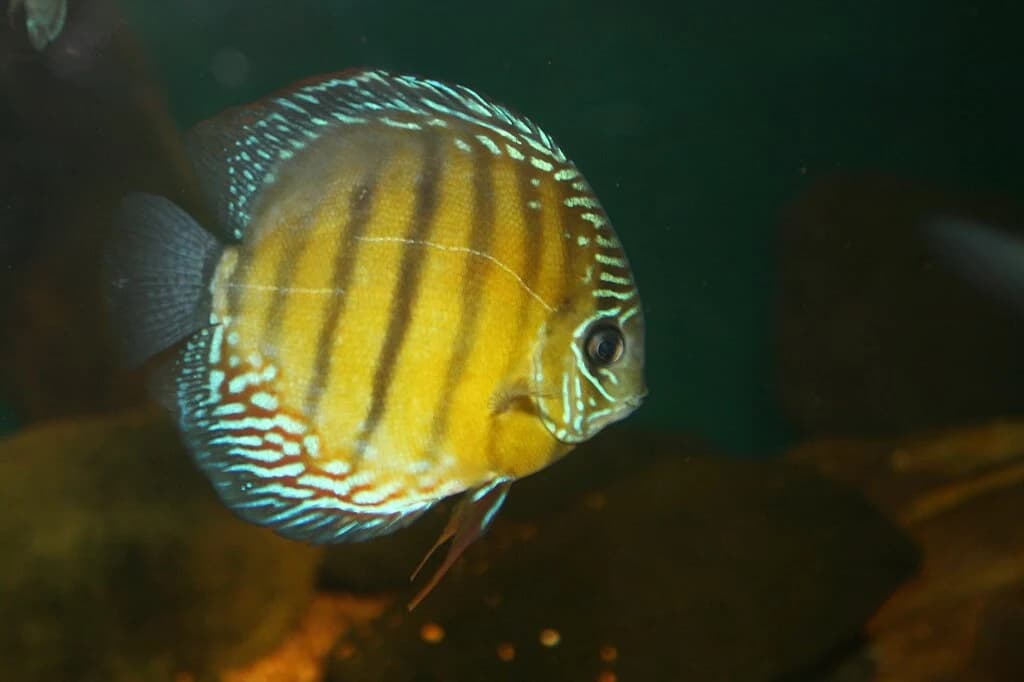
The hallmark feature of Symphysodon heckel is its prominent fifth vertical bar, which is significantly wider and darker than in other discus species such as the common discus or the green discus. The base body coloration ranges from warm reddish-brown to bluish-turquoise tones with a fine reticulated pattern. Adults reach 12-15 cm in size and can live 10-15 years with proper care.
This is a schooling fish with a well-developed social hierarchy, best kept in groups of six or more. The Heckel Discus is considered the most demanding of all discus species and is suited for experienced aquarists.
Tank Requirements
A group of Symphysodon heckel requires an aquarium of at least 250 liters. These fish need open swimming space, so wide, relatively shallow tanks are preferable.
Water parameters should closely replicate their natural habitat:
- Temperature: 26-30 °C (optimal 28-29 °C)
- pH: 5.0-6.5
- General Hardness (GH): 1-8
Fine dark sand works best as substrate. Decorating the tank with mangle or mopani driftwood not only provides hiding spots but also acidifies the water by releasing tannins. Adding dried Indian almond leaves or oak leaves helps maintain the required acidity.
Plants should be heat-tolerant species — various Echinodorus and Anubias work well. Lighting should be subdued, mimicking the shaded areas of their natural habitat.
Filtration must be powerful yet produce minimal current. External canister filters with a spray bar on the outlet are ideal. Using reverse osmosis or rainwater greatly simplifies maintaining the necessary softness.
Feeding and Diet
Symphysodon heckel is an omnivore, though in nature its diet consists primarily of small invertebrates and plant periphyton. In the aquarium, a varied diet should be provided:
- Staple food: high-quality granules or flakes specifically formulated for discus
- Live and frozen foods: bloodworms, brine shrimp, daphnia, tubifex — offered 2-3 times per week
- Supplementary: seafood blend (so-called "discus beef heart mix") enriched with vitamins and spirulina
Feed 2-3 times daily in small portions that fish consume within 3-5 minutes. Uneaten food must be promptly removed to prevent water quality deterioration. Juveniles should be fed more frequently — up to 4-5 times per day to promote growth.
Care and Maintenance
The Heckel Discus is one of the most demanding freshwater aquarium fish, and successful keeping depends on maintaining stable water parameters. Any sudden fluctuations in temperature, pH, or hardness can lead to stress and illness.
Water changes are the cornerstone of proper care. It is recommended to change 25-30 % of the volume 2-3 times per week using prepared water with matching parameters. Before adding replacement water, it must be heated to match the tank temperature.
Regular monitoring is essential:
- Ammonia and nitrite levels (must be zero)
- Nitrate concentration (no higher than 20 mg/l)
- pH and temperature values
Heckel Discus are susceptible to several diseases, including hexamitiasis and bacterial infections. Quarantining new fish for 2-4 weeks is mandatory. At the first signs of illness — darkening coloration, loss of appetite, rapid breathing — water parameters should be checked immediately and treatment initiated if necessary.
Compatibility
Symphysodon heckel is a peaceful but shy fish that thrives best in a species-only tank or with carefully selected tank mates.
Suitable companions:
- Other discus species — common discus and green discus
- Small peaceful tetras — neon tetra, cardinal tetra, green neon tetra
- Sterba's Corydoras — one of the few corydoras species that tolerates high temperatures well
- Small loricariid catfish (otocinclus)
Not recommended:
- Large and aggressive cichlids
- Active barbs that may nip fins
- Fast-moving fish that compete for food
- Shrimp and small crustaceans (will be eaten)
When keeping with other fish, it is essential that all tank inhabitants are comfortable at 28-30 °C in soft, acidic water.
Breeding
Breeding Symphysodon heckel is an exceptionally challenging endeavor, accessible only to experienced aquarists. This species is considerably more difficult to breed than other members of the genus.
To stimulate spawning, the following conditions are needed:
- Lower pH to 4.5-5.5
- Raise temperature to 30-31 °C
- Provide extremely soft water (GH 0-2)
- Increase the proportion of live foods in the diet
Discus form stable pairs, choosing their own partners from within the group. Spawning occurs on vertical or angled surfaces — broad leaves, driftwood, or specially designed spawning cones. The female lays 80-200 eggs, which both parents diligently guard and fan with their fins.
A unique characteristic of discus is the feeding of fry with skin secretions. During the first days after hatching, the larvae attach themselves to the parents' bodies and feed on a special mucus produced by their skin. This period is critically important, and attempts at artificial rearing without parents are rarely successful.
As the fry grow, they are gradually transitioned to brine shrimp nauplii and fine dry food. Raising juveniles requires daily water changes and frequent feeding — up to 6-8 times per day.