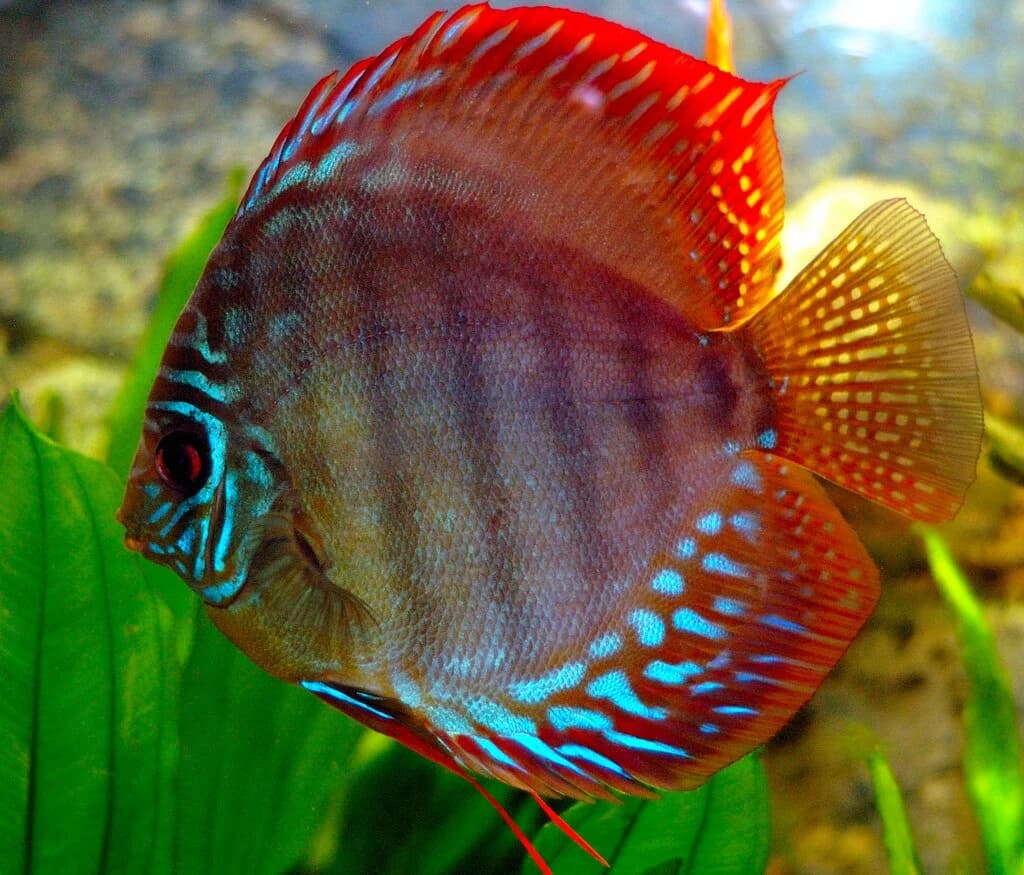
Overview
Symphysodon discus, also known as the Heckel Discus, is a freshwater fish belonging to the family Cichlidae, native to the Amazon River basin. This species was first described in 1840 by Johann Jacob Heckel, after whom it is named. In the wild, Heckel Discus is found predominantly in the waters of the Rio Negro — a tributary of the Amazon known for its soft, acidic, and dark-stained water.
The Heckel Discus is distinguished from the closely related Symphysodon aequifasciatus (Blue Discus) by its characteristic wide fifth vertical bar running through the center of its body. Adults reach 15–20 cm in size, and with proper care, their lifespan can reach 10–15 years. The body is strongly laterally compressed and nearly circular in shape — a feature that makes discus fish among the most recognizable aquarium species.
The Heckel Discus is considered the most demanding of all discus varieties, making it a fish for experienced aquarists.
Tank Requirements
A group of Heckel Discus requires an aquarium of at least 300 liters. These fish are extremely sensitive to water parameters, so stability is the key to success.
Optimal water parameters:
- Temperature: 26–30 °C (ideally 28–29 °C)
- pH: 5.5–7.5 (preferably 5.5–6.5)
- General Hardness (GH): 1–10 dGH (soft water below 5 dGH is best)
The aquarium should be equipped with a powerful external filter providing excellent biological filtration. Water flow should be moderate — discus do not appreciate strong currents. Lighting is best kept subdued, using floating plants to diffuse the light.
Driftwood and densely planted areas with shade-tolerant plants work well as decoration. It is important to leave sufficient open swimming space. The substrate should be fine sand or none at all (a so-called "bare-bottom tank"), which makes maintaining cleanliness much easier.
Feeding and Diet
Symphysodon discus is an omnivorous species, but a varied and high-quality diet is essential for maintaining health and vibrant coloration.
Staple diet:
- Specialized discus granules and flakes
- Frozen bloodworms, brine shrimp, and glassworms
- Beef heart (finely minced, fat-free) — a classic discus food
Supplementary foods:
- Spirulina and vegetable-based supplements
- Live foods (daphnia, cyclops) as occasional treats
Discus should be fed 2–3 times daily in small portions. Uneaten food should be removed within 5–10 minutes to prevent water quality deterioration. Juveniles benefit from more frequent feeding — up to 4–5 times daily for optimal growth.
Care and Maintenance
The Heckel Discus is one of the most demanding aquarium fish, and successful keeping requires discipline and attention to detail.
Regular water changes are the cornerstone of discus care. It is recommended to change 25–30% of the water 2–3 times per week, and even more frequently in tanks housing juvenile fish. Replacement water must match the temperature and parameters of the aquarium water.
Discus must be kept in groups of at least 5–6 individuals — they are schooling fish that become stressed and lose appetite when kept alone. Within a group, a natural hierarchy forms, and the fish display more vivid coloration and active behavior.
Regularly monitor ammonia levels (should be 0), nitrites (0), and nitrates (no more than 20 mg/l). Use reliable water test kits and keep a parameter log — this will help you catch deviations early.
Compatibility
Symphysodon discus is a peaceful fish, but its high temperature requirements and sensitivity to water quality limit the choice of tank mates.
Good tank mates:
- Cardinal Tetra — the classic discus companion
- Neon Tetra and Green Neon Tetra
- Sterba's Corydoras — one of the few corydoras species that tolerates high temperatures well
- Otocinclus — helpful in controlling algae
- Blue Discus — can be kept together, though crossbreeding is not recommended
Unsuitable tank mates:
- Large and aggressive cichlids
- Barbs and other fin-nipping species
- Small, hyperactive fish that cause stress
- Shrimp and small invertebrates — may become food
During spawning, discus become territorial, and this should be considered when planning tank inhabitants.
Breeding
Breeding Symphysodon discus is a moderately challenging task that requires patience and experience. Discus form stable monogamous pairs that may stay together for several years.
To stimulate spawning, it is recommended to lower the pH slightly (to 5.5–6.0), raise the temperature to 30–31 °C, and ensure soft water (GH 1–3). The pair selects a vertical surface — a broad plant leaf, a spawning cone, or the tank wall — and meticulously cleans it before laying eggs.
The female deposits 100–300 eggs, which both parents guard and fan with their fins. Incubation lasts approximately 48–60 hours. A unique feature of discus is that fry feed on the parents' skin secretion during their first days, attaching themselves to the parents' flanks. This is why fry must remain with their parents for at least 2–3 weeks.
For successful breeding, it is best to set up a dedicated spawning tank of at least 100 liters, with no substrate and minimal decoration. This makes maintaining cleanliness easier and reduces stress from the presence of tank mates.