Overview
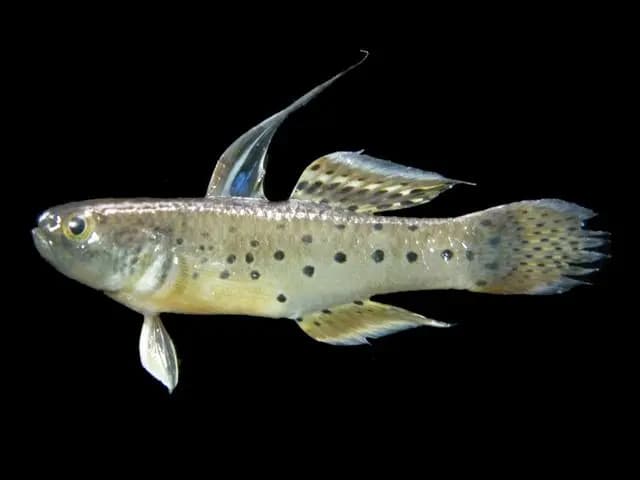
Stigmatogobius sadanundio, commonly known as the Knight Goby, is a member of the Gobiidae family native to the coastal brackish and freshwater habitats of Southeast Asia, ranging from India and Sri Lanka to Indonesia and the Philippines. In the wild, this fish inhabits estuaries, mangrove areas, and river mouths where fresh water mixes with seawater.
The Knight Goby has an elongated, slightly flattened body that reaches 7–10 cm in length. Its base coloration is silvery-grey or beige, adorned with numerous dark spots that create a distinctive "leopard" pattern. Like all gobies, its pelvic fins are fused into a suction disc — a characteristic adaptation that allows the fish to cling to rocks and driftwood in currents. Males are typically larger than females and display more contrasting coloration, especially during breeding season.
With proper care, Knight Gobies live 3–5 years. Despite their moderate level of territoriality, these fish are extremely engaging to observe: they actively explore the bottom, claim shelters, and display complex social behaviors.
Tank Requirements
Stigmatogobius sadanundio requires a tank of at least 60 liters. Optimal water parameters are: temperature 22–28°C, pH 7.0–8.5, and general hardness (GH) 8–15. A key aspect of keeping Knight Gobies is that they naturally inhabit primarily brackish water, so adding marine salt at a rate of 2–5 grams per liter significantly improves their health and coloration.
The substrate should be fine — sand or fine gravel works best, as gobies enjoy sifting through it. The tank must be furnished with plenty of hiding spots: rocks, ceramic tubes, coconut shell halves, and driftwood. Each goby needs its own "cave" — this reduces territorial conflicts. Plants can be used but should be species that tolerate brackish conditions: Java moss, Anubias, and Vallisneria.
Filtration should be efficient with moderate flow — gobies are accustomed to water movement in their natural habitat. A tight-fitting lid is essential, as these fish occasionally attempt to escape.
Feeding and Diet
The Knight Goby is an omnivorous fish with a strong preference for animal-based foods. In nature, it feeds on small crustaceans, worms, insect larvae, and other benthic invertebrates.
In the aquarium, the diet should be based on frozen and live foods: bloodworms, brine shrimp, daphnia, tubifex, and small shrimp. Most specimens will accept dry foods (sinking pellets and tablets for bottom-dwellers), but this may require an adjustment period. Flakes floating on the surface are typically ignored, as Knight Gobies feed exclusively from the bottom.
Feed 1–2 times daily in small portions. It is important to ensure that food reaches the bottom and is not intercepted by more active tankmates.
Care and Maintenance
Stigmatogobius sadanundio is a moderately demanding species to keep. The primary focus should be on maintaining stable water parameters and appropriate salinity levels.
Weekly water changes of 20–25% are recommended. When performing water changes, it is important to pre-dissolve marine salt in the replacement water to avoid sudden fluctuations in salinity. Regularly test ammonia and nitrite levels — gobies are sensitive to deteriorating water quality.
The substrate should be vacuumed periodically, as bottom-dwelling fish are the first to suffer from organic waste accumulation in the gravel. Monitor the condition of hiding spots and ensure all structures are stable — gobies actively dig around rocks and decorations.
Compatibility
The Knight Goby can be kept in a species-only setup or in a community tank with carefully selected tankmates. It is important to note that S. sadanundio is territorial toward conspecifics and other bottom-dwellers, so when keeping a group, ample hiding spots are essential.
Good companions include other fish that thrive in brackish water: Bumblebee Gobies, Mollies, Mono Angels, and Orange Chromides. Archerfish can also be considered, as they occupy the upper water column and do not compete with gobies for territory.
Avoid housing Knight Gobies with very small fish (they may snack on shrimp and fry), as well as with large aggressive cichlids that would harass bottom-dwellers.
Breeding
Breeding Stigmatogobius sadanundio in the aquarium is challenging but achievable for experienced aquarists. To stimulate spawning, gradually increase water salinity and temperature to the upper end of the acceptable range (26–28°C), along with generous feedings of live foods.
Spawning occurs inside a shelter — the female deposits eggs on the ceiling of a cave or the inner surface of a rock. The male takes full responsibility for brood care: guarding the eggs, fanning them with his fins for ventilation, and removing unfertilized ones. Incubation lasts 7–10 days depending on temperature.
Raising fry is the most challenging stage. The larvae are very small and initially require infusoria or rotifers. As they grow, they can be transitioned to newly hatched brine shrimp. Fry grow slowly, and maintaining stable water parameters and cleanliness in the rearing tank is essential.