Overview
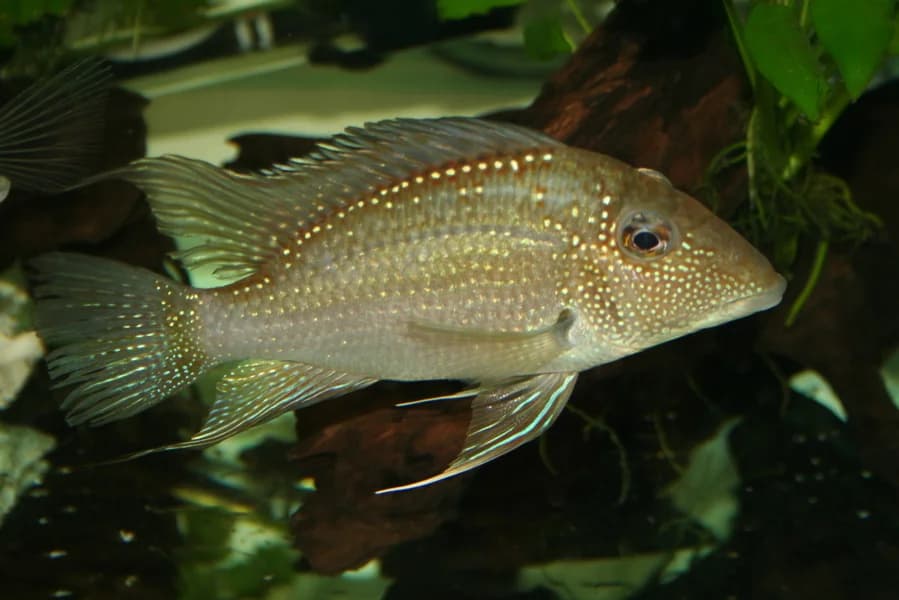
The Demon Eartheater (Satanoperca leucosticta) is a freshwater cichlid from the group known as "eartheaters," inhabiting rivers of Guyana, Suriname, and northern Brazil. The species gets its common name from its characteristic feeding behavior: the fish takes mouthfuls of sand and sifts it through its gill slits, extracting small invertebrates and organic particles. This fascinating process captivates observers and is the hallmark of all Satanoperca species.
Adults reach 20–25 cm in length and have an elegant, slightly elongated body with distinctive iridescent spots on the head and gill covers, which gave the species its name "leucosticta" (white-spotted). The overall coloration ranges from silvery-olive to golden, with reddish tints on the fins.
How to Distinguish Males from Females?
Sexual dimorphism is subtle, especially in younger specimens:
- Size: Males are generally larger and more robust than females.
- Fins: Males have more elongated dorsal and anal fins with pointed tips.
- Head: Adult males may develop a slight nuchal hump.
- Coloration: During spawning, males become more vibrant while females display darker body coloration.
Tank Requirements
A group of Satanoperca requires a spacious aquarium of at least 300 liters. Optimal water parameters:
- Temperature: 24–28°C
- pH: 6.5–7.5
- Hardness (dGH): 8–15
The key requirement is a fine sand substrate. This is critically important since the fish constantly sifts the substrate while foraging. Coarse gravel can damage the gills and prevents the fish from performing its natural feeding behavior.
For decoration, driftwood and large rocks are recommended to create hiding spots. Plants should be hardy and well-rooted (Anubias, Echinodorus) or placed in pots, as these fish actively dig through the substrate. Lighting should be moderate and subdued — closer to the conditions of shaded tropical rivers.
Feeding and Diet
Satanoperca leucosticta is an omnivorous fish with a preference for animal-based foods. In the wild, the diet consists primarily of small invertebrates, insect larvae, and organic detritus extracted from sand.
In the aquarium, the recommended diet includes:
- High-quality sinking pellets and flakes for cichlids
- Frozen and live foods: bloodworm, brine shrimp, daphnia, tubifex
- Blanched vegetables: spinach, zucchini, cucumber
- Specialized eartheater foods
Feed 2–3 times daily in small portions. It is beneficial to scatter some food across the sand surface to encourage natural sifting behavior.
Care and Maintenance
The Demon Eartheater requires attentive but not overly demanding care. Weekly water changes of 25–30% are necessary to maintain stable parameters. These fish are sensitive to elevated nitrate levels, so regular water quality monitoring is essential.
Filtration should be powerful but with moderate flow — in the wild, Satanoperca inhabit calm river sections. When cleaning the substrate, be careful: siphon the sand gently without going too deep to preserve the biological balance of the substrate.
With proper care, the lifespan is 10–15 years. The main health concerns are related to poor water quality and the use of unsuitable substrate.
Compatibility
Satanoperca leucosticta is one of the most peaceful cichlids, making it an excellent candidate for a community tank with appropriately sized companions. Good tank mates include:
- Angelfish — similar care requirements and calm temperament
- Severum and Festivum — South American cichlids from similar biotopes
- Sterbai Corydoras and other large corydoras
- Bristlenose Pleco and other peaceful catfish
- Large tetras such as the Cardinal Tetra (in schools of 10 or more)
Avoid keeping them with very small fish (under 4 cm) that may be accidentally swallowed, as well as aggressive cichlids that can bully the peaceful Satanoperca. They are best kept in groups of 5–6 individuals — this reduces stress and allows for observation of natural social behavior.
Breeding
Breeding Satanoperca leucosticta in an aquarium is challenging but achievable with experience. This species is a delayed mouthbrooder: the pair deposits eggs on a flat rock or cleared area of substrate, and after 24–48 hours the female takes the larvae into her mouth, where she incubates them until they are free-swimming (typically 10–14 days).
To stimulate spawning:
- Raise the temperature to 28°C
- Provide generous feeding with live foods
- Simulate the rainy season with frequent water changes using soft, cooler water
During incubation, the female refuses food. After releasing the fry, both parents guard the offspring for some time. Fry should be fed newly hatched brine shrimp and microworms. Raising juveniles requires patience, as Satanoperca grow relatively slowly.