Overview
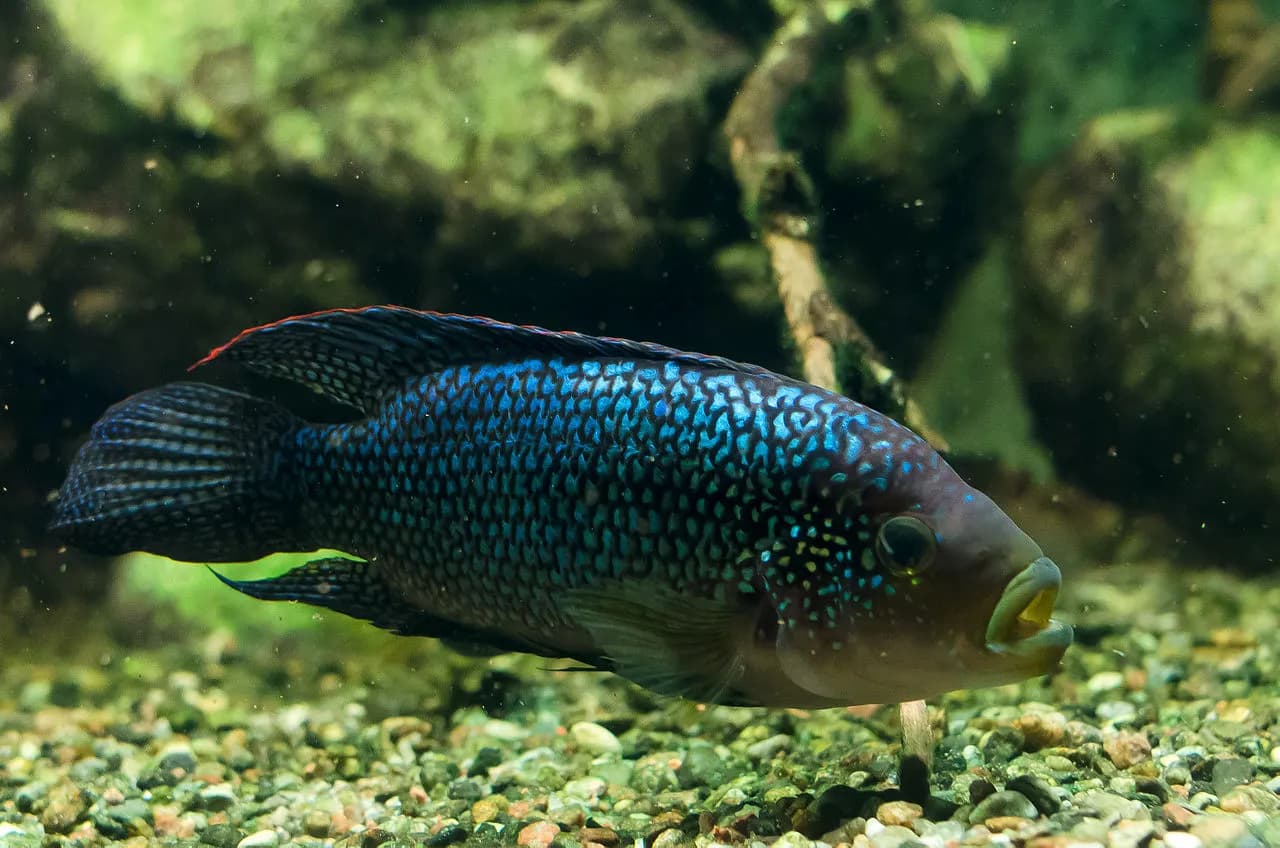
The Jack Dempsey (Rocio octofasciata) is a large Central American cichlid from the family Cichlidae, named after the legendary boxer for its pugnacious temperament and robust build. In the wild, these fish inhabit slow-moving rivers, swampy areas, and lakes across Mexico, Guatemala, Honduras, and Belize, favoring spots with soft substrates and plenty of cover.
Adults reach 15–20 cm in length and live 10–15 years with proper care. Their body is dark and covered with shimmering blue, green, and gold speckles that become more intense with age. Males are larger, more vividly colored, and have more pointed dorsal and anal fins. A notable variant is the "Electric Blue Jack Dempsey" — a selectively bred morph displaying intense blue coloration across the entire body.
Tank Requirements
A pair of Jack Dempseys requires an aquarium of at least 200 liters. These fish are notorious interior decorators — they dig through substrate, rearrange decorations, and uproot poorly anchored plants, so the setup must account for their habits.
Water parameters:
- Temperature: 24–28 °C
- pH: 7.0–8.0
- Hardness (GH): 8–12
Use fine gravel or coarse sand as substrate — the fish will actively sift through it without damaging their gills. Provide large rocks, driftwood, and ceramic caves to establish territorial boundaries and shelters. For plants, choose hardy species like Anubias and Java fern attached to driftwood — anything planted in the substrate will be excavated. Filtration must be robust: an external canister filter rated at 4–5 times the tank volume per hour is recommended.
Feeding and Diet
Rocio octofasciata is an omnivorous predator with a strong preference for protein-rich foods. In nature, they feed on insects, larvae, small fish, and crustaceans.
In the aquarium, the staple diet should consist of high-quality pellets formulated for large cichlids. Supplement regularly with live or frozen foods: bloodworms, brine shrimp, glassworms, earthworms, and shrimp. Occasionally offer blanched zucchini or spinach to balance the diet.
Feed adults once or twice daily in portions consumed within 2–3 minutes. Juveniles should be fed more frequently — 2–3 times per day. Overfeeding is a common issue: Jack Dempseys are greedy eaters and easily become overweight, which shortens their lifespan.
Care and Maintenance
Weekly water changes of 25–30% are essential for keeping these fish healthy. Jack Dempseys produce a significant amount of waste, and without regular changes, nitrate levels will climb quickly. Use a gravel vacuum to clean the substrate, especially in corners and under decorations.
Test water parameters at least once a week: ammonia and nitrites should remain at zero, and nitrates below 20–30 mg/l. Monitor the filter condition and rinse media in removed tank water as needed.
Jack Dempseys are fairly hardy, but deteriorating conditions can trigger Ich (white spot disease) and bacterial infections. Early warning signs include faded coloration, loss of appetite, and clamped fins. If you notice these symptoms, check water parameters immediately and consider raising the temperature to 28–30 °C.
Compatibility
Jack Dempseys are territorial and moderately aggressive fish, especially during breeding. Tankmates must be chosen carefully — ideal companions are fish of similar size and temperament.
Suitable tankmates:
- Firemouth cichlid and other Central American cichlids
- Oscar
- Convict cichlid
- Large catfish (Pterygoplichthys, Synodontis)
- Large characins (Giant danio, Silver dollar)
Unsuitable tankmates:
- Small fish (neons, guppies, rasboras) — will be treated as food
- Slow-moving fish with flowing fins (Angelfish)
- Overly aggressive species that may cause chronic stress
When keeping multiple large cichlids together, it is critical to provide sufficient tank volume and numerous visual barriers — driftwood, rocks, and clay pots — to break up line of sight between territories.
Breeding
Breeding Rocio octofasciata in the aquarium is quite achievable and does not require advanced skills — the difficulty level is moderate. These fish form stable pairs, and pairs often form naturally within a group of juveniles.
To trigger spawning, raise the temperature to 26–28 °C and provide generous protein-rich feedings. The pair will select a flat surface — a rock, ceramic tile, or cave wall — and meticulously clean it. The female lays up to 500–800 eggs, which both parents fiercely guard.
Incubation takes 3–4 days, and fry become free-swimming after another 4–6 days. The parents show pronounced brood care, moving larvae in their mouths and guarding the fry school. However, parental aggression toward tankmates escalates dramatically during this period — be prepared for conflicts in a community tank.
First foods for fry include baby brine shrimp and microworms. Gradually transition to crushed pellets as they grow. Fry develop relatively quickly, reaching 3–4 cm by 2–3 months of age.