Overview
Rasbora kalochroma, commonly known as the Clown Rasbora, is one of the most visually appealing members of the Cyprinidae family. In the wild, this species inhabits blackwater streams and peat swamps of Borneo, Sumatra, and the Malay Peninsula, where the water takes on a characteristic tea-brown color due to high tannin concentrations from decomposing leaf litter.
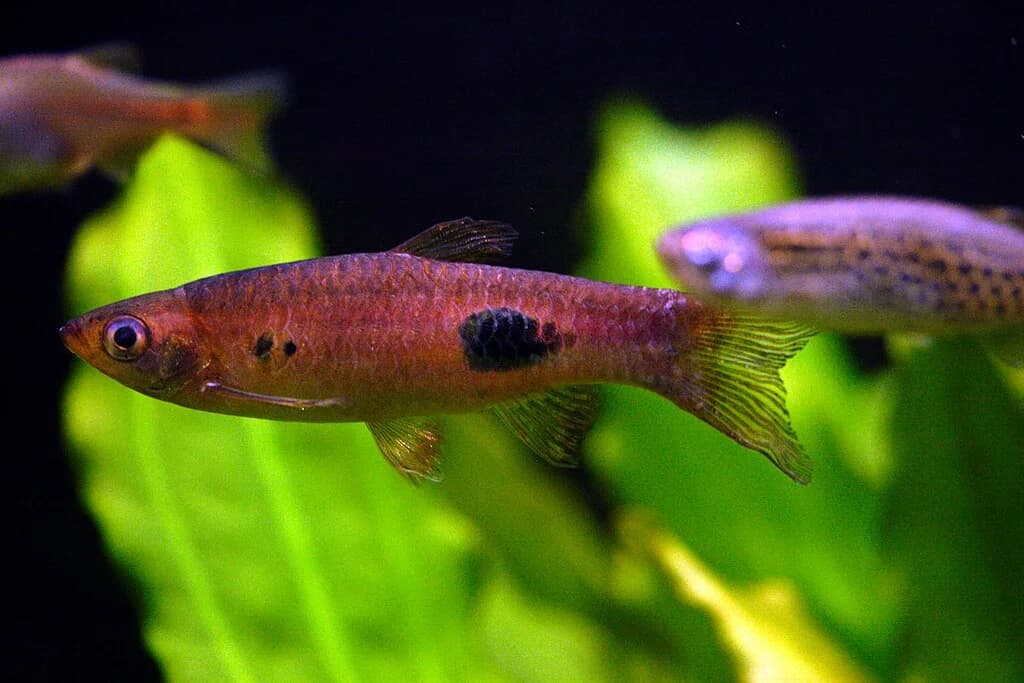
Adults reach 8-10 cm in length, making them one of the larger rasboras available in the aquarium hobby. The base body coloration is pinkish-orange with a reddish hue that intensifies considerably under proper care. The species' most distinctive feature is a pair of large dark spots on each flank: one positioned near the base of the dorsal fin and another closer to the caudal peduncle. These spots, reminiscent of a clown's makeup, give the fish its common name.
By temperament, Rasbora kalochroma is a typical peaceful schooling fish. When kept in a group, individuals display confident, active behavior, swimming freely through the middle and upper water layers. Life expectancy in the aquarium is 4-6 years with proper care.
Tank Requirements
A tank of at least 80 liters (approximately 21 gallons) is required for a school of Clown Rasboras. Given that this is a schooling species needing a group of 6 or more, this volume represents a reasonable minimum — a larger tank is preferable when possible.
Optimal water parameters are: temperature 24-28°C (75-82°F), pH 5.0-7.0, and general hardness (GH) 1-10. These fish originate from soft-water habitats and display their best coloration and overall health in soft, slightly acidic water. I strongly recommend setting up a blackwater-style biotope aquarium: place fallen leaves of oak, Indian almond (catappa), or beech on the substrate, and add driftwood and branches. The tannins released by these materials not only create a natural water color but also provide mild antibacterial benefits.
A dark substrate works best — sand or fine gravel. Live plants are welcome, especially shade-tolerant species: cryptocorynes, anubias, and Java moss. Floating plants such as water lettuce or salvinia help create the subdued lighting that rasboras are accustomed to in nature. Avoid bright lighting — in dimmer conditions, the fish feel more secure and display richer coloration.
Feeding and Diet
Rasbora kalochroma is an omnivorous species that feeds on small insects, their larvae, zooplankton, and plant particles in the wild. In the aquarium, they readily accept high-quality dry foods — flakes and small pellets — but regular inclusion of live and frozen foods is essential for maintaining health and vibrant coloration.
Excellent live and frozen food options include: daphnia, brine shrimp, bloodworms (small), cyclops, and moina. It is precisely the regular feeding of live foods that brings out the truly vivid coloration in these rasboras.
The optimal feeding schedule is 2-3 times daily in small portions that the fish consume within 2-3 minutes. This approach more closely mirrors their natural feeding pattern and helps maintain water quality. Overfeeding is one of the most common mistakes when keeping this species, as leftover food rapidly degrades water quality in a soft, acidic environment.
Care and Maintenance
The key to successfully keeping Clown Rasboras is stability of water parameters. These fish do not tolerate sudden changes, so all water manipulations should be carried out gradually and carefully.
Weekly water changes of 15-20% are essential. Use replacement water that closely matches the aquarium water in temperature, softness, and acidity. If using tap water, always treat it with a water conditioner and, if necessary, reduce hardness by blending with reverse-osmosis water.
Filtration should be effective but gentle — without strong current. Sponge filters or external canister filters with a spray bar work well. Peat media in the filter will help maintain proper water parameters and provide consistent mild acidification.
Monitor water parameters regularly: pH, hardness, ammonia, nitrites, and nitrates. Rasbora kalochroma is sensitive to elevated nitrate levels, which should be maintained below 20 mg/l. Indian almond leaves and alder cones should be replaced as they decompose, typically every 2-3 weeks.
Compatibility
The Clown Rasbora is a peaceful fish that makes an excellent addition to a community tank with other calm species. The essential requirement is keeping them in a school of at least 6, ideally 8-10 individuals. In a small group, the fish become shy, lose their color, and tend to hide.
Excellent tankmates include other rasboras such as the Scissortail Rasbora or Brigittae Rasbora, as well as the Harlequin Rasbora. They coexist well with small peaceful species: Boraras, Neon Tetras, and Cardinal Tetras. Among bottom dwellers, Pygmy Corydoras and Kuhli Loaches are superb companions that share similar soft-water requirements.
Avoid housing them with large or aggressive fish, as well as active species that create strong currents or compete aggressively for food. Barbs such as the Tiger Barb can be overly boisterous tankmates.
Breeding
Rasbora kalochroma is an egg-scattering species, and breeding is quite achievable in the home aquarium when proper conditions are provided.
Prepare a separate breeding tank of 30-40 liters with very soft, acidic water (pH 5.0-5.5, GH 1-3, temperature 26-27°C / 79-81°F). Place a mesh or a layer of Java moss on the bottom to protect the eggs from being consumed by the parents. Lighting should be minimal, and the water should be tinted with tannins.
For 1-2 weeks before the anticipated spawning, condition the breeders generously with live foods — brine shrimp, daphnia, and bloodworms. A female carrying ripe eggs will become noticeably rounder. Introduce a pair or a small group (2-3 females per male) into the breeding tank in the evening. Spawning typically occurs in the morning hours.
After spawning, the parents must be removed immediately, as they will readily consume their own eggs. The eggs are small and slightly adhesive, with an incubation period of 24-36 hours. The larvae initially feed on their yolk sacs, then transition to infusoria and microworms. After 7-10 days, the fry begin accepting freshly hatched brine shrimp nauplii. Growth is gradual; the juveniles start developing their characteristic coloration at around two months of age.