Overview
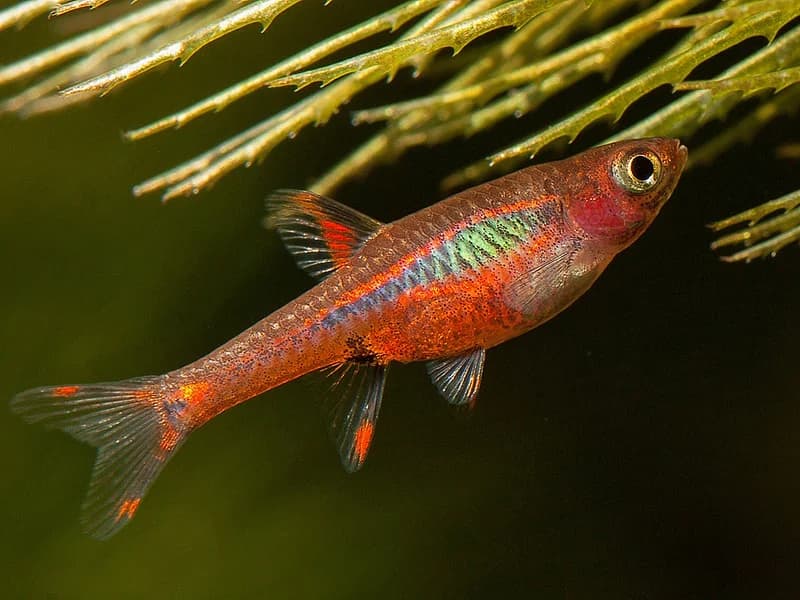
Rasbora brigittae, also known as the Chili Rasbora or Mosquito Rasbora, is one of the smallest and most vibrantly colored freshwater fish available in the aquarium hobby. This tiny member of the Cyprinidae family reaches only 2-3 cm in length and can live 5-8 years with proper care. These fish originate from the blackwater streams and peat swamps of southwestern Borneo (Indonesia), where they inhabit densely vegetated shorelines in waterways with very soft, acidic water stained dark brown by tannins.
The coloration of Rasbora brigittae is its crowning feature. The body displays a rich ruby-red hue with a dark longitudinal stripe running from the snout to the base of the caudal fin. Along this stripe, a thin lighter line is often visible, creating a striking contrast. Males are typically more vividly colored than females, showing a more intense red tone, especially during spawning periods. Females tend to be slightly larger and fuller-bodied with less saturated coloration. Notably, color intensity is directly linked to keeping conditions — in a proper setup with soft water and dark substrate, these fish display truly impressive colors.
Despite their tiny size, Chili Rasboras are active during the day and exhibit fascinating social behavior. Males regularly engage in peaceful displays toward one another, flaring their fins and intensifying their colors, making a group of these fish a genuine pleasure to observe.
Tank Requirements
The Chili Rasbora is an ideal inhabitant for nano aquariums. The minimum volume for a school is 30 liters (approximately 8 gallons), though a 40-50 liter tank provides noticeably more comfort. Water parameters should mimic their natural habitat: temperature 22-28°C (72-82°F), pH 4.0-6.5, and general hardness (GH) 1-5. This is one of the few aquarium fish that genuinely prefers very soft and acidic water.
The key to successful keeping is creating a biotope that closely replicates the blackwater conditions of Borneo. Use a dark substrate (black sand or fine basalt), add driftwood and branches, and place dried Indian almond (catappa) leaves, oak leaves, or beech leaves in the water. The tannins released by these materials not only acidify the water and give it a characteristic tea color but also possess mild antibacterial properties. Lighting should be subdued — it can be softened with floating plants such as water lettuce, riccia, or salvinia.
For rooted plants, cryptocorynes, bucephalandra, and various mosses (Java moss, Christmas moss) work well, creating hiding spots and foraging zones. Dense vegetation helps the fish feel secure and encourages the display of their vivid coloration.
Feeding and Diet
In nature, Rasbora brigittae is a typical micropredator, feeding on the tiniest invertebrates, insect larvae, and zooplankton. In the aquarium, high-quality micro pellets and crushed flakes can form the dietary base, but to maintain health and vibrant coloration, live and frozen foods should be included regularly.
The best foods for Chili Rasboras include baby brine shrimp (artemia nauplii), microworms (nematodes), cyclops, moina daphnia, and grindal worms. All of these are appropriately sized for the fish's tiny mouth. Regular daphnia and adult brine shrimp are best avoided as they are too large. Feed 1-2 times daily in small portions that the fish consume within 2-3 minutes.
An important practical note: when keeping Chili Rasboras in a community nano tank with other fish, ensure they are getting enough food. Due to their small size, they may lose out to more active tankmates during feeding time.
Care and Maintenance
The Chili Rasbora is an undemanding species with a care level of 1 out of 5, yet stability of water parameters is critically important. Weekly water changes of 15-20% will help maintain cleanliness without causing sudden parameter fluctuations. Replacement water should be prepared in advance, bringing its temperature and parameters to match the aquarium values.
Filtration should be gentle — air-driven sponge filters or low-powered internal filters with adjustable flow are ideal. Strong currents exhaust these tiny fish and cause stress. Note that when using external filters, the intake must be protected with fine mesh to prevent fish and fry from being sucked in.
Regularly test water parameters — monitoring pH and hardness is especially important for this species. If you use catappa leaves, replace them as they decompose (typically every 2-3 weeks). Chili Rasboras are sensitive to elevated nitrate levels, so aim to keep nitrates below 20 mg/l.
Compatibility
Rasbora brigittae is an exceptionally peaceful fish with an aggression rating of 1 out of 5. They should be kept in groups of 8-10 or more, with 12-15 being ideal. In a larger group, the fish display more confident behavior, brighter coloration, and fascinating social interactions between males.
Choosing tankmates requires attention to size. Ideal companions include other small peaceful species: Spotted Rasbora, Phoenix Rasbora, Celestial Pearl Danio, Pygmy Corydoras, Otocinclus, as well as small shrimp — Neocaridina and Caridina species. Cherry shrimp make excellent companions and help keep the tank clean.
Under no circumstances should Chili Rasboras be housed with large or medium-sized fish — even peaceful but larger species will cause constant stress, while predatory fish may view them as food. Avoid keeping them with barbs, cichlids, and large tetras. Even the Harlequin Rasbora, despite its peaceful disposition, is significantly larger than the Chili Rasbora and may intimidate it.
Breeding
Breeding Rasbora brigittae is accessible even for beginner aquarists, with a difficulty rating of 2 out of 5. These fish are egg scatterers and may spawn regularly in a well-maintained community tank, though a dedicated breeding setup is recommended for intentional fry production.
Prepare a small 5-10 liter tank with very soft, acidic water (pH 5.0-6.0, GH 1-2, temperature 26-27°C / 79-81°F). Line the bottom with Java moss or a fine mesh through which eggs can fall, remaining inaccessible to the parents. Lighting should be minimal. For 1-2 weeks before spawning, condition the breeding pair generously with live foods — artemia nauplii and microworms.
Spawning typically occurs in the morning. The female lays a small number of eggs (10-30), scattering them among plants or moss. After spawning, the parents must be removed, as they are prone to eating their own eggs.
Eggs incubate for 24-48 hours. The larvae spend the first 1-2 days feeding on their yolk sac before becoming free-swimming and actively feeding. First food should be infusoria and microscopic organisms from a mature aquarium. After 7-10 days, the fry transition to artemia nauplii and microworms. Fry grow slowly and develop adult coloration at approximately 3-4 months of age.