Overview
Puntius denisonii is one of the most striking members of the Cyprinidae family, having gained enormous popularity among aquarists worldwide. This fish is commonly known as Denison's Barb, the Red Torpedo Barb, or the Roseline Shark. It is worth noting that this species is closely related to Sahyadria denisonii — some classifications even merge them into a single species, though today Sahyadria denisonii is more commonly recognized as a separate taxon.
The natural habitat of Puntius denisonii lies in the fast-flowing rivers and streams of Southern India, particularly in the state of Kerala. In the wild, these fish inhabit clear waters with rocky substrates and high oxygen content.
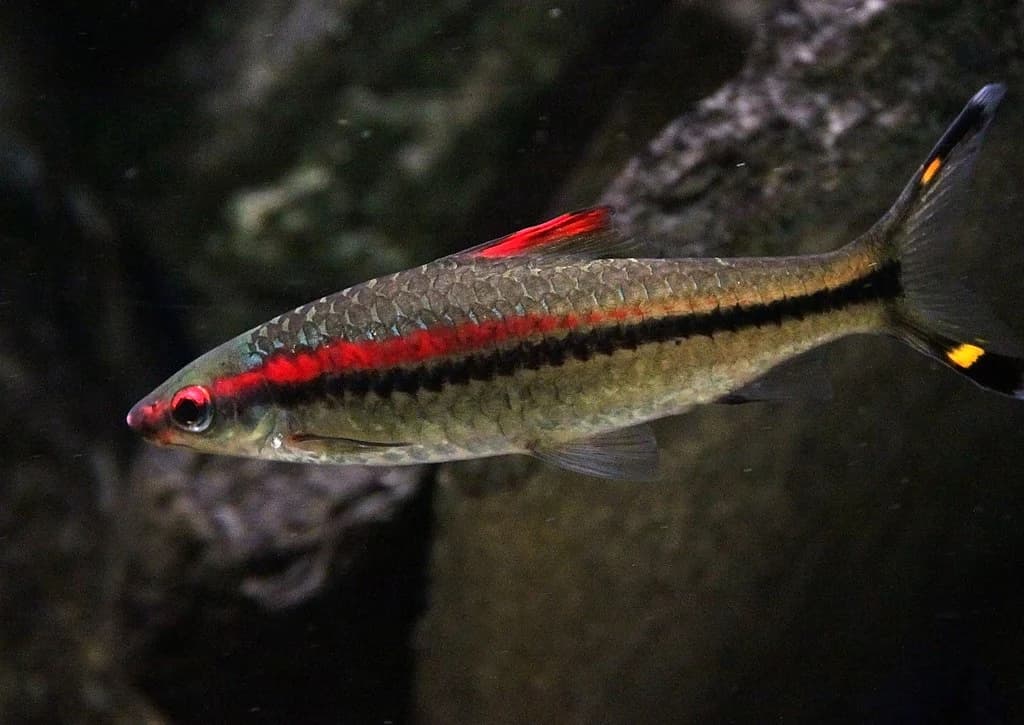
The main highlight of this barb is a vivid red stripe running from the tip of the snout through the eye along the upper body. Its torpedo-shaped body gives the fish a sleek, dynamic appearance that reflects its active nature. The caudal fin features contrasting black and yellow bands. Adults reach a size of 6-7 cm and can live 5 to 7 years with proper care.
Tank Requirements
For keeping a school of Puntius denisonii, I recommend an aquarium of at least 100 liters. These fish are active swimmers, so providing ample swimming space is essential. A longer tank is preferable to a tall one, allowing the fish to build up speed — mimicking their natural behavior in river currents.
Optimal water parameters:
- Temperature: 22-28°C
- pH: 6.5-7.5
- General Hardness (GH): 5-15 dGH
Fine gravel or coarse sand works best as a substrate, simulating a riverbed. Add driftwood and smooth stones to create natural hiding spots. Choose hardy plants such as Anubias and Java Fern, attached to rocks and driftwood. Be sure to fit a tight-fitting lid on the aquarium — Denison's Barbs are prone to jumping, especially when startled or stressed.
It is important to provide good water flow using a powerhead or powerful filter — these fish naturally inhabit flowing waters and need strong aeration.
Feeding and Diet
Puntius denisonii are omnivorous fish and feeding them is straightforward. In nature, they feed on small invertebrates, algae, and plant matter. In the aquarium, high-quality flakes or small granules for tropical fish can serve as a staple diet.
To maintain vibrant coloration and overall health, supplement the diet with:
- Live or frozen foods: bloodworms, daphnia, brine shrimp
- Plant-based supplements: blanched spinach leaves, spirulina tablets
- Specialized foods: barb pellets containing carotenoids for color enhancement
Feed 2-3 times daily in small portions that the fish consume within 2-3 minutes. In my experience, rotating different food types yields the best results and keeps the fish actively interested in feeding.
Care and Maintenance
Denison's Barb is a fairly undemanding species when basic conditions are met. The key requirement is stable water quality. Perform weekly water changes of 25-30%, using dechlorinated or conditioned water with parameters close to the tank water.
Care recommendations:
- Use an external canister filter that provides both mechanical and biological filtration
- Monitor ammonia and nitrite levels — they should remain at zero
- Keep the fish in a school of at least 5-6 individuals — when kept alone or in pairs, they become shy and lose their vibrant coloration
- Regularly vacuum the substrate with a gravel siphon to remove accumulated organic waste
Pay attention to the fish's behavior: healthy Denison's Barbs swim actively in a school, eagerly accept food, and display rich coloration. Fading colors or hiding behavior may indicate stress or the onset of illness.
Compatibility
Puntius denisonii are peaceful schooling fish that make an excellent choice for a community aquarium with suitable tank mates. Their active behavior and moderate size allow them to coexist with most non-aggressive species.
Good tank mates:
- Other medium-sized barbs, such as the Tiger Barb or Cherry Barb
- Peaceful tetras like the Neon Tetra
- Corydoras catfish — calm bottom dwellers such as the Panda Corydoras or Sterbai Corydoras
- Rasboras and danios
Not recommended to keep with:
- Large cichlids, including Angelfish, which can be territorial
- Slow-moving, long-finned fish — active barbs may harass them
- Aggressive or predatory species
Breeding
Breeding Puntius denisonii in a home aquarium is an achievable goal, though it does require some preparation. These are egg-scattering fish that deposit eggs among plants.
To trigger spawning, set up a separate breeding tank of 50-80 liters with soft water (GH 4-8) and slightly elevated temperature (26-28°C). Place fine-leaved plants or synthetic spawning mops on the bottom. A strong air pump will ensure the water is well-oxygenated.
Select breeding stock from a well-fed group — females are noticeably plumper than males. Heavy feeding with live foods for 1-2 weeks and gradually lowering water hardness helps stimulate spawning.
After spawning, remove the adults immediately, as they will readily eat their own eggs. Incubation takes 24-48 hours. Once the fry are free-swimming, start feeding them infusoria, then gradually transition to baby brine shrimp and finely crushed dry food. The fry grow relatively slowly, but with regular feeding and water changes, they develop steadily.