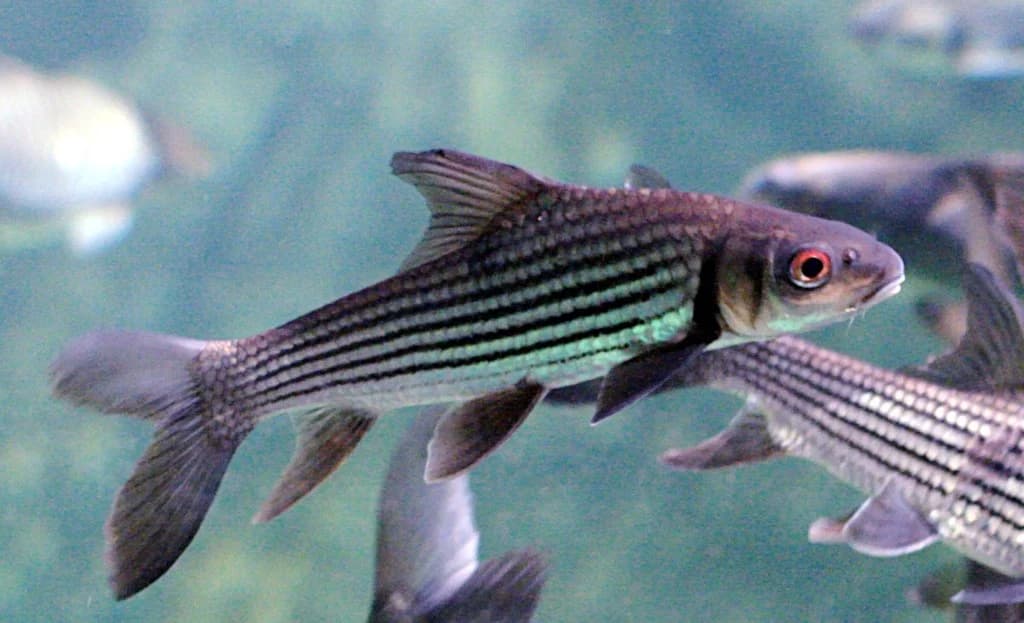
Overview
Probarbus jullieni, commonly known as Jullien's Golden Carp or the Isok Barb, is one of the largest representatives of the Cyprinidae family, capable of reaching 120-150 cm in length. This impressive species inhabits the Mekong and Chao Phraya river basins in Southeast Asia, occurring in Thailand, Cambodia, Laos, Vietnam, and Malaysia. In the wild, these fish prefer large river channels with moderate to strong currents, dwelling near the bottom of waterways.
It is important to note that Probarbus jullieni is listed under CITES as an endangered species. Wild populations are declining rapidly due to overfishing, hydroelectric dam construction, and destruction of natural spawning grounds. For this reason, the species is extremely rare in the aquarium trade, and its acquisition and keeping are restricted by law in many countries.
Keeping this giant is a task exclusively for public aquariums or very large private installations. Even a spacious home aquarium simply cannot provide this species with adequate space for a healthy life.
Tank Requirements
The minimum tank volume for Probarbus jullieni is 1000 liters, but this is only a starting point for juvenile specimens. Adult fish realistically need significantly more — 3000-5000 liters or above. Ideally, this species requires a pool or flow-through pond. The tank length should be several times the body length of the fish to allow free movement.
Optimal water parameters: temperature 22-26°C, pH 6.5-7.5, hardness GH 5-12. Powerful filtration is essential — external filters with a flow rate several times the tank volume are necessary. Strong water movement is welcome, as this species naturally inhabits fast-flowing rivers.
Coarse sand or fine gravel works well as substrate. Decorations should consist of large rocks and substantial driftwood while leaving ample open swimming space. Live plants are unlikely to survive in a tank with Probarbus jullieni — the fish will damage or uproot them. Weekly water changes of 25-30% are necessary to maintain stable water quality.
Feeding and Diet
In the wild, Probarbus jullieni is an omnivorous species, feeding on aquatic invertebrates, mollusks, plant matter, and detritus. In aquarium conditions, the diet should be varied and well-balanced.
High-quality granulated feeds designed for large fish can form the dietary basis. These should be supplemented with live or frozen foods: large shrimp, mussels, earthworms, and river fish. The vegetable component is equally important — lettuce leaves, spinach, blanched peas, and zucchini pieces are all suitable.
Given this fish's size, feeding volumes are substantial. Feeding once or twice daily is recommended, with careful portion control to prevent overfeeding and water contamination. Juvenile specimens have higher protein requirements, while the proportion of plant-based components should be increased with age.
Care and Maintenance
Keeping Probarbus jullieni is a serious responsibility that demands experience and significant resources. Water parameter stability is the key factor for successful husbandry. This species is sensitive to sudden fluctuations in temperature and pH, as well as elevated levels of ammonia and nitrites.
Weekly water changes of 25-30%, regular parameter monitoring with test kits, and maintenance of filtration equipment are mandatory care elements. Given the fish's size, the tank must be constructed from sturdy materials with a reliable frame — large individuals can damage glass walls or displace decorations.
Moderate lighting that approximates natural river conditions is best. Aeration is essential to maintain high oxygen levels. The tank must be securely covered with a lid, as large fish are capable of jumping out of the water. It is also important to monitor the fish's overall condition: loss of appetite, color fading, or atypical behavior may indicate health problems.
Compatibility
Probarbus jullieni is a relatively peaceful species despite its imposing size. However, tank mates must be selected with dimensions in mind — any fish that can fit in the carp's mouth will inevitably be eaten. Therefore, small and medium species such as rosy barbs or zebra danios are entirely unsuitable as companions.
Optimal tank mates are other large, peaceful fish that thrive in similar conditions. Keeping them in a species group of several individuals is also possible if sufficient volume is available. Aggressive and territorial species that may provoke stress in these calm giants should be avoided.
Overall, the ideal setup for Probarbus jullieni is a species-only tank or housing with a small number of comparably sized inhabitants.
Breeding
Breeding Probarbus jullieni in captivity is an exceptionally challenging task, virtually impossible under standard aquarium conditions. In the wild, this species undertakes long migrations to spawning grounds located in upper river reaches, where the fish deposit eggs on rocky substrates during the monsoon season. Spawning is triggered by seasonal changes in water level, temperature, and current strength.
Replicating such specific conditions in an artificial environment is extremely difficult. Successful breeding has been documented only in isolated cases at specialized fish-breeding stations in Thailand and Cambodia, where hormonal stimulation and large flow-through ponds were employed.
For the hobbyist aquarist, breeding this species is effectively unattainable. If you are interested in large representatives of the Cyprinidae family that are more feasible to keep and breed, consider more accessible species such as the Denison barb.