Overview
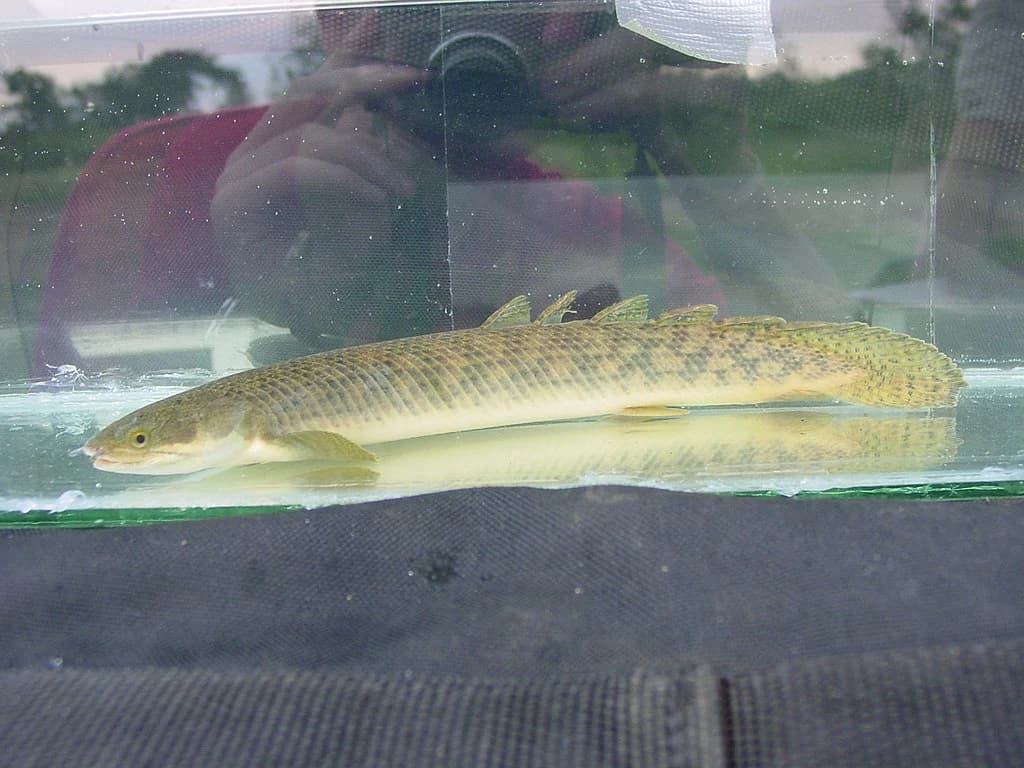
Polypterus palmas, known as the shortfin bichir or marble bichir, is one of the most compact and manageable members of the family Polypteridae. This ancient species inhabits slow-moving rivers, swamps, and floodplain pools of West Africa, ranging from Guinea to the Congo basin. Unlike its larger relatives such as the Nile bichir or the endlicheri bichir, Polypterus palmas reaches a modest 30-35 cm, making it an excellent choice for those entering the world of polypterus keeping.
The body of the shortfin bichir is more elongated and "snake-like" than most of its relatives. A distinctive row of small dorsal finlets, robust pectoral fins on fleshy bases, and a covering of ganoid scales give this fish a truly prehistoric appearance. Coloration ranges from olive-green to grey-brown with dark spots and bands — superb camouflage for a bottom-dwelling species.
The key biological feature of Polypterus palmas is its pair of primitive lungs, which allow it to breathe atmospheric air. The fish regularly rises to the surface to gulp air, and being deprived of this ability can be fatal. With proper care, the shortfin bichir lives 15-20 years, making it a truly long-term companion.
Tank Requirements
A single Polypterus palmas requires an aquarium of at least 200 liters. Despite its relatively modest size, this fish is active at night and needs ample space to move along the bottom.
Optimal water parameters:
- Temperature: 24-28 °C
- pH: 6.5-7.5
- General hardness (GH): 5-20
Fine sand makes the best substrate — it will not damage the fish's delicate belly as it crawls along the bottom. The tank should include driftwood, ceramic tubes, and rock formations that create shaded hiding spots where the bichir will spend the daylight hours. Live plants are acceptable, but prefer hardy, broad-leaved species attached to decorations — the fish may uproot anything planted in the substrate.
A tightly fitting lid is absolutely essential. Polypterus palmas can squeeze through the smallest gaps and escape the aquarium. All openings for equipment must be securely covered. Subdued lighting is preferred: under bright lights, the fish will hide and experience stress.
Feeding and Diet
Polypterus palmas is a dedicated predator. In the wild, it hunts small fish, insect larvae, worms, and crustaceans. In the aquarium, the core diet should consist of:
- Frozen bloodworms and glassworms
- Shrimp and squid pieces
- Small live fish (as an occasional supplement)
- Sinking pellets for carnivorous fish (once trained to accept them)
Feed in the evening or at night — this matches the fish's natural activity cycle. The shortfin bichir has poor eyesight and relies primarily on scent, so food must be sufficiently aromatic and must sink to the bottom. Feed juveniles daily and adults 3-4 times per week. Overfeeding is dangerous: polypterus species are prone to obesity when given excess food.
Care and Maintenance
The shortfin bichir is a reasonably hardy fish when basic husbandry rules are followed. Weekly water changes of 20-25% maintain stable water quality. Use a filter with moderate flow — in the wild, this species prefers calm waters.
It is critically important to ensure the fish has unobstructed access to the water surface for breathing atmospheric air. There should be an air gap of at least 3-5 cm between the lid and the water surface. Monitor the air temperature above the water: excessively cold air can cause respiratory problems.
Exercise caution during tank maintenance — Polypterus palmas may dart toward any gap in the lid. Many aquarists use a safety net during servicing. Regularly test water parameters and inspect the fish for skin and fin damage.
Compatibility
Polypterus palmas has a moderate temperament: it is not aggressive toward similarly sized tankmates, but any fish that fits in its mouth will be treated as food. A simple rule of thumb when selecting companions — a tankmate should be at least half the length of the bichir.
Good tankmates include:
- Large peaceful catfish (synodontis, plecostomus)
- Medium to large cichlids with moderate temperaments
- Other polypterus species, such as the delhezi bichir
- Large barbs and characins
Avoid housing with aggressive cichlids that may damage the bichir's delicate fins, as well as small fish (neons, guppies, small rasboras) that will inevitably become prey. When keeping multiple polypterus together, provide each individual with its own hiding spot to reduce territorial conflicts.
Breeding
Breeding Polypterus palmas in the aquarium is a challenging endeavor that requires patience and experience. In the wild, spawning coincides with the rainy season, when the water becomes softer and warmer.
To stimulate spawning in captivity, the following techniques are used:
- Gradually lowering the water level, then refilling with soft, slightly warmer water (simulating rainfall)
- Intensive feeding with live foods for 2-3 weeks before the expected spawning
- Abundant fine-leaved plants or synthetic spawning mops as a substrate
During spawning, the male forms a cup-like structure with his anal fin, into which the female deposits a batch of eggs. The male then scatters the fertilized eggs among the plants. Parents should be removed after spawning, as they may consume the eggs. Incubation takes 3-4 days at approximately 26 °C. The larvae initially feed on their yolk sac, then transition to brine shrimp nauplii and microworms. Fry grow slowly and require clean water with frequent water changes.