Overview
Poecilia wingei, commonly known as Endler's guppy, is a small livebearer from the Poeciliidae family discovered in 1975 by Professor John Endler in Laguna de Patos in northeastern Venezuela. Despite a superficial resemblance to the common guppy, Poecilia wingei is a distinct species, confirmed by genetic studies. Maintaining pure bloodlines is one of the most important concerns for aquarists keeping these fish, as crossbreeding with common guppies causes the offspring to lose their characteristic species traits.
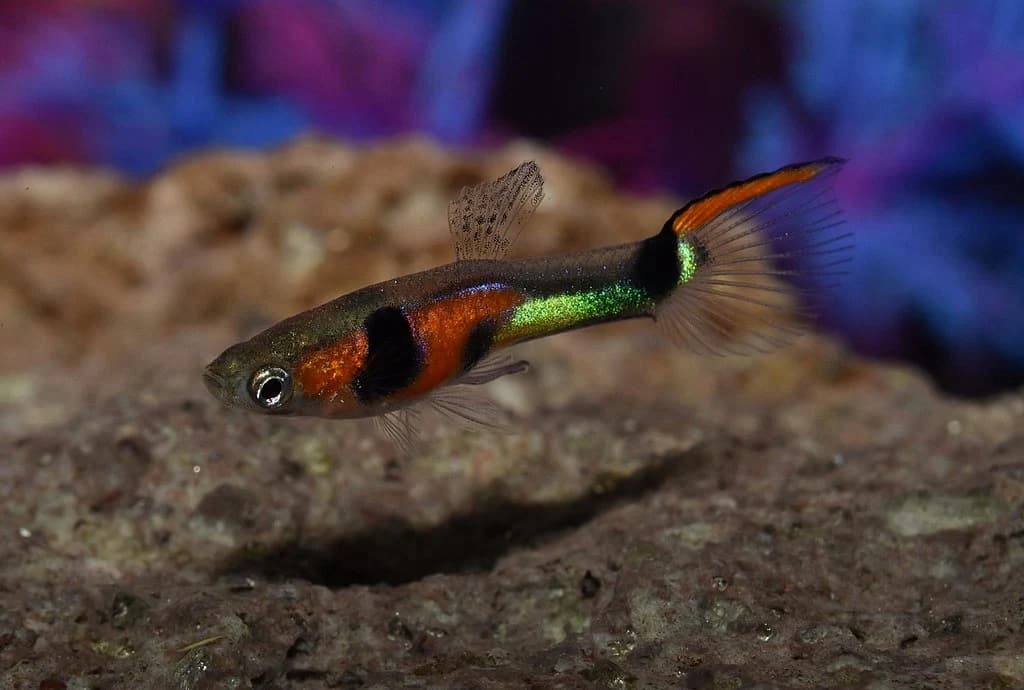
The most striking feature of Endler's guppy is the incredibly vivid neon coloration of males. Their bodies shimmer with intense shades of orange, emerald green, blue, and black, creating a glowing mosaic-like pattern. Females are noticeably larger, with a modest silvery-gray coloring and a more rounded body. Adults reach a size of 3–4 cm, and their lifespan is 2–4 years.
Thanks to their miniature size, brilliant appearance, and hardiness, Poecilia wingei has become one of the most popular fish for nano aquariums. These are active, lively fish that are constantly on the move, bringing energy and color to any tank.
Tank Requirements
A tank of at least 60 liters is suitable for keeping a small group of Endler's guppies. Optimal water parameters are: temperature 24–28°C, pH 6.5–8.5, and GH 10–25. These fish adapt well to a wide range of conditions but prefer clean, well-oxygenated water.
The aquarium should be densely planted with live plants such as Java moss, hornwort, and najas. Plant thickets serve as shelter for females and fry while creating a more natural habitat. At the same time, it is important to leave enough open swimming space, as males constantly display their colors while actively moving around the tank.
Any substrate works, but the neon colors of males look especially striking against a dark background. A lid on the aquarium is essential — Endler's guppies are excellent jumpers and can leap out of the water.
Feeding and Diet
In the wild, Poecilia wingei feeds on algae growth, detritus, and small invertebrates. In the aquarium, these fish readily accept all types of food: high-quality flakes, micro-pellets, as well as live and frozen foods such as brine shrimp nauplii, daphnia, and cyclops.
To maintain the vivid coloration of males, the diet should be varied and include foods rich in carotenoids. Specialized foods for small tropical fish with color enhancers work well. Feed 2–3 times a day in small portions that the fish consume within 1–2 minutes. Overfeeding is the biggest threat to the health of these tiny fish, so it is better to underfeed than overfeed.
Care and Maintenance
Endler's guppies are among the hardiest aquarium fish, making them an ideal choice for beginners. Weekly water changes of 20–25% and a good filter with moderate flow are the foundation of successful keeping. A sponge filter is the best option, as strong currents tire out these small fish, and fry can be sucked into the intake of a standard power filter.
It is recommended to keep these fish in groups of at least 6 individuals with a female-to-male ratio of 2–3 females per male. This reduces stress on females from the constant courtship of males. It is important to remember the need to maintain pure bloodlines: Endler's guppies should not be kept together with common guppies to avoid unwanted hybridization.
Regularly monitor ammonia and nitrite levels — they should remain at zero. Nitrates should ideally be kept below 20 mg/l.
Compatibility
Poecilia wingei are peaceful fish that are well suited for community tanks with calm tankmates of comparable size. Ideal companions include neon tetras, cherry barbs, pygmy corydoras, small rasboras, and ember tetras.
They can also be kept with other livebearers such as mollies and swordtails, although larger livebearers may bother the miniature Endlers. Keeping them with aggressive, predatory species or large fish that might view Endler's guppies as food is strongly discouraged.
It bears repeating: housing them together with common guppies is not recommended due to the risk of hybridization and loss of species purity.
Breeding
Breeding Endler's guppies is straightforward — this is a livebearer species, and reproduction occurs with virtually no intervention from the aquarist. Gestation lasts 23–28 days, after which the female gives birth to 5–25 fully formed fry.
For successful breeding, dense thickets of fine-leaved plants where fry can hide from adult fish are sufficient. When kept in a species-only tank with plenty of cover, fry survival rates are high even without separating the female. Fry begin feeding immediately after birth — brine shrimp nauplii, micro worms, and finely crushed dry food are all suitable.
Young fish reach sexual maturity by 2–3 months of age. Males develop their coloration quickly, and the sex of fry can be distinguished as early as one month old. To preserve the purity of bloodlines, it is recommended to keep different color morphs in separate tanks and prevent mixing with other species of the genus Poecilia.