Overview
The guppy (Poecilia reticulata) is arguably the most recognizable aquarium fish in the world. These small livebearers from the family Poeciliidae were first described in 1866 and have since become a true icon of the fishkeeping hobby. Their natural range spans the freshwater and brackish habitats of Venezuela, Guyana, Trinidad, and Barbados, but thanks to human introduction they have spread to tropical regions across the globe.
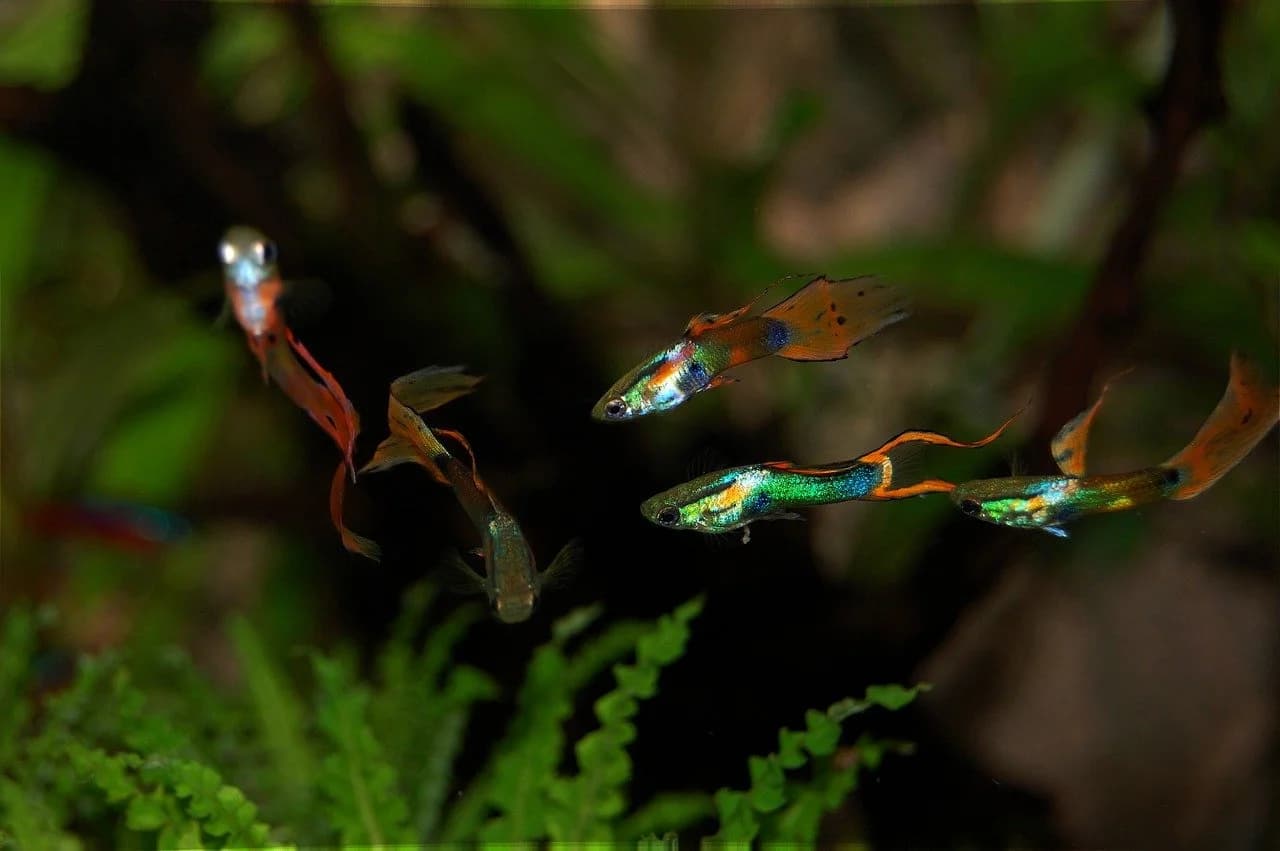
The hallmark of the guppy is its extraordinary diversity of selectively bred forms. Decades of dedicated breeding have produced hundreds of color variations and tail shapes: fan-tail, veil-tail, lyre-tail, spear-tail, flag-tail, and many more. Males reach 3-4 cm and display vivid, iridescent coloring with patterns of red, blue, green, yellow, and orange. Females are noticeably larger (4-6 cm) and more plainly colored — typically silvery-gray with a subtle sheen on the tail.
For comfortable keeping, a ratio of 1 male to 2-3 females is recommended. This reduces stress on females from excessive male attention and allows you to observe more natural behavior.
Tank Requirements
Guppies are undemanding fish, but providing proper conditions ensures their health and longevity. The minimum tank volume for a small group of 6-8 individuals is 40 liters. Optimal water temperature is 22-28°C, with the most comfortable range being 24-26°C. The pH should be maintained between 6.8-7.8, and general hardness (GH) between 10-30.
Guppies prefer moderate water flow and good aeration. Filtration is essential, but a sponge pre-filter on the intake is a must — especially if fry are present, as they can be sucked into the filter. Lighting should be moderate, running 8-10 hours per day.
The aquarium should be densely planted with live vegetation: Java moss, hornwort, cabomba, and vallisneria create natural shelters and serve as hiding spots for fry. Leave enough open swimming space in the center and upper portions of the tank, as guppies tend to occupy these zones.
Feeding and Diet
Guppies are omnivores with a hearty appetite. The staple diet should consist of high-quality dry foods: flakes or fine granules formulated for tropical fish. However, varying the menu is important for maintaining vibrant coloration and overall health.
Two to three times per week, offer live or frozen foods: baby brine shrimp, daphnia, cyclops, or small bloodworms. Vegetable supplementation is also necessary — spirulina, blanched lettuce leaves, or spinach. Guppies eagerly graze on soft algae growing on tank walls, which is an added bonus.
Feed 2-3 times daily in small portions that the fish consume within 2-3 minutes. Overfeeding is one of the most common mistakes made by beginning aquarists, leading to water pollution and health problems. A weekly fasting day is also beneficial.
Care and Maintenance
Keeping guppies requires minimal effort, making them ideal for beginning aquarists. Weekly water changes of 20-25% are the cornerstone of proper care. Use dechlorinated or aged water at room temperature.
Regularly monitor water parameters using test kits: ammonia and nitrites should read zero, while nitrates should stay below 20-30 mg/l. Vacuum the substrate with a gravel siphon during each water change, and rinse filter media in removed tank water every 2-3 weeks.
Guppies are generally hardy fish, but when conditions deteriorate they can suffer from ich (white spot disease), fin rot, and mycobacteriosis. Selectively bred forms with elaborate tails are especially vulnerable and require stable water parameters. Quarantining new fish for 2-3 weeks is an essential practice that helps prevent the introduction of diseases.
Compatibility
Guppies are peaceful fish that are perfectly suited for community tanks. They get along excellently with other calm species of similar size. The best tankmates for guppies include:
- Neon tetras and cardinal tetras — peaceful schooling tetras
- Bronze corydoras — gentle bottom-dwellers that help keep the substrate clean
- Platies and swordtails — close relatives from the same family
- Mollies — fellow livebearers with similar requirements
- Harlequin rasboras — calm schooling fish
It is strongly advised against keeping guppies with bettas, cichlids, or other aggressive species that may nip their flowing tails or view small guppies as food. Large barbs are also unsuitable tankmates.
Breeding
Breeding guppies is one of the easiest endeavors in the aquarium hobby — even complete beginners can succeed. Poecilia reticulata are livebearers: the female carries fertilized eggs inside her body and gives birth to fully formed, free-swimming fry.
Sexual maturity is reached at 3-4 months of age. The male fertilizes the female using his gonopodium — a modified anal fin. Gestation lasts 21-30 days depending on water temperature. Signs of approaching birth include an enlarged dark spot near the female's anal fin (the gravid spot) and a visibly rounded abdomen.
A single female can produce 20 to 100 fry per brood. To maximize fry survival, move the pregnant female to a separate breeding tank or use a breeding trap in the main aquarium. Dense thickets of fine-leaved plants (Java moss, najas) also significantly improve fry survival rates.
Fry are fully independent at birth and begin feeding immediately. Suitable first foods include baby brine shrimp, microworms, or finely powdered dry food. With good nutrition and regular water changes, fry grow quickly, and the first signs of coloration in males appear as early as 4-6 weeks.