Overview
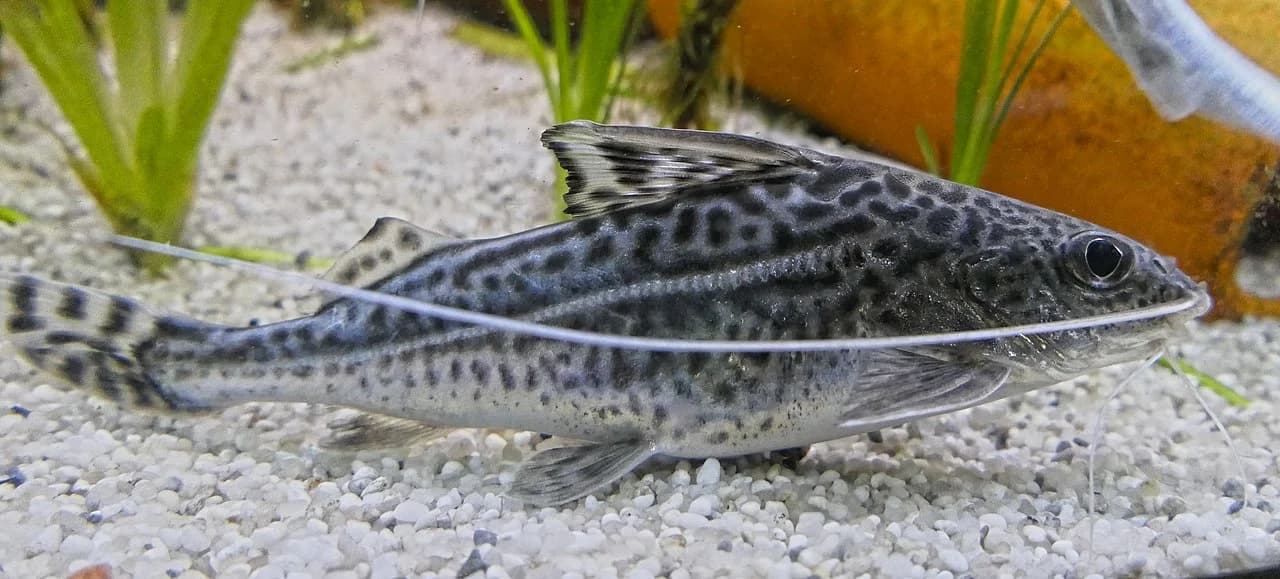
Pimelodus pictus is one of the most recognizable members of the Pimelodidae family, native to the Amazon and Orinoco river basins in South America. This catfish captivates aquarists with its elegant silver body adorned with contrasting black spots and long barbels that it uses to navigate murky waters. In an aquarium, the Pictus Catfish reaches a size of 10-15 cm and can live for 5-8 years with proper care.
Pimelodus pictus is a nocturnal species. During the day, it prefers to hide in shelters, but as dusk falls, it becomes extremely active, darting swiftly throughout the entire aquarium. This is a schooling fish, and in a group of 3-5 individuals, Pictus Catfish feel much more confident and display more natural behavior.
An important feature of this species is the sharp spines on its pectoral fins. These spines easily become entangled in nets, which can injure the fish. When catching a Pictus Catfish, always use a plastic container or cup — never a net.
Tank Requirements
Keeping a group of Pimelodus pictus requires an aquarium of at least 100 liters with good water flow. Optimal water parameters are: temperature 24-28°C, pH 6.0-7.5, and general hardness (GH) 5-15. Pictus Catfish need efficient filtration and aeration, as in the wild they inhabit clean, oxygen-rich waters.
Fine river sand makes the best substrate — it is safe for the fish's sensitive barbels. Coarse gravel can damage the barbels during digging, leading to infections. The aquarium should be equipped with plenty of hiding spots: driftwood, ceramic tubes, rock formations, and dense plant growth. At the same time, it is important to leave enough open swimming space, as Pictus Catfish are very active swimmers.
Subdued lighting is recommended, matching the species' nocturnal lifestyle. Floating plants help create shaded areas where the catfish will feel comfortable even during the day. A tight-fitting lid is essential — Pictus Catfish are capable of jumping out of the water.
Feeding and Diet
Pimelodus pictus is an omnivorous species with pronounced predatory tendencies. In the wild, it feeds on small fish, crustaceans, insects, and their larvae. In the aquarium, the staple diet can consist of sinking pellets and catfish wafers, supplemented with live and frozen foods: bloodworms, tubifex, brine shrimp, and glassworms.
It is best to feed Pictus Catfish in the evening, after the main lights are turned off, when they begin to become active. One feeding per day is sufficient. Avoid overfeeding — these catfish are prone to gluttony and can quickly gain excess weight. It is important to remember that a Pictus Catfish can swallow small fish up to 2-3 cm in length, so tiny tankmates such as neon tetras may be seen as food.
Care and Maintenance
Keeping Pimelodus pictus is not difficult even for beginner aquarists. The key is to maintain stable water parameters and perform weekly water changes of 20-25% of the total volume. Pictus Catfish are sensitive to elevated nitrate and ammonia levels, so regular water quality testing is essential.
These catfish are virtually scaleless, making them more susceptible to diseases and sensitive to medications, especially those containing copper. When treating the aquarium, use half doses of medication and carefully observe the fish's reaction.
Keep in mind the nocturnal activity of Pictus Catfish: if your aquarium is in a bedroom, be prepared for these catfish to move actively at night, sometimes creating noticeable noise. To observe their behavior, you can use a dim blue or red nightlight.
Compatibility
Pimelodus pictus is a peaceful species that is well suited for a community aquarium with medium-sized fish. Good tankmates include Corydoras, Bristlenose Plecos, medium and large tetras such as the Congo Tetra, as well as peaceful cichlids and appropriately sized barbs.
Avoid keeping Pictus Catfish with very small fish — neon tetras, celestial pearl danios, and fry, as they may be eaten. Also avoid adding large aggressive fish that will compete for hiding spots or attack the catfish.
The ideal setup is a group of 3-5 individuals. Solitary Pictus Catfish often become timid and spend most of their time hiding. In a school, they are much bolder and show themselves more frequently, especially during the evening hours.
Breeding
Breeding Pimelodus pictus in an aquarium is a challenging but achievable task. In the wild, spawning coincides with the rainy season, when water levels rise and the water chemistry changes. To stimulate spawning in an aquarium, simulate the rainy season: gradually lower the temperature by 2-3 degrees, then raise it to 27-28°C while simultaneously performing large water changes with soft water.
Pimelodus pictus is an egg-scattering species. The female disperses eggs among plants and decorations, after which the parents show no care for the offspring. Eggs and fry should be protected from being eaten by adult fish by moving the breeding pair back to the main tank after spawning. Fry begin feeding 3-4 days after hatching — newly hatched brine shrimp and microworms are suitable first foods.
The main difficulty in breeding lies in selecting a pair: sexual dimorphism in Pictus Catfish is poorly expressed. Females are generally slightly larger and fuller than males, especially before spawning. For successful breeding, it is recommended to keep a group of 6-8 individuals and provide them with a varied high-protein diet.