Overview
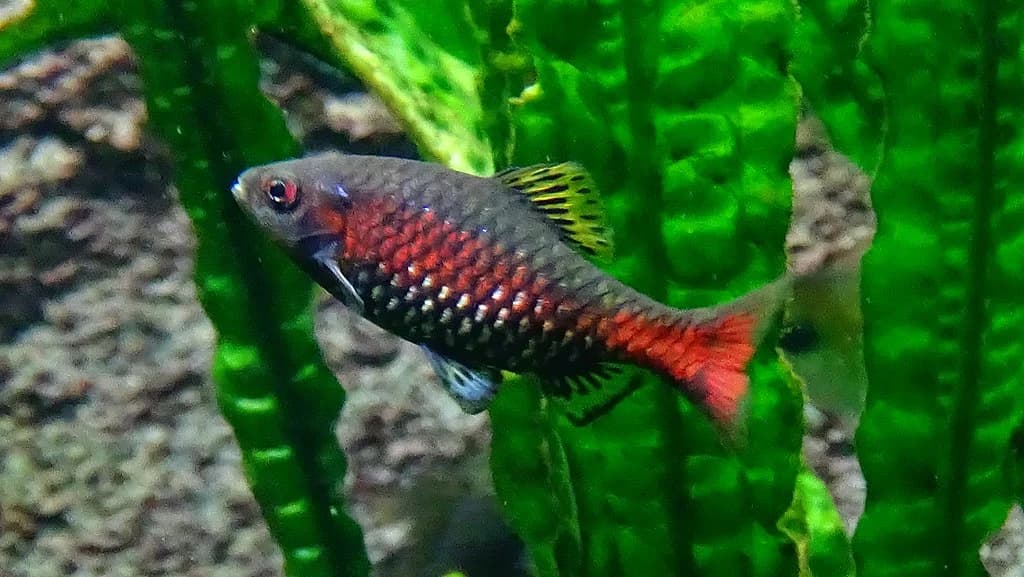
The Odessa Barb (Pethia padamya) is a small and strikingly beautiful freshwater fish from the Cyprinidae family, native to the rivers and streams of central Myanmar. Although the species was only formally described in 2008, it had been known in the aquarium hobby long before under the name "Odessa barb" — it is believed the fish entered the trade through aquarists in Odessa, Ukraine, during the 1970s.
Adults reach 5–7 cm in length and live 5–7 years with proper care. The males' most distinctive feature is a broad, vivid red stripe running along the entire body from head to tail, set against silvery-olive scales with dark speckling. Females are more modestly colored in golden-silver tones but remain attractive in their own right. The body is compact and slightly elongated, typical of the barb shape.
Pethia padamya is a diurnal, active, and schooling fish. In groups of 6 or more, the barbs display natural behavior: males engage in impressive "tournaments," competing with one another in color intensity. Keeping them in a school also reduces stress and makes the fish more confident.
How to Distinguish Males from Females?
Sexual dimorphism in Pethia padamya is clearly pronounced:
- Coloration: Males possess a vivid red-orange stripe along the body; females are pale yellowish without a distinct red stripe.
- Body shape: Females are larger and fuller, especially in the belly area. Males are slimmer and more compact.
- Color intensity: Males' coloration becomes especially vivid during breeding and when competing with other males.
Tank Requirements
A school of 6–8 Odessa Barbs requires an aquarium of at least 80 liters. The fish are active and need ample open swimming space, so elongated tanks are preferred.
Optimal water parameters:
- Temperature: 22–26°C
- pH: 6.0–7.5
- Hardness (dGH): 5–10
The aquarium layout should combine dense vegetation along the back and side walls with open space in the center. A dark substrate of fine gravel or sand will highlight the males' vibrant coloration. Add several pieces of driftwood and rocks for shelter. Floating plants help create soft, diffused lighting that approximates natural conditions. Filtration should be moderate, without strong current. A lid is essential, as barbs can jump out of the water when startled.
Feeding and Diet
Pethia padamya is an omnivorous species that presents no feeding challenges. The diet should consist of:
- High-quality flakes or small granules for tropical fish (daily staple)
- Frozen foods: brine shrimp, daphnia, bloodworms, cyclops
- Live foods: small bloodworms, daphnia, tubifex — excellent supplementary feeding, especially before breeding
- Vegetable supplements: blanched spinach, zucchini, spirulina tablets
Feed twice daily in small portions that the fish consume within 2–3 minutes. A varied diet with regular inclusion of live and frozen foods is the key to maintaining the males' intense red coloration. Carotenoids found in brine shrimp and cyclops are particularly beneficial for color enhancement.
Care and Maintenance
The Odessa Barb is an undemanding species with a care level of 2 out of 5, suitable even for beginning aquarists. Key recommendations:
- Water changes: 20–25% weekly
- Filtration: an internal or external filter with moderate flow
- Aeration: recommended to maintain optimal oxygen levels
- Lighting: moderate; under bright light, the males' red stripe appears especially striking
Regularly monitor ammonia and nitrite levels — both should remain at zero. Keep nitrate concentrations below 20 mg/l. Vacuum the substrate during each water change to remove food remnants and organic waste. Observe your fish closely: healthy Odessa Barbs are active, have good appetites, and display vivid coloration. Lethargy, color loss, or refusal to eat are early signs of trouble.
Compatibility
Pethia padamya is a peaceful and sociable species, well-suited for community aquariums. Unlike some other barbs, the Odessa Barb very rarely nips the fins of tank mates, making it one of the best candidates for a mixed community.
Excellent tank mates:
- Rosy Barb and Black Ruby Barb — related species with similar temperament
- Zebra Danio — active and fast, a great match in personality
- Neon Tetras and Cardinal Tetras — peaceful schooling tetras
- Harlequin Rasboras — calm and non-confrontational
- Panda Corydoras — peaceful bottom dwellers that complement the mid-level swimmers
- Black Skirt Tetra — an active tetra of suitable size
Avoid keeping with large or aggressive cichlids. Slow-moving, long-finned species such as Bettas are also not recommended as tank mates, although the risk of nipping from Odessa Barbs is minimal.
Breeding
Breeding Pethia padamya is a moderately challenging task, achievable for aquarists with basic experience. This is an egg-scattering species with no parental care.
To set up for spawning:
- A separate breeding tank of 20–30 liters
- Soft water at 24–26°C with a pH around 6.5
- Fine-leaved plants (Java moss, Cabomba) or a synthetic spawning mop
- A protective mesh over the bottom to prevent egg predation
For 1–2 weeks before the planned spawn, feed the breeding group generously with live foods to stimulate the maturation of reproductive products. In the evening, introduce a pair or a group (2 males to 1 female) into the breeding tank. Spawning typically occurs the following morning. The female deposits up to 150–200 semi-transparent eggs, which fall among the plants or under the mesh.
Immediately after spawning, remove the adults — they will actively consume their own eggs. Larvae hatch within 24–48 hours, and after 3–4 days the fry become free-swimming. Initial food should be infusoria and liquid fry food, followed by baby brine shrimp. By 2–3 months, the juveniles develop the species' characteristic coloration, with the males' red stripe appearing at around 4–5 months.