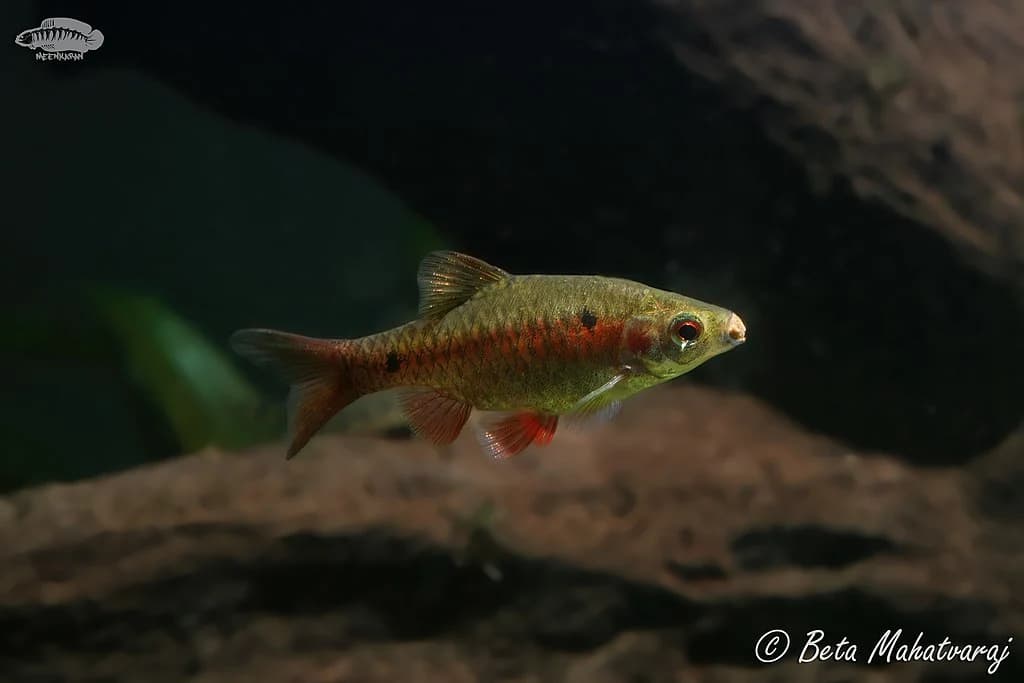
Overview
The Manipur Barb (Pethia manipurensis) is a small freshwater fish from the Cyprinidae family, endemic to the water bodies of Manipur state in northeastern India. While not yet as widely available in the hobby as its close relative the Rosy Barb, this species deserves attention for its peaceful temperament, compact size, and undemanding care requirements.
Adults reach 4–5 cm in length and live 3–5 years with proper care. The body is moderately elongated, typical of small barbs, with a silvery-olive base tone and characteristic dark markings. In a well-decorated aquarium with subdued lighting, the fish display noticeably more vivid and expressive coloration.
Pethia manipurensis is a diurnal schooling species. The fish are active during daylight hours, constantly on the move, and prefer to stay together as a group in the middle water layers. Keeping them in a school of 8–10 individuals allows observation of natural social behavior: males display their colors to one another, and the entire group feels significantly more confident.
How to Distinguish Males from Females?
Sexual dimorphism is moderate:
- Coloration: Males are brighter, especially during spawning — their pattern becomes more contrasting with more saturated tones.
- Body shape: Females are slightly larger and plumper, with a rounded belly that becomes particularly noticeable when carrying eggs.
- Size: Males tend to be slightly slimmer and smaller than females.
Tank Requirements
A school of 8–10 Manipur Barbs will do well in an aquarium of at least 50 liters (approximately 13 gallons). Thanks to their small size, this species is perfectly suited for nano tanks and planted aquariums.
Optimal water parameters:
- Temperature: 22–26°C (72–79°F)
- pH: 6.0–7.5
- Hardness (dGH): 4–15
For the aquascape, I recommend using dense vegetation — Java moss, Cryptocorynes, Anubias — combined with open swimming space. Dark, fine-grained substrate enhances the fish's coloration. Driftwood and Indian almond leaves create soft, slightly acidic water that approximates their natural habitat. Filter flow should be gentle — Manipur Barbs do not appreciate strong currents. A lid or cover glass is essential, as small barbs are prone to jumping.
Feeding and Diet
Pethia manipurensis is an omnivorous species that presents no feeding challenges. The diet should include:
- High-quality micro-granules or small flakes for tropical fish (daily staple)
- Frozen foods: brine shrimp, daphnia, cyclops, small bloodworms
- Live foods: baby brine shrimp, micro worms, daphnia — excellent supplementary feeding for maintaining health and vibrant coloration
- Vegetable supplements: spirulina tablets, blanched spinach
Feed twice daily in small portions that the fish consume within 1–2 minutes. Given the small size of these fish, it is important to select appropriately sized food — overly large granules will be too big for their mouths. Dietary variety is the key to vivid coloration and a strong immune system.
Care and Maintenance
The Manipur Barb is one of the least demanding species in the Pethia genus, making it an excellent choice for beginner aquarists. Key care recommendations:
- Water changes: 20–25% weekly
- Filtration: a small internal or hang-on-back filter with gentle flow
- Aeration: recommended, especially in densely planted tanks at night
- Lighting: moderate; subdued light helps the fish feel more comfortable and display brighter coloration
Despite their hardiness, strive to maintain stable water parameters. Regularly test ammonia and nitrite levels and vacuum the substrate promptly. Manipur Barbs are sensitive to sudden parameter swings, so use aged or conditioned water at the same temperature when performing water changes.
Compatibility
Pethia manipurensis is one of the most peaceful barbs available, which sets it apart from its more boisterous relatives. It almost never shows aggression and does not nip the fins of tank mates, making it safe to keep alongside even the most delicate species.
Ideal tank mates:
- Black Ruby Barb and Padamya Barb — related species with similar temperament
- Harlequin Rasbora and Hengel's Rasbora — calm schooling fish
- Neon Tetra and Cardinal Tetra — classic peaceful tetras
- Panda Corydoras and Pygmy Corydoras — ideal bottom-dwelling companions
- Celestial Pearl Danio — another miniature and peaceful species
Avoid keeping with large or aggressive species that may view the small barbs as food. Also avoid housing them with overly active fish that could stress this calm species.
Breeding
Breeding Pethia manipurensis at home is achievable, though it requires some effort. This is a typical egg-scattering species that provides no parental care.
To set up for spawning:
- A separate breeding tank of 15–20 liters (4–5 gallons)
- Temperature of 24–26°C (75–79°F) — a couple of degrees above the usual range
- Soft water with a pH around 6.5
- Fine-leaved plants (Java moss, Cabomba) or synthetic spawning mops as spawning substrate
- A protective mesh over the bottom to prevent egg predation
For 7–10 days before spawning, feed the breeders generously with live foods to stimulate gonad maturation. In the evening, place a pair or a small group (2 males and 3–4 females) into the breeding tank. Spawning typically occurs in the morning with the first light.
After spawning, immediately remove the adults — they will actively eat their own eggs. Incubation takes 24–48 hours. Fry become free-swimming 2–3 days after hatching. Initial food should be infusoria and liquid fry food; after 5–7 days, baby brine shrimp can be offered. Growth is relatively slow, but with regular feeding and clean water, the fry reach 1.5–2 cm within 2–3 months.