Overview
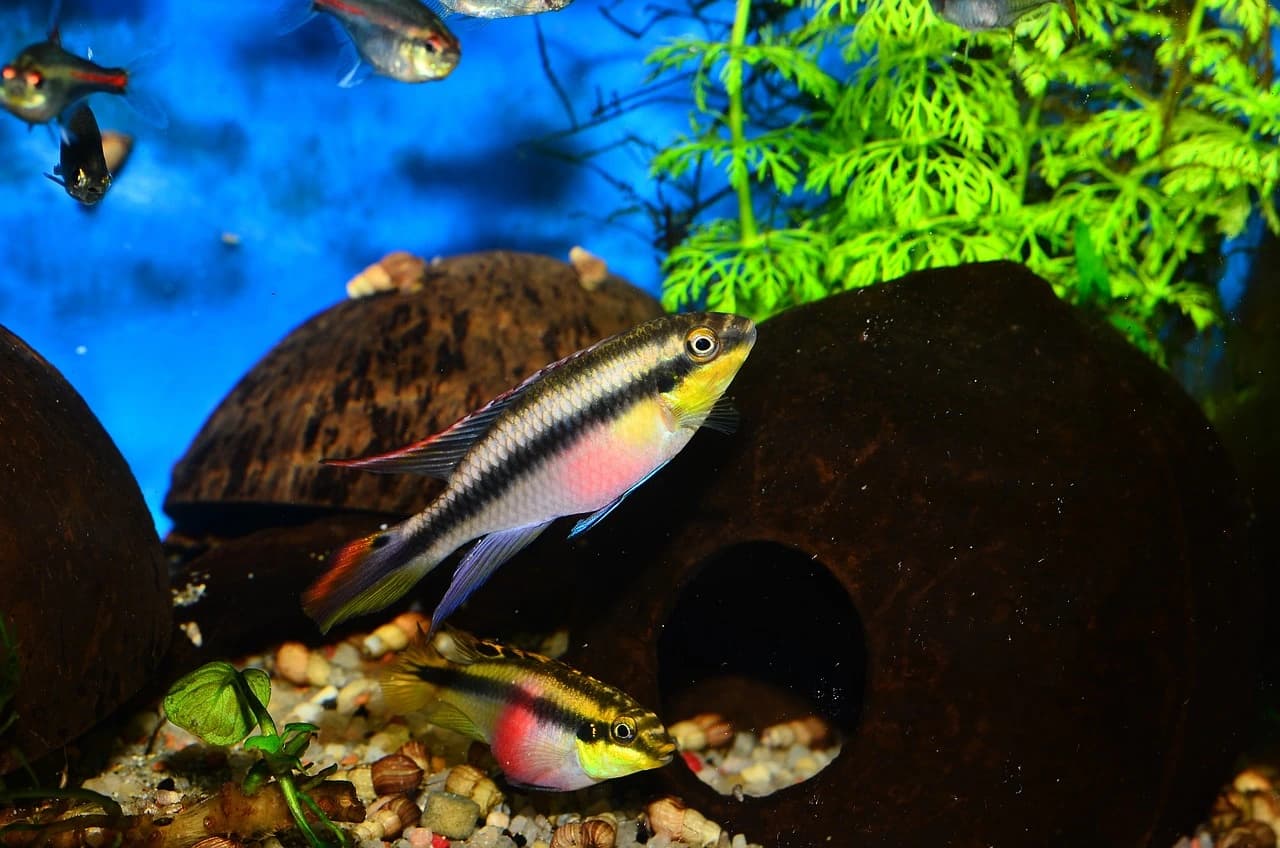
The Kribensis (Pelvicachromis pulcher) is one of the most popular dwarf cichlids in the aquarium hobby. Native to the rivers and streams of Nigeria and Cameroon, this fish has earned widespread admiration for its vibrant coloration, fascinating behavior, and relatively undemanding care requirements. Males reach 8-10 cm in length and display an elongated body with shimmering bluish-violet flanks. Females are slightly smaller but are the true showstoppers — during breeding season, their belly turns a deep cherry-red, earning the species the nickname "rainbow krib."
In the wild, Pelvicachromis pulcher inhabits slow-moving rivers with soft, slightly acidic water, dense vegetation, and abundant hiding spots among roots and rocks. This species is closely related to Pelvicachromis kribensis, with which it is often confused, though they are distinct species. With proper care, these fish live for 5-7 years.
Tank Requirements
A pair of Pelvicachromis pulcher requires an aquarium of at least 100 liters. Optimal water parameters are: temperature 24-28°C, hardness 6-15 GH, and pH 6.0-7.5. These fish adapt well to a wide range of conditions, making them an excellent choice for beginners.
Fine substrate is preferable — sand or small gravel — as these fish enjoy digging. Hiding spots are essential: ceramic pots, coconut shell halves, rock caves, or dedicated spawning tubes. These shelters will serve as breeding sites where the pair raises their offspring. Live plants are welcome, providing natural shade and additional cover. Anubias, Java moss, and cryptocorynes work particularly well, as they can withstand the occasional uprooting.
Filtration should be efficient but gentle — in nature, these fish prefer calm stretches of rivers. Weekly water changes of 20-25% will help maintain stable water quality.
Feeding and Diet
Pelvicachromis pulcher is an omnivorous species with a hearty appetite. The base diet can consist of high-quality dry cichlid food in pellet or flake form. However, to maintain optimal health and vibrant coloration, the diet should be regularly supplemented with live and frozen foods: bloodworms, brine shrimp, daphnia, and tubifex worms.
From personal experience, a varied diet with an emphasis on live foods produces the most intense coloration, particularly in females preparing to spawn. A vegetable component can be provided through spirulina-based foods or blanched spinach leaves.
Adult fish should be fed 1-2 times daily in small portions that are consumed within 2-3 minutes. Overfeeding should be avoided, as it can lead to obesity and health issues.
Care and Maintenance
Keeping Kribensis requires minimal effort, making them one of the best cichlids for beginning aquarists. Weekly water changes (20-25%), parameter monitoring, and regular gravel vacuuming are the core maintenance routines.
These fish are quite disease-resistant when kept in stable conditions. The key is to avoid sudden fluctuations in water parameters, especially temperature and pH. Always quarantine newly purchased fish — this will protect your established aquarium from potential infections.
It is worth noting that Kribensis are active diggers. They may uproot poorly anchored plants and rearrange the landscape around their chosen shelter. This is normal behavior associated with territory preparation for spawning. Plants are best secured in pots or attached to rocks and driftwood.
Compatibility
Pelvicachromis pulcher is a relatively peaceful cichlid that works well in community aquariums. Outside of breeding periods, their territorial behavior is moderate and typically limited to defending the immediate area around their shelter.
Good tank mates include:
- Corydoras catfish and other bottom dwellers — they occupy a different water layer and avoid conflict
- Congo tetras — excellent companions for the mid and upper water columns
- Bristlenose plecos — peaceful algae eaters that do not compete for territory
- Rasboras and small barbs — active fish for the mid and upper water layers
Avoid keeping them with large aggressive cichlids or very small fish that may be perceived as prey. During spawning, the pair becomes noticeably more aggressive, actively defending eggs and fry, so in smaller tanks it is best to keep only a single pair.
Breeding
Breeding Pelvicachromis pulcher is one of the most rewarding experiences in the aquarium hobby, accessible even to beginners. These are cave-spawning cichlids: the female lays her eggs on the ceiling of a cave or shelter, after which both parents care for the clutch.
To stimulate spawning, raise the temperature to 26-28°C and provide the pair with a suitable shelter — a ceramic pot, an inverted coconut shell with an entrance hole, or a dedicated spawning cave. A female ready to breed develops an intensely red belly and actively displays to the male, arching her body and vibrating.
The female lays 100-300 eggs on the ceiling of the shelter and remains inside, fanning the clutch with her fins and removing unfertilized eggs. The male patrols the territory outside, driving away any intruders. Incubation takes approximately 3-4 days, and after another 5-7 days the fry become free-swimming.
One of the most endearing sights in fishkeeping is the parental pair escorting their cloud of fry around the aquarium. Both parents actively protect their offspring, and the fry obediently follow them in a tight group. First foods should be baby brine shrimp (artemia nauplii) and microworms. With good feeding, the fry grow quickly and begin developing adult coloration by 3-4 months of age.