Overview
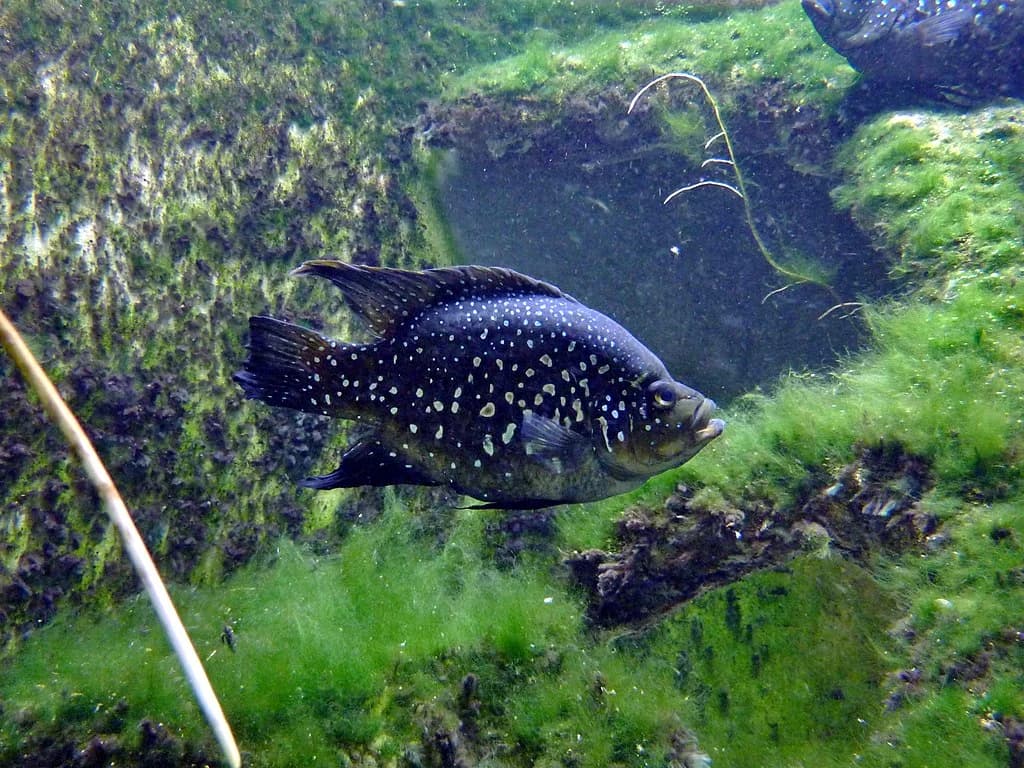
Paratilapia polleni, known among aquarists as the polleni cichlid or starry night cichlid, is one of the most visually striking freshwater fish available in the hobby. This endemic species from the island of Madagascar belongs to the family Cichlidae and is rightfully considered a gem among cichlids thanks to its unmistakable appearance: a dark, nearly black body densely covered with bright pearlescent spots reminiscent of a starry sky. Under certain lighting, the scales take on a deep blue or violet sheen.
In the wild, Paratilapia polleni inhabits rivers and lakes of northwestern Madagascar, preferring areas with rocky substrates and moderate current. Adults reach an impressive 15–30 cm in length, with males typically being larger than females and displaying more intense coloration. Life expectancy in an aquarium is 10–12 years with proper care.
It is worth noting that this species is endangered in the wild due to habitat destruction and the introduction of invasive species. Keeping Paratilapia polleni in aquariums contributes to preserving the gene pool of this remarkable species.
Tank Requirements
Keeping Paratilapia polleni requires a spacious aquarium of at least 300 liters. For a pair or a community setup, a tank of 400–500 liters or more is preferable, as this significantly reduces territorial conflicts.
Optimal water parameters:
- Temperature: 23–27 °C
- pH: 6.5–7.5
- Hardness (GH): 5–15
Fine sand or smooth gravel works best as substrate, as these fish enjoy digging through it in search of food. The aquarium should be decorated with large rocks, driftwood, and caves to create natural shelters and visual barriers for territory division. Live plants are difficult to maintain since cichlids tend to uproot them, but hardy species attached to rocks (such as Anubias) can survive.
Filtration must be powerful — an external canister filter rated at 4–6 times the tank volume per hour is the optimal choice. Weekly water changes of 25–30% are mandatory, as large cichlids produce a significant biological load.
Feeding and Diet
Paratilapia polleni is a predator with a predominantly carnivorous diet. In the wild, its diet consists mainly of small fish, crustaceans, and aquatic insects.
In the aquarium, the diet should be varied:
- Staple (60–70%): high-quality pellets for large cichlids with high protein content
- Live and frozen foods (25–30%): bloodworms, shrimp, krill, mussels, fish fillet
- Vegetable supplement (5–10%): blanched spinach, peas, spirulina
Adult fish should be fed once or twice daily in portions they can consume within 3–5 minutes. One fasting day per week benefits digestion. Juveniles should be fed more frequently — three to four times daily in small portions to promote growth.
In my experience, polleni readily accept food from the surface and mid-water, but become particularly animated at the sight of live food — their hunting instinct is remarkably strong.
Care and Maintenance
The care level for Paratilapia polleni is rated as moderate, though there are several nuances worth keeping in mind.
These fish are sensitive to water quality, so regular parameter testing is an essential part of their care routine. Pay particular attention to ammonia and nitrite levels, which must remain at zero, while nitrates should not exceed 20–30 mg/L.
Water changes should be performed weekly at 25–30% volume. It is important that fresh water closely matches the tank water in temperature and pH — sudden parameter shifts cause stress.
Paratilapia polleni are active daytime fish. They are curious, quickly become accustomed to their owner, and over time learn to recognize the person who feeds them. This makes them truly interactive pets. However, caution is needed during tank maintenance — large specimens can bite, especially during spawning periods.
Pay attention to lighting — moderate light with shaded areas highlights the fish's starry coloration and creates comfortable conditions. A secure lid on the aquarium is essential, as excited fish are capable of jumping out of the water.
Compatibility
Paratilapia polleni has a semi-aggressive temperament that intensifies with age and especially during breeding. Selecting tank mates requires a thoughtful approach.
Suitable tank mates:
- Large cichlids with a similar temperament — oscar, severum, red terror cichlid
- Large catfish — featherfin squeaker, sailfin pleco
- Jaguar cichlid — provided the tank is large enough
Unsuitable tank mates:
- Small and peaceful fish (they will be seen as prey)
- Overly aggressive species that could dominate the polleni
- Fish with similar coloration that may provoke conflicts
The ideal scenario is keeping a pair of Paratilapia polleni in a species-only tank. If a community setup is planned, the tank volume should be at least 500–600 liters with plenty of hiding spots and visual barriers.
Breeding
Breeding Paratilapia polleni is a challenging endeavor (difficulty rated as hard), but entirely achievable under the right conditions.
Sexual dimorphism is subtle: males are slightly larger and have more elongated fins. To form a pair, it is best to raise a group of 5–6 juveniles and allow them to choose their own partner naturally.
To stimulate spawning:
- Raise the temperature to 26–27 °C
- Increase aeration
- Provide flat rocks or ceramic tiles as spawning substrate
- Increase the frequency of water changes with smaller volumes (10–15% every 2–3 days)
The female deposits 200–500 eggs on a prepared flat surface. Both parents actively tend to the clutch, fanning the eggs with their fins and removing unfertilized ones. During this period, the pair's aggression increases sharply — all tank mates should be removed or separated with a divider.
The larvae hatch after 3–4 days and begin free-swimming after another 5–7 days. First foods include baby brine shrimp, microworms, and finely crushed flakes. The parents continue to guard the fry for several weeks, which is one of the most fascinating spectacles in the aquarium hobby.
It is important to note that a pair that has successfully spawned usually maintains their bond for a long time, and subsequent spawnings become easier.