Overview
Paracheirodon simulans, commonly known as the Green Neon Tetra, is the smallest member of the Paracheirodon genus, reaching only 2.5–3 cm in length. Unlike its larger relatives — the Neon Tetra and the Cardinal Tetra — this species is a true endemic of the blackwater biotopes of the upper Rio Negro and Orinoco basins, where the water is stained deep brown by tannins and the pH can drop below 5.0.
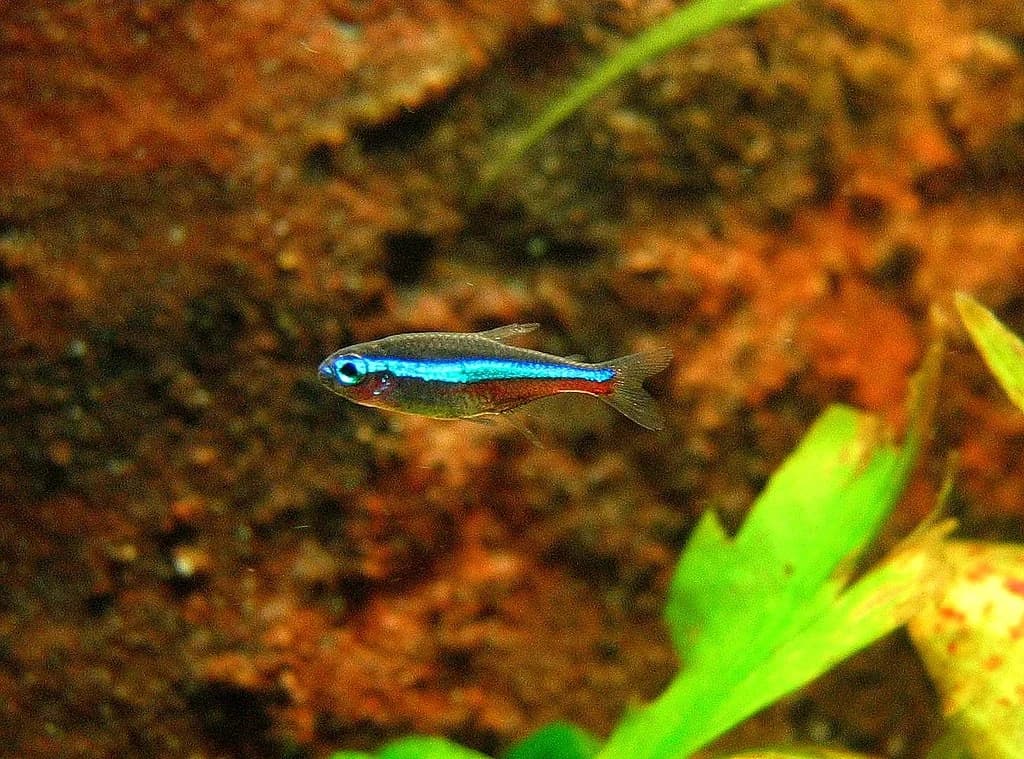
The key visual distinction of the Green Neon Tetra from its cousins is the dominant green-blue iridescent stripe that runs from the eye to the caudal peduncle, covering a much larger portion of the body relative to the red zone. In the Neon Tetra and the Cardinal Tetra, the red coloration is far more prominent, whereas in P. simulans it is the shimmering green-blue glow that defines the fish's appearance. This creates a mesmerizing flickering effect in a school, particularly prized by blackwater biotope enthusiasts.
In the wild, Green Neon Tetras inhabit vast shoals among submerged vegetation and leaf litter. On the global market, the majority of specimens remain wild-caught, as commercial breeding of this species is extremely limited.
Tank Requirements
A tank of at least 40 liters is required for a school of Paracheirodon simulans. The essential requirement is replicating blackwater biotope conditions. Water temperature should be maintained between 23–28 °C, pH between 5.0–6.5, and general hardness (GH) between 1–8 dGH. This is significantly more acidic and softer water than most aquarium fish require, and this parameter is critical for the species' health.
The tank should feature dark substrate with abundant driftwood and Indian almond, oak, or beech leaves to release tannins. Lighting must be subdued — bright light causes stress and leads to color loss. Peat filtration or the addition of blackwater conditioners helps achieve the correct water chemistry. Water flow should be minimal, mimicking their natural biotope.
Feeding and Diet
Paracheirodon simulans is an omnivorous species with a very small mouth, which must be considered when selecting food. The staple diet should consist of high-quality micro-pellets and flakes crushed to an appropriate size. The diet must be supplemented with live and frozen foods: baby brine shrimp, daphnia, micro-worms, and cyclops.
In the wild, Green Neon Tetras feed primarily on small invertebrates and zooplankton. Live foods not only support the fish's health but also significantly enhance the intensity of the iridescent green-blue stripe. Feed small portions 2–3 times daily, ensuring all food is consumed within a few minutes.
Care and Maintenance
Despite a relatively moderate base care level, Paracheirodon simulans is demanding when it comes to water parameter stability. Weekly water changes of 15–20% should be performed using water prepared to match the same acidity and hardness parameters. Sudden fluctuations in pH or temperature can be fatal for this species.
Green Neon Tetras should be kept in schools of at least 10–15 individuals — in smaller groups they experience stress, becoming pale and skittish. In a large school, the fish display their natural behavior, swimming actively in the middle water layers and showing their best coloration. Test water parameters regularly — even a slight increase in hardness or pH can lead to declining health.
Compatibility
Paracheirodon simulans is one of the most peaceful species in the hobby, ideally suited for a blackwater biotope aquarium. The best tankmates are other small fish that prefer soft, acidic water: small rasboras, dwarf corydoras (such as Corydoras pygmaeus or Corydoras habrosus), otocinclus, and dwarf cichlids of the Apistogramma genus.
Due to their extremely small size, Green Neon Tetras should not be kept with any large or moderately aggressive fish. Even peaceful species that significantly exceed them in size may be perceived as a threat. Fish requiring hard alkaline water are categorically unsuitable — the incompatibility in water chemistry makes cohabitation impossible.
Breeding
Breeding Paracheirodon simulans in captivity is a serious challenge even for experienced aquarists. The breeding difficulty is substantially higher than that of the Neon Tetra or the Cardinal Tetra. Spawning requires a separate tank with extremely soft water (GH below 2, pH 5.0–5.5) and near-total darkness.
The temperature is raised to 26–28 °C, and fine-leaved plants or synthetic spawning mops serve as the spawning substrate. The eggs are extremely sensitive to light and bacterial infections, so the tank must be darkened and the water treated with methylene blue. The parents show no brood care and will actively consume eggs, so they must be removed immediately after spawning.
Larvae hatch within 24–36 hours, and fry become free-swimming on day 3–4. First food should be infusoria and micro-worms, transitioning to baby brine shrimp after one to two weeks. Fry growth is slow, and this stage is the most critical — high juvenile mortality explains why the species is rarely bred commercially, and the majority of fish on the market remain wild-caught.