Overview
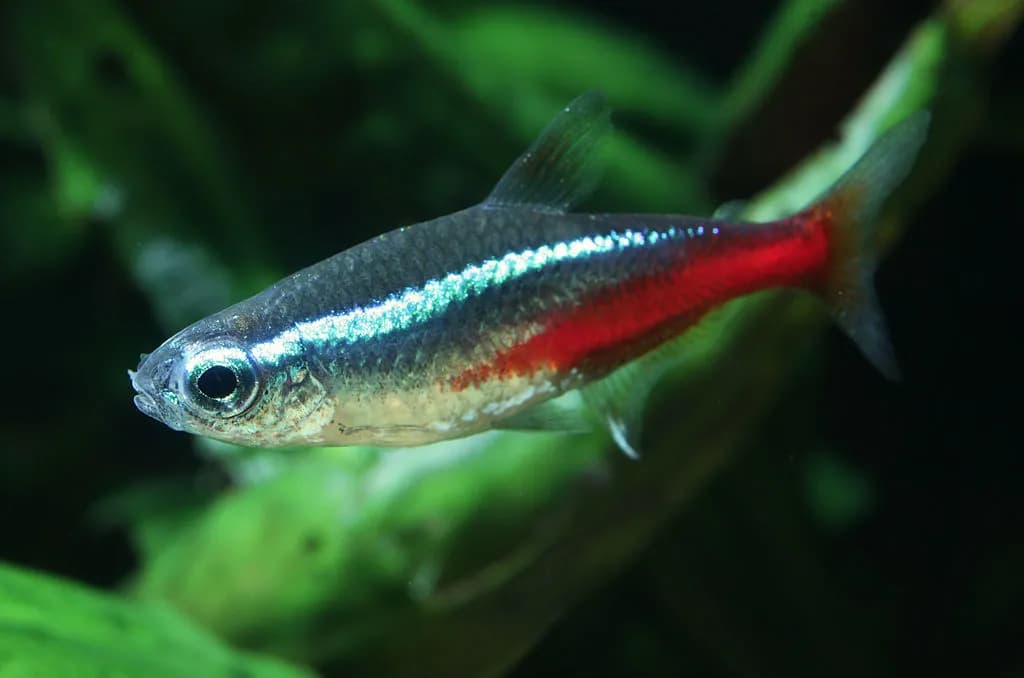
The Neon Tetra (Paracheirodon innesi) is one of the most famous and recognizable aquarium fish in the world. This small member of the Characidae family was first discovered in 1936 in the waters of the Peruvian Amazon and named after American ichthyologist and publisher William Thornton Innes. Since its introduction to the aquarium hobby, the Neon Tetra has captured the hearts of millions of enthusiasts worldwide and is rightfully considered an icon of freshwater fishkeeping.
In the wild, Paracheirodon innesi inhabits slow-moving tributaries of the Amazon with soft, slightly acidic water stained by tannins from fallen leaves. The fish reaches a size of 3-4 cm and features a distinctive bright blue neon stripe running from the eye to the adipose fin, along with a red stripe on the rear half of the body. This is precisely what distinguishes the Neon Tetra from the Cardinal Tetra, which has a red stripe extending the full length of its body, and from the Green Neon Tetra, which has more subdued coloration.
Neon Tetras are schooling fish that truly reveal their beauty in groups of 10 or more. A school of neons moving in unison through subdued lighting among lush greenery creates a truly mesmerizing spectacle.
Tank Requirements
A tank with a minimum volume of 40 liters is suitable for keeping a school of Neon Tetras. The optimal water temperature is 20-26°C — it is worth noting that this species tolerates cooler water compared to many other tropical fish. The water should be soft (GH 1-8) and slightly acidic (pH 6.0-7.0), matching the conditions of their natural Amazonian biotopes.
The aquarium should be equipped with subdued lighting, a dark substrate, and an abundance of live plants — such conditions not only replicate the natural habitat but also accentuate the fish's neon coloration. Floating plants that create shaded areas work particularly well. Filtration should be gentle, without strong current. Driftwood and fallen Indian almond or oak leaves will add tannins to the water, creating conditions as close to natural as possible.
Feeding and Diet
The Neon Tetra is an omnivorous fish with a small mouth. In nature, the diet of Paracheirodon innesi consists of small invertebrates, insect larvae, and plant microparticles. In the aquarium, high-quality flakes or micro-pellets sized appropriately for small characins can serve as the staple diet.
To maintain vibrant coloration and robust health, the diet should be supplemented with live or frozen foods: brine shrimp nauplii, daphnia, cyclops, and small bloodworms. Feeding 2-3 times daily in small portions that the fish consume within 2-3 minutes is recommended. Overfeeding is one of the most common mistakes among beginner aquarists and can lead to deteriorating water quality.
Care and Maintenance
The Neon Tetra is one of the most undemanding aquarium fish, making it an ideal choice for beginner aquarists. The foundation of successful care lies in maintaining stable water parameters. Weekly water changes of 20-25% will help maintain cleanliness and consistency of water chemistry. It is important to avoid sudden fluctuations in temperature and pH, to which neons are sensitive.
Special attention should be given to the so-called Neon Tetra Disease (pleistophorosis), caused by the parasite Pleistophora hyphessobryconis. This disease was first described in Neon Tetras and named after them. Affected fish lose their coloration, become pale, lose weight, and separate from the school. Unfortunately, no effective treatment exists, making quarantine of new fish and purchasing neons only from reputable suppliers the most important preventive measures.
With proper care, Neon Tetras can live 5-10 years, which is a remarkably impressive lifespan for such a small fish.
Compatibility
The Neon Tetra has an exceptionally peaceful temperament and is perfectly suited for community tanks. Neons should be kept in schools of at least 10 individuals — in a larger group, the fish feel more confident, experience less stress, and display natural schooling behavior.
Ideal tankmates include other small, peaceful fish: harlequin rasboras, flame tetras, glowlight tetras, pygmy corydoras, and other bottom-dwelling fish. Neons also coexist well with peaceful dwarf cichlids, provided the aquarium is of sufficient size. Large or aggressive species are categorically unsuitable as tankmates — angelfish, barbs, and other fish that may perceive neons as prey.
Breeding
Breeding Neon Tetras in a home aquarium is possible but requires some experience and preparation. A separate spawning tank of 10-20 liters with very soft water (GH up to 2) and a pH of 5.5-6.0 is used for breeding. The temperature is raised to 24-25°C. The tank must be darkened, as Paracheirodon innesi eggs are sensitive to light.
Fine-leaved plants or a spawning grid are placed on the bottom. The breeders are introduced in the evening, with spawning typically occurring at dawn. After spawning, the adults must be removed immediately, as they are prone to eating the eggs. The eggs are transparent, very small, and incubation lasts 24-36 hours. The fry become free-swimming on days 4-5, after which they can be fed infusoria and brine shrimp nauplii.
The difficulty of breeding stems from the high requirements for water softness and the need to carefully control lighting and cleanliness in the spawning tank.