Overview
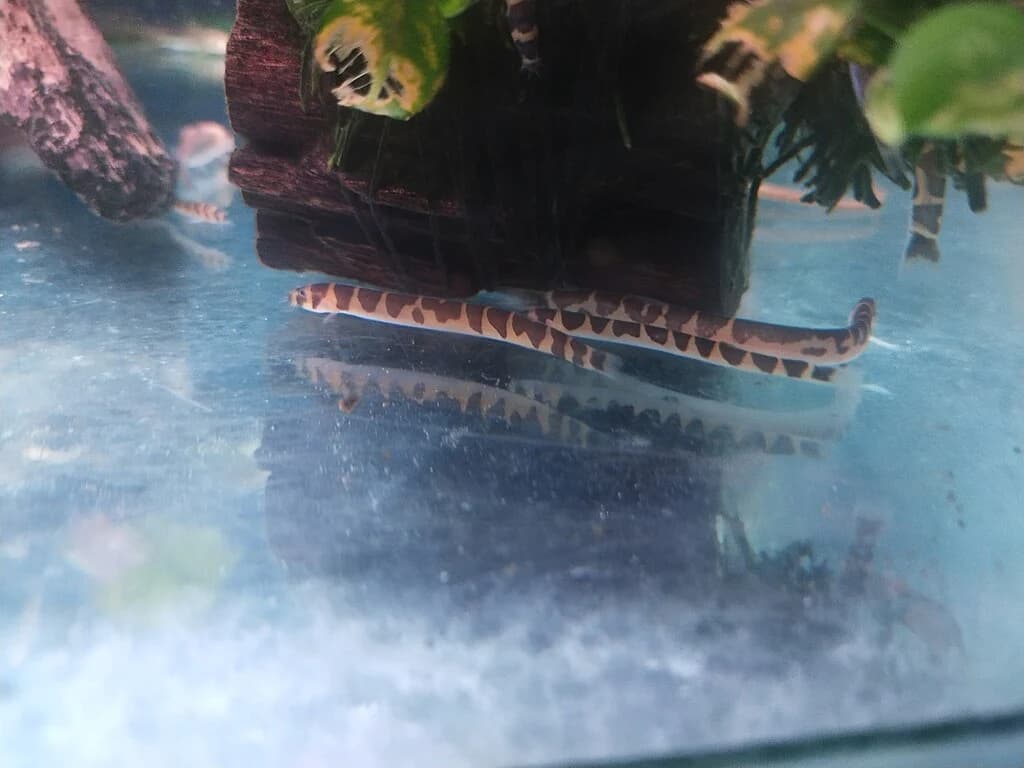
Pangio semicincta is a small freshwater loach belonging to the family Cobitidae, native to waterways of Southeast Asia — specifically the Malay Peninsula, Sumatra, and Borneo. This fish reaches a size of 6–8 cm and has a characteristic elongated, eel-like body. Its base coloration is a warm yellow-orange adorned with dark brown or black transverse bands. The key distinguishing feature of Pangio semicincta from the closely related Kuhli Loach is that the dark bands do not encircle the body completely but only cover the upper half — this is precisely why the species is called "half-banded" (semicincta meaning "half-girdled"). These two species are frequently confused in the aquarium trade, so it is worth carefully examining the banding pattern when purchasing.
Pangio semicincta is a nocturnal species that prefers to hide among plants, driftwood, and within soft substrate during the day. As dusk falls, the fish become active and begin scouring the bottom in search of food. This is a social species that should be kept in groups of at least 5 — in the company of conspecifics, the loaches feel more confident and are more likely to be visible. With proper care, their lifespan in an aquarium ranges from 5 to 10 years.
Tank Requirements
A group of Pangio semicincta requires an aquarium with a minimum volume of 60 liters. Optimal water parameters are: temperature 24–28 °C, pH 6.0–7.5, and general hardness (GH) 5–12. A soft sandy substrate is essential — these loaches actively burrow into the bottom, and sharp gravel particles can injure their delicate body and sensitive barbels.
The aquarium should be densely planted and equipped with plenty of hiding spots made from driftwood, rocks, and ceramic tubes. Subdued lighting will help replicate conditions similar to their natural shaded streams and reduce stress levels. It is critically important to have a tightly fitting lid — Pangio semicincta are notorious escape artists capable of squeezing through the smallest gaps. Filter intakes should also be covered with fine mesh or sponge to prevent the small loaches from being drawn inside.
Feeding and Diet
In the wild, Pangio semicincta feeds on small invertebrates, insect larvae, and organic detritus found in bottom sediments. In the aquarium, the staple diet should consist of high-quality sinking pellets and wafers designed for bottom-dwelling fish. The diet should be supplemented with live or frozen foods such as bloodworms, brine shrimp, daphnia, and tubifex worms.
Since this is a nocturnal species, feeding is best done in the evening, shortly before lights out, or even in complete darkness. This ensures the food reaches the loaches rather than being consumed by more active daytime inhabitants. It is important that the food sinks to the bottom — this is where Pangio semicincta searches for it, meticulously combing through the substrate with their sensitive barbels.
Care and Maintenance
Pangio semicincta is a relatively undemanding species with a care level of 2 out of 5, but several important guidelines must be followed to keep the fish healthy. Weekly water changes of 20–25% will help maintain stable water quality. Test water parameters regularly, paying special attention to ammonia and nitrite levels, to which loaches are particularly sensitive.
The sandy substrate requires occasional light vacuuming, but this should be done carefully to avoid disturbing burrowed fish. Always count your loaches during tank maintenance — their secretive lifestyle makes it easy to overlook a missing individual. Pay attention to skin condition: like other scaleless fish, Pangio semicincta are sensitive to medications containing copper and formalin, so half-doses should be used when treating diseases in the community tank.
Compatibility
Pangio semicincta is a peaceful species with an aggression level of 2 out of 5 that is well suited for community aquariums. Ideal tank mates are small, peaceful fish inhabiting the middle and upper water layers: neon tetras, harlequin rasboras, and ember tetras. They also coexist well with other peaceful bottom dwellers such as corydoras and other Pangio species, including the Kuhli Loach.
Pangio semicincta must be kept in groups of no fewer than 5 individuals. When kept alone or in pairs, the loaches become extremely shy and rarely emerge from hiding. In a group, however, they display fascinating social behavior, often piling together in a single hiding spot. Avoid housing them with large or aggressive species such as large cichlids, which may view the small loaches as prey.
Breeding
Breeding Pangio semicincta in captivity is a challenging endeavor (difficulty level 4 out of 5), and successful spawning in home aquariums is extremely rare. These loaches are egg scatterers and do not exhibit any parental care.
To stimulate spawning, it is recommended to raise the water temperature to the upper end of the acceptable range (26–28 °C), soften the water, and provide an abundance of fine-leaved plants or spawning mops where the female can deposit her eggs. Spawning is sometimes triggered by simulating the rainy season — performing a large water change with soft, cool water. After spawning, the adults must be removed, as they will eat the eggs. The fry hatch within a few days and initially feed on infusoria and microworms before transitioning to newly hatched brine shrimp.