Overview
Pangio kuhlii, commonly known as the Kuhli Loach, Coolie Loach, or Leopard Loach, is a small bottom-dwelling fish from the family Nemacheilidae, native to the waterways of Southeast Asia. Its natural range spans the rivers and streams of Java, Sumatra, Borneo, and the Malay Peninsula, where it inhabits shallow areas with slow currents and soft substrates.
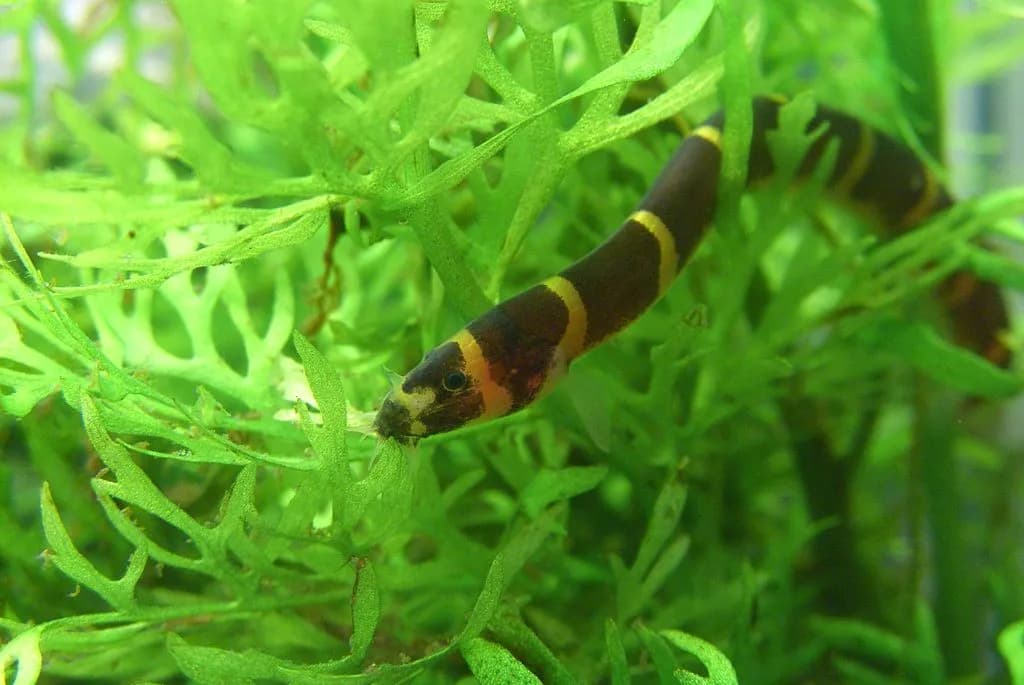
The Kuhli Loach has a distinctive eel-like, highly elongated body that reaches 2.5–3.5 cm in length. Its base coloration is orange-brown with contrasting dark brown or black transverse bands, making this fish easily recognizable. In an aquarium, it can live for 2–3 years with proper care.
By temperament, Pangio kuhlii is a very peaceful and calm fish that is primarily nocturnal or crepuscular, showing peak activity during dawn, dusk, and nighttime hours. This is a social species, so Kuhli Loaches should be kept in groups of 6 or more — in a school they feel more confident and display more interesting behavior.
Tank Requirements
A group of Kuhli Loaches requires an aquarium with a minimum volume of 30 liters. The water temperature should be maintained between 20–28 °C, the pH level at 6.5–7.5, and the general hardness (GH) within 4–12. Stability of water parameters is of great importance for the health of these fish.
The most critical element of the tank setup is the substrate. Kuhli Loaches are burrowing fish that love to dig into the substrate, so fine soft sand is essential. Coarse gravel or substrates with sharp edges can injure the fish's delicate body. The aquarium should be furnished with plenty of hiding spots — driftwood, rocks, dense plant growth, and ceramic tubes. Subdued lighting will help the fish feel more comfortable and encourage them to come out into the open more often.
Special attention should be paid to aquarium security. Kuhli Loaches can squeeze through extremely narrow gaps, so the tank must be equipped with a tightly fitting lid. Filter intakes should also be covered with fine mesh or sponge to prevent the fish from getting trapped inside the equipment.
Feeding and Diet
In the wild, Pangio kuhlii feeds on small invertebrates, worms, insect larvae, and organic debris found in the bottom substrate. In the aquarium, the diet should be varied and include both dry and live or frozen foods.
The staple diet can consist of high-quality sinking pellets and tablets designed for bottom-dwelling fish. The diet should be regularly supplemented with frozen or live bloodworms, tubifex, brine shrimp, and daphnia. Since Kuhli Loaches are most active during dark hours, it is best to feed them in the evening, shortly before the lights go off — this ensures the food reaches them rather than being consumed by faster-moving daytime tank mates.
Care and Maintenance
Caring for Kuhli Loaches does not require significant effort, making them suitable for aquarists with moderate experience. Weekly water changes of 20–25% help maintain cleanliness and parameter stability. It is important to regularly test the temperature, pH, and hardness of the water.
When maintaining the aquarium, care should be taken during substrate cleaning: Kuhli Loaches often burrow into the sand and can be accidentally injured by a gravel vacuum. It is advisable to clean the substrate gently, avoiding areas where the fish typically hide. It is also necessary to monitor the condition of hiding spots and ensure the tank has sufficient shaded areas.
Kuhli Loaches are resistant to most common diseases, but they are sensitive to copper content in the water and tolerate certain medications poorly. If tank mates require treatment, this sensitivity should be taken into account and the loaches should be moved to a separate container whenever possible.
Compatibility
Thanks to their exceptionally peaceful nature, Kuhli Loaches make excellent inhabitants of a community aquarium. They get along wonderfully with other calm, small-sized fish species. Good tank mates include Corydoras, Neon Tetras, Rasboras, Zebra Danios, and other peaceful tropical fish.
It is not recommended to keep Kuhli Loaches with large or aggressive species that may view the small loaches as prey. Territorial cichlids and large predatory catfish should also be avoided as tank mates. Ideal companions are fish that occupy the upper and middle water layers, which helps avoid competition for space near the bottom.
Breeding
Breeding Pangio kuhlii in a home aquarium is an achievable task, though it does require some preparation. To stimulate spawning, it is recommended to keep a group of several males and females, providing them with abundant and varied live food for several weeks.
The breeding tank should be equipped with fine-leaved floating plants or a special spawning grid through which eggs can fall to the bottom. Females lay greenish adhesive eggs among floating plants or near the water surface. After spawning, the adults should be removed to prevent egg consumption.
The fry hatch within 24–48 hours and initially feed on the contents of their yolk sac. Once the yolk sac is absorbed, they should be fed infusoria, then gradually transitioned to baby brine shrimp. It is important to maintain clean water and stable parameters in the breeding tank for successful development of the young fish.