Overview
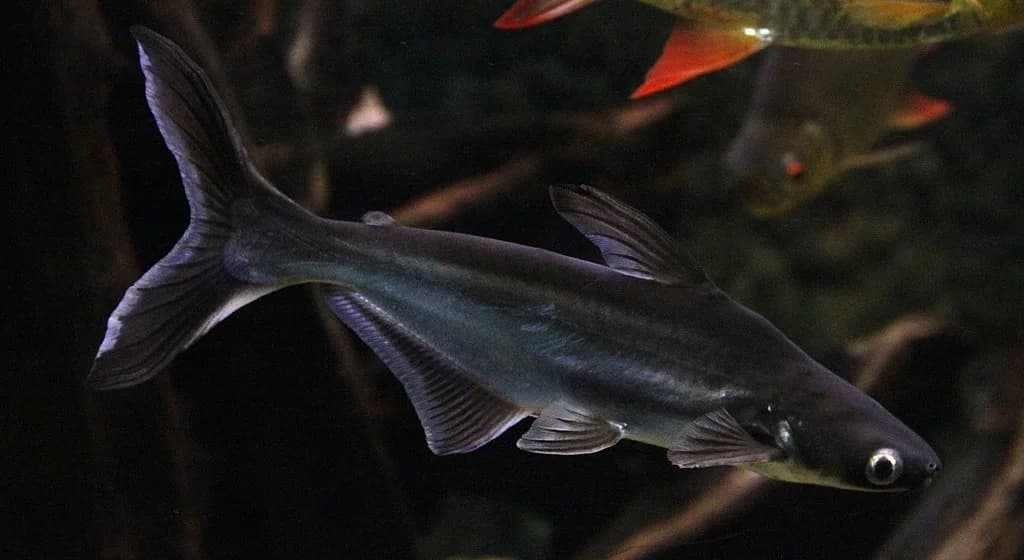
Pangasius sutchi, commonly known as the Iridescent Shark or Shark Catfish, is a large freshwater fish belonging to the family Pangasiidae. In the wild, this species inhabits the Mekong and Chao Phraya river basins across Thailand, Vietnam, Laos, and Cambodia. The Iridescent Shark is one of the most commercially important food fish in Southeast Asia — its fillets are sold worldwide under the names "pangasius" or "basa."
The common name "Shark Catfish" comes from its streamlined body shape and tall dorsal fin, which resemble the silhouette of a shark. Juveniles display a striking iridescent stripe along their body, which unfortunately fades as they mature. Adult fish reach impressive sizes of 60 to 90 cm in length, with a lifespan of 10-15 years.
It is important to note that Iridescent Sharks are often sold in pet stores as small juveniles of just 5-8 cm, with no warning to buyers about their eventual near-meter size. Before purchasing this species, one must carefully evaluate their ability to provide proper long-term care.
Tank Requirements
Pangasius sutchi is one of the most demanding species in terms of tank volume. The minimum aquarium size is 500 liters, though a group of these fish will require an even larger tank. The aquarium should be predominantly long to provide ample swimming space — this is critically important for this species.
Optimal water parameters are: temperature 24-28°C, pH 6.5-7.5, and general hardness (GH) 5-15. A powerful filtration system with good water flow is essential, simulating river-like conditions. Weekly water changes of 25-30% are mandatory.
Sand or fine rounded gravel works best as substrate. Decorations should be placed along the periphery of the tank, leaving the central area open for swimming. Sharp rocks and driftwood with protruding edges should be avoided, as panicked Iridescent Sharks can injure themselves during sudden dashes. A secure lid is essential — frightened fish are capable of jumping out of the tank.
Feeding and Diet
Pangasius sutchi is an omnivorous species with an excellent appetite. In the wild, they feed on small fish, crustaceans, insects, and plant matter. In the aquarium, the staple diet should consist of high-quality pellets formulated for large fish.
In addition to the staple food, offer frozen and live foods: shrimp, bloodworms, pieces of fish, and squid. A vegetable component is also important — blanched lettuce, spinach leaves, and pieces of zucchini and cucumber. A varied diet ensures good health and vibrant coloration.
Adult fish should be fed 1-2 times daily, in portions they can consume within 3-5 minutes. Juveniles should be fed more frequently — 2-3 times per day. Keep in mind that Iridescent Sharks are prone to overeating, so it is important to monitor food quantities.
Care and Maintenance
The key characteristic of Iridescent Sharks is their extremely skittish and nervous temperament. Sudden movements near the tank, abrupt light changes, or loud noises can send them into a panic, causing them to dart around the aquarium and crash into walls and decorations. This can result in serious injuries, so the tank should be placed in a calm location, away from high-traffic areas and noise sources.
Regular monitoring of water parameters is crucial. Watch ammonia and nitrite levels closely — large fish produce significant amounts of waste. Weekly substrate vacuuming and water changes will help maintain a healthy environment. When conditions deteriorate, Iridescent Sharks are susceptible to bacterial infections and fin rot.
It must be emphasized that Pangasius sutchi is a schooling fish and should be kept in a group of at least 3-5 individuals. A solitary Iridescent Shark experiences severe stress, becomes even more skittish, and may refuse food. Considering the adult size and the need for group keeping, this species is truly suitable only for very large aquariums or ornamental ponds.
Compatibility
Pangasius sutchi is a relatively peaceful species, but it can swallow any fish that fits in its mouth. Tank mates should be of comparable size and non-aggressive. Good companions include other large catfish such as the Sailfin Pleco, large cichlids like the Oscar, and the Bala Shark.
Do not keep Iridescent Sharks with small fish — tetras, guppies, neons — as they will be treated as food. Aggressive territorial species are also unsuitable, as they will constantly harass the timid Iridescent Sharks, increasing their stress levels.
Breeding
Breeding Pangasius sutchi in a home aquarium is virtually impossible. In the wild, these fish are a migratory species — they travel hundreds of kilometers upstream to spawn, a behavior that cannot be replicated in captivity.
On commercial farms in Southeast Asia, Iridescent Shark breeding is achieved through hormonal stimulation in specially equipped ponds of enormous size. The fish are egg scatterers, and a single female can release tens of thousands of eggs in one spawning event.
Aquarists should accept the fact that Pangasius sutchi specimens they acquire are fish to be enjoyed throughout their long lives, but producing offspring in captivity without specialized equipment is not feasible.