Overview
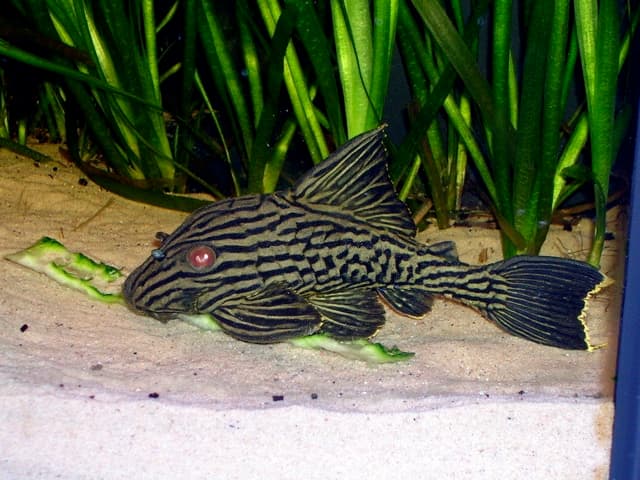
Panaque nigrolineatus, commonly known as the Royal Pleco, belongs to the family Loricariidae. It is one of the most impressive armored catfish, reaching 30-43 cm in length. This species inhabits the Orinoco, Magdalena, and Meta river basins in Colombia and Venezuela, where it dwells among submerged driftwood and fallen trees.
The Royal Pleco's most striking feature is its dramatic coloration: a dark brown or black body covered with contrasting longitudinal cream or tan stripes, forming the characteristic "royal" pattern. The body is encased in sturdy bony plates, and the powerful sucker mouth is equipped with strong teeth adapted for scraping and grinding wood.
Panaque nigrolineatus is one of the very few fish species capable of actually digesting wood. This is made possible by symbiotic bacteria in the gut that break down cellulose. This type of feeding is called xylivory and makes this species truly unique among aquarium fish. The Royal Pleco is primarily nocturnal: it hides in shelters during the day and actively feeds during the dark hours. With proper care, it can live 10-15 years.
An important anatomical feature is the presence of strong spiny odontodes in the interopercular area (on the gill covers). These spines can easily become entangled in aquarium nets, so a plastic container should be used when transferring the fish.
Tank Requirements
Panaque nigrolineatus requires an aquarium of at least 200 liters. Optimal water parameters are: temperature 24-28 °C, pH 6.0-7.5, and general hardness (GH) 2-15. The water should be well-oxygenated, as these catfish naturally inhabit flowing waters.
The most critical element of the tank setup is driftwood — and not merely as decoration. For a xylivore, driftwood serves as the primary food source, so the aquarium must contain several large pieces of natural, aquarium-safe wood (mopani, mangrove wood). As the wood is gradually consumed, it must be replaced with fresh pieces.
Filtration must be powerful. By digesting wood, the Royal Pleco produces an enormous amount of woody waste, placing significant demands on the filtration system. An external canister filter with a turnover rate of at least 5-6 times the tank volume per hour is recommended. Sand or fine gravel makes the best substrate. Shelters such as caves, hollow tubes, and clay pots should be provided for the fish to hide in during the day. Subdued lighting is preferred, which suits the species' nocturnal lifestyle.
Feeding and Diet
The foundation of Panaque nigrolineatus' diet is wood. Natural driftwood must always be present in the aquarium, as the fish will constantly rasp on it. However, wood alone is not sufficient for complete nutrition, so the diet must be supplemented.
Fresh vegetables work excellently: zucchini, cucumber, pumpkin, sweet potato, and blanched spinach leaves. Specialized sinking tablets and wafers designed for loricariid catfish can also be offered. A small amount of protein in the form of frozen bloodworms or brine shrimp is acceptable but should not exceed 10-15% of the diet.
Feeding should be done in the evening or at night when the fish is active. During the day, the Royal Pleco barely feeds, preferring to rest in its shelter. Remember to remove uneaten vegetable remnants from the tank after 8-12 hours to prevent water quality deterioration.
Care and Maintenance
Keeping the Royal Pleco demands attention and experience, reflected in its care level of 4 out of 5. The primary challenge is maintaining water quality given the heavy biological load from wood waste.
Weekly water changes should amount to 25-30% of the tank volume. The substrate must be regularly vacuumed to remove accumulated waste. Filter media should be rinsed every 2-3 weeks in aquarium water to prevent excessive clogging.
Monitor ammonia and nitrite levels — they must remain at zero. Nitrate levels should not exceed 30-40 mg/L. Regularly inspect the condition of the driftwood: if pieces have been significantly gnawed down, replace them with fresh ones.
When transferring the fish, never use an aquarium net — the spiny odontodes on the gill covers easily become entangled in the mesh, which can cause injuries. Instead, use a plastic container or glass vessel.
Watch for signs of illness: fading coloration, refusal to eat, rapid breathing, or white patches on the body. The most common problems are fungal and bacterial infections arising from poor water quality.
Compatibility
Panaque nigrolineatus has a moderately peaceful temperament (behavior level 2 out of 5) but can show territoriality toward other bottom-dwelling species, especially conspecifics. It is best to keep a single specimen per tank unless the aquarium exceeds 400-500 liters.
Good tankmates are large, peaceful fish that inhabit the middle and upper water layers. Suitable options include angelfish, severums, festivums, and discus. Among bottom dwellers, Sterbai corydoras can be added, as they occupy a different ecological niche and rarely conflict with panaques.
Avoid keeping the Royal Pleco with other large loricariids such as sailfin plecos, as this will lead to territorial conflicts and competition for shelters. Also avoid aggressive cichlids like Oscars, which may harass the panaque.
Breeding
Breeding Panaque nigrolineatus in captivity is exceptionally challenging (difficulty 5 out of 5), and successful spawning events are extremely rare. In the wild, spawning occurs in submerged logs and tree hollows during the rainy season.
For a breeding attempt, a very spacious aquarium (500 liters or more) with numerous large hollow logs and caves is required. Spawning can be stimulated by lowering the water temperature by 2-3 °C followed by a gradual increase, combined with large water changes using soft water to simulate the onset of the rainy season.
Sexual dimorphism is subtle: males are generally slightly larger and have more developed odontodes. The female lays eggs in a cave or hollow log, after which the male assumes responsibility for guarding the clutch. He remains with the eggs until they hatch and continues to protect the fry during the early stages.
Fry begin feeding on the finest wood particles and biofilm on driftwood surfaces. Raising the young requires special attention to water quality and the availability of suitable feeding substrate. Due to the extreme difficulty of captive breeding, most specimens available in the trade are wild-caught.