Overview
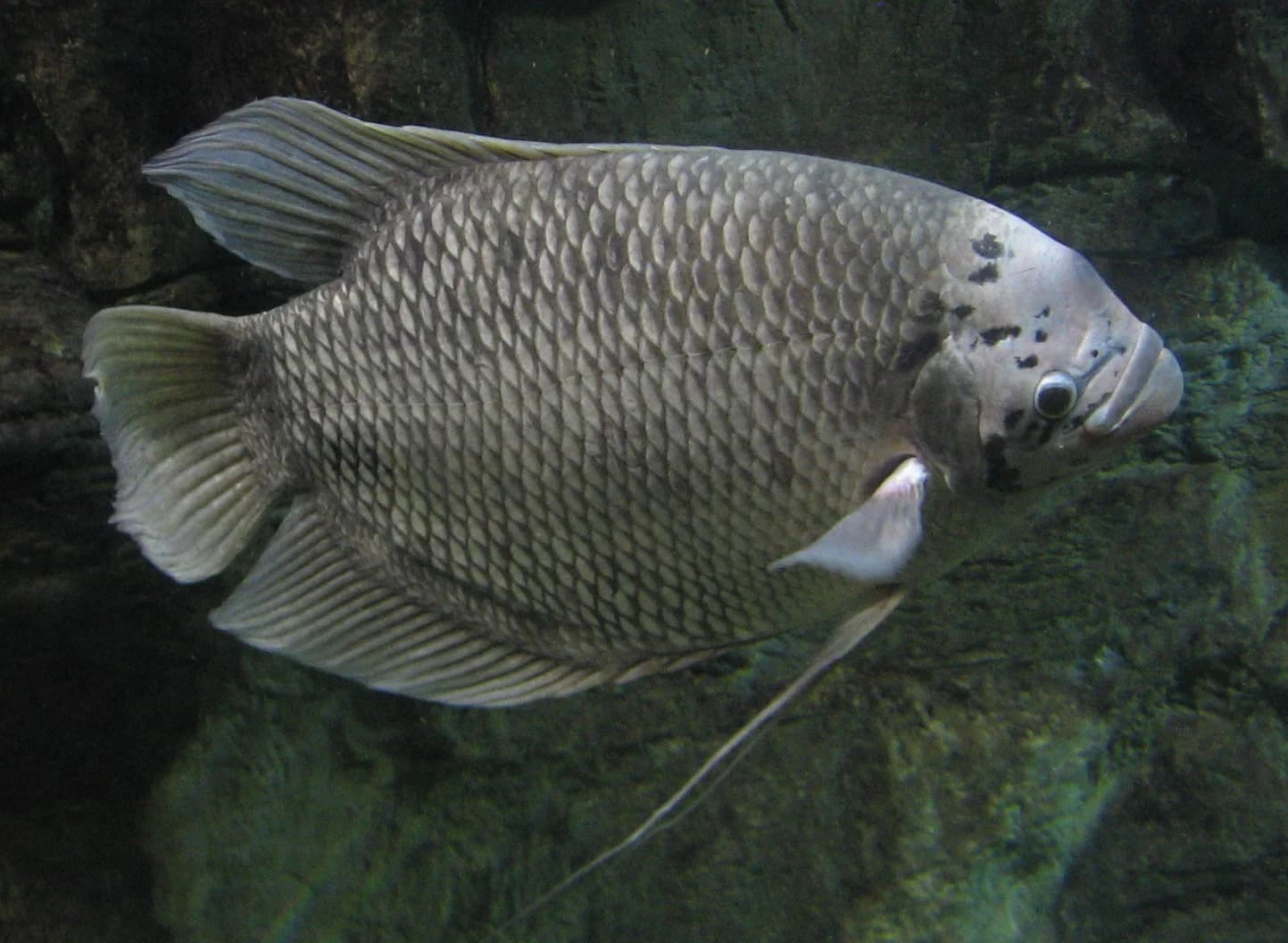
Osphronemus gourami, commonly known as the Giant Gourami, is one of the largest and most impressive labyrinth fish kept in the aquarium hobby. This species originates from Southeast Asia, inhabiting slow-moving rivers, swamps, and lakes of Indonesia (Java, Sumatra, Borneo), Malaysia, Thailand, and Indochina. In its native range, Osphronemus gourami is an important commercial food fish — extensively farmed in ponds across Southeast Asia for its meat.
The Giant Gourami reaches impressive dimensions of 30 to 50 cm in length, with a lifespan of 15 to 20 years, making its keeping a serious long-term commitment. Like other members of the labyrinth fish suborder, this species possesses a specialized organ called the labyrinth, which allows it to breathe atmospheric air, similar to the betta or pearl gourami.
Juveniles display a striking banded pattern with alternating dark and light stripes. As they mature, the pattern fades, and adults develop a uniform coloration — grey, pinkish, or golden. The body is broad and laterally compressed, with large rounded fins and characteristically thick lips.
One of the most remarkable traits of the Giant Gourami is its notable intelligence. These fish can recognize their owner, respond to their approach, and over time learn to accept food directly from the hand.
Tank Requirements
Due to its imposing size, Osphronemus gourami requires a very large aquarium — the minimum recommended volume is 300 liters, though for adult specimens a tank of 500 liters or more is preferable. Ideally, fully grown fish are best suited to a spacious pond.
Optimal water parameters are: temperature 24–28°C, pH 6.5–7.5, and general hardness (GH) 5–15. A powerful filtration system is essential, as this large fish produces a significant amount of waste. Weekly water changes of 25–30% are mandatory.
Sand or fine gravel works well as substrate. Decorations should be large and securely anchored — the Giant Gourami is capable of moving objects around the aquarium. Live plants will most likely be eaten, so artificial ones are recommended. It is important to provide ample open swimming space as well as shelters made from large driftwood and rocks. An air gap must be maintained between the water surface and the tank lid to allow the fish to freely breathe atmospheric air through its labyrinth organ.
Feeding and Diet
Osphronemus gourami is an omnivorous species with a hearty appetite. In the wild, these fish feed on aquatic vegetation, algae, insects, worms, small fish, and frogs. In the aquarium, the staple diet can consist of high-quality pellets for large fish, supplemented with a variety of foods.
The diet should include: lettuce leaves, spinach, zucchini and cucumber slices, and boiled peas (vegetable component), as well as live and frozen foods — earthworms, shrimp, bloodworms, and pieces of fish fillet (protein component). A varied diet supports overall health and vibrant coloration.
Adult fish should be fed 1–2 times daily in portions appropriate to their size. Juveniles require more frequent feeding at 2–3 times per day. It is important to avoid overfeeding and to remove any uneaten food promptly.
Care and Maintenance
Keeping the Giant Gourami requires a responsible approach, primarily due to its enormous size and longevity. When purchasing a juvenile measuring just 5–10 cm, one must understand that within a few years the fish will grow to 30–50 cm and will need a very large aquarium or pond.
Regular water changes and parameter monitoring form the foundation of fish health. Ammonia and nitrite levels must be watched closely, as they can accumulate quickly due to the large volume of waste produced. A powerful filter with substantial biological media is essential.
Despite having a labyrinth organ, clean and well-oxygenated water remains important. With proper care, Giant Gouramis are resistant to disease; however, deteriorating water quality can lead to bacterial infections and fin rot. Regular inspection of the skin and fins will help detect problems early.
Giant Gouramis are known for their calm temperament and quickly bond with their owner. They may swim up to the glass when their keeper approaches and even allow themselves to be petted. This makes them one of the most interactive aquarium fish available.
Compatibility
Despite their imposing size, Osphronemus gourami has a peaceful disposition. However, they may view small fish as food, so tank mates must be large enough not to fit in their mouth.
Good companions include: large catfish such as the sailfin pleco, large cichlids like the oscar, iridescent shark, and other large labyrinth fish such as the kissing gourami. Peaceful large fish with similar water parameter requirements make optimal choices.
They should not be kept with small fish, aggressive cichlids, or overly territorial species. Housing multiple adult males in the same aquarium should also be avoided, as conflicts may arise between them.
Breeding
Breeding Osphronemus gourami in captivity is a challenging endeavor, primarily due to the need for a very large space. A spacious aquarium or pond is required for successful spawning.
Unlike most smaller gouramis that build nests from air bubbles, the Giant Gourami constructs a floating nest from plant material — stems, leaves, and plant fragments. The male gathers plant debris and forms it into a large nest at the water surface, which can reach 30–40 cm in diameter.
To stimulate spawning, maintain a temperature of 26–28°C and ensure excellent water quality. The aquarium should contain floating plants and plant material that the male can use for nest construction.
After the nest is built, the female deposits her eggs into it, which the male fertilizes and diligently guards. The male cares for the clutch and the hatched fry, protecting them from potential threats. The fry can be raised on infusoria, brine shrimp nauplii, and finely crushed food as they grow.