Overview
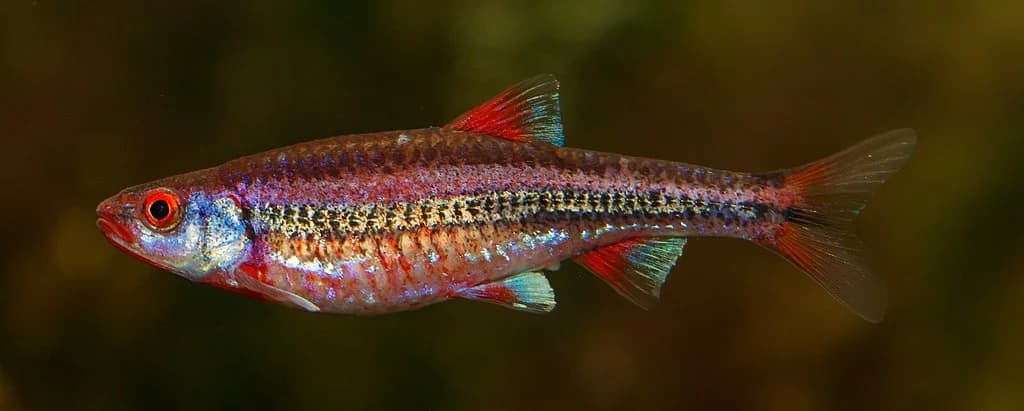
Notropis chrosomus, commonly known as the Rainbow Shiner, is one of the most beautiful freshwater fish native to North America. This species belongs to the family Cyprinidae and inhabits clear streams and tributaries of the Coosa River system in the southeastern United States — Alabama, Georgia, and Tennessee. Adults reach a size of 5-8 cm and live 3-5 years with proper care.
The most remarkable feature of Notropis chrosomus is the spectacular nuptial coloration of males. During the breeding season (spring), males develop iridescent pink, violet, and blue hues across their head and body, making them among the most striking freshwater fish in the world. Outside the breeding season, both sexes display a plain silver coloration. This is a cold-water species with a temperature range of 15-22°C, which is an essential consideration when planning an aquarium setup.
Tank Requirements
Notropis chrosomus is a stream-dwelling fish accustomed to clean waterways with moderate to strong current. The minimum tank volume is 60 liters, though a tank of 100 liters or more is preferable for a school of 8-10 individuals. Water temperature must be maintained within 15-22°C — this is a critically important parameter, as the species cannot tolerate tropical temperatures. The optimal pH is 6.5-8.0, with general hardness (GH) of 5-12.
The aquarium should be equipped with a powerful filter that generates noticeable current, along with strong aeration, since these fish naturally inhabit fast-flowing, oxygen-rich streams. Fine gravel or coarse sand works well as a substrate. Add rocks of various sizes and driftwood to create a natural landscape, while leaving ample open swimming space. Live plants that tolerate cooler water will complement the biotope nicely.
Feeding and Diet
In the wild, Notropis chrosomus feeds on small invertebrates, insect larvae, algae, and plant matter. In the aquarium, these fish readily accept high-quality flakes and small pellets as a staple diet.
To maintain health and encourage vivid nuptial coloration, regularly supplement their diet with live or frozen foods such as daphnia, brine shrimp, bloodworms, and cyclops. A varied diet is especially important during the pre-spawning period. Feed twice daily in small portions, ensuring all food is consumed within a few minutes.
Care and Maintenance
Notropis chrosomus is a relatively undemanding species (care level 2 out of 5), but it does require one key condition — cool, clean water. Weekly water changes of 25-30% are essential. Filtration should be powerful enough to provide both mechanical cleaning and water movement. Aeration is critically important, as these fish are sensitive to low oxygen levels.
Avoid sudden fluctuations in temperature and water chemistry. During summer, if room temperature rises above 22°C, you may need to use an aquarium chiller or fans to cool the water. This is a schooling species — keep at least 8 individuals together so the fish feel secure and display natural behavior.
Compatibility
The Rainbow Shiner is a peaceful schooling fish (aggression level 2 out of 5) that is well-suited for a community aquarium with other cold-water species. It is essential to keep them in groups of 8 or more, where males will display their finest colors while competing for female attention.
Excellent tank mates include White Cloud Mountain Minnows, small danios, and cold-tolerant corydoras such as Panda Corydoras and Pygmy Corydoras. Avoid housing them with large, aggressive, or strictly tropical fish that require water warmer than 24°C. The primary principle for selecting tank mates is temperature compatibility.
Breeding
Breeding Notropis chrosomus in the aquarium is achievable but requires some effort (difficulty 3 out of 5). The key stimulus for spawning is simulating seasonal changes. During winter, keep the fish at 15-17°C, then gradually raise the temperature to 20-22°C in spring, which triggers breeding behavior.
It is during this period that males develop their famous nuptial coloration — iridescent pink, violet, and blue tones cover the head and body, creating a truly breathtaking display. For spawning, prepare an area with fine gravel and flat rocks where females can scatter their eggs. After spawning, remove the adults to prevent them from eating the eggs. The eggs develop over 3-5 days, after which the fry can be fed infusoria and microworms, gradually transitioning to baby brine shrimp.