Overview
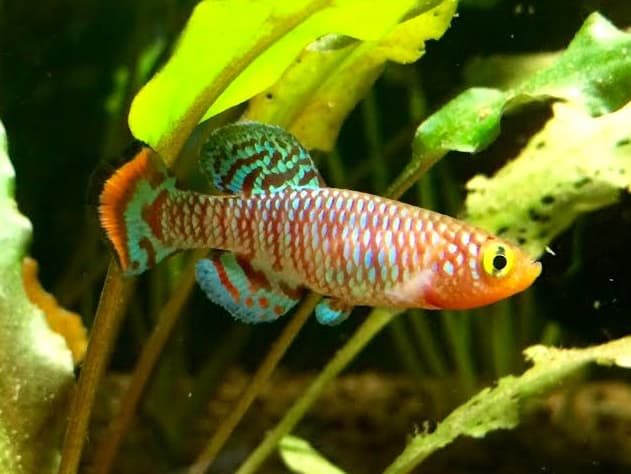
Nothobranchius rachovii is one of the most spectacular members of the Nothobranchiidae family and is rightfully considered one of the most beautiful freshwater aquarium fish in the world. This small killifish, reaching a size of 5-6 cm, inhabits seasonal pools and floodplains of Mozambique in East Africa.
The defining feature of the species is its annual life cycle. In the wild, Nothobranchius rachovii completes its entire lifespan within a single rainy season: the fish hatch when the rains come, grow rapidly, breed, and perish when the pools dry up. Even in aquarium conditions, their lifespan is only 1-2 years.
Sexual dimorphism is extremely pronounced. Males possess a magnificent coloration: their bodies are a brilliant red or orange covered with a scattering of electric blue spots and patterns, while their fins are adorned with contrasting blue stripes. Females, in contrast, are modestly colored in grey-brown tones, which helps them camouflage in their natural environment.
Tank Requirements
A tank of at least 20 liters is sufficient for keeping Nothobranchius rachovii. Optimal water parameters are: temperature 22-26°C, pH 6.0-7.5, and hardness (GH) 5-15. Filtration should be gentle -- these fish do not tolerate strong currents, as they naturally inhabit still or slow-moving waters.
A dark fine sand or peat substrate works best, mimicking the bottom of their seasonal pools. The tank should be densely planted, including floating plants to create subdued lighting. Under soft, diffused light, the vibrant coloration of males is displayed most strikingly. Driftwood and leaf litter from oak or Indian almond leaves complement the natural biotope and help acidify the water.
Feeding and Diet
Nothobranchius rachovii is a predator that feeds on small invertebrates, insect larvae, and zooplankton in the wild. In the aquarium, the diet should be based on live and frozen foods: brine shrimp, daphnia, bloodworms, cyclops, and glassworms. It is on such a diet that these fish display their most vivid coloration.
Dry flakes and pellets can serve as a supplement but should not form the core of their diet. Feed 2-3 times daily in small portions, keeping in mind that with their short life cycle, daily balanced nutrition is essential. Avoid overfeeding -- leftover food quickly pollutes the water in small tanks.
Care and Maintenance
Caring for Nothobranchius rachovii requires attention to water quality. Weekly water changes of 20-30% are essential, as parameters can deteriorate quickly in small tanks. Regularly test for ammonia, nitrites, and nitrates.
It is important to understand that even with perfect care, these fish live only 1-2 years -- this is not a sign of disease but a biological characteristic of the species. After 12-15 months, the fish begin to age: coloration may fade and activity may decline. It is recommended to keep a group of one male with 2-3 females to reduce the burden on each female during spawning periods. Monitor fin condition -- males under stress or in poor water quality are susceptible to fungal infections and fin rot.
Compatibility
Nothobranchius rachovii is a relatively peaceful fish with an aggression level of 2 out of 5. Males may display territorial behavior toward each other, flaring their fins and intensifying their coloration, but serious confrontations rarely occur.
Suitable tankmates include small, calm species that prefer similar conditions. Good companions include Chili Rasboras, small Pygmy Corydoras, and other peaceful killifish. Harlequin Rasboras and Celestial Pearl Danios are also suitable. Avoid keeping them with large or aggressive fish, as well as active species that would compete for food or nip the males' fins.
Breeding
Breeding Nothobranchius rachovii is a fascinating process tied to the unique biology of annual killifish. The breeding difficulty is rated 3 out of 5 -- a specific approach simulating diapause is required.
For spawning, place a container filled with moist peat moss (3-5 cm deep) in the aquarium. The female lays several eggs daily in the peat, diving into the substrate together with the male. After 2-3 weeks, carefully remove the peat with eggs, gently squeeze out excess water, and place it in a plastic bag or container.
The crucial stage follows -- dry incubation (diapause). The eggs must be stored in moist (but not wet) peat at 22-25°C for 2-6 months. This period simulates the drying of pools in nature and is an essential requirement for embryo development.
Once diapause is complete, flood the peat with soft, cool water (18-20°C). The fry will hatch within a few hours. First food should be newly hatched brine shrimp, which the fry can consume from the very first day. The young grow very rapidly and begin to show coloration at 4-6 weeks, reaching sexual maturity by 8-12 weeks -- a reflection of the species' accelerated life cycle.