Overview
Nematobrycon palmeri is one of the most graceful members of the Characidae family, rightfully earning its regal common name. This fish originates from rivers and streams in Colombia, inhabiting waters of the Atrato and San Juan river basins under the canopy of tropical rainforest.
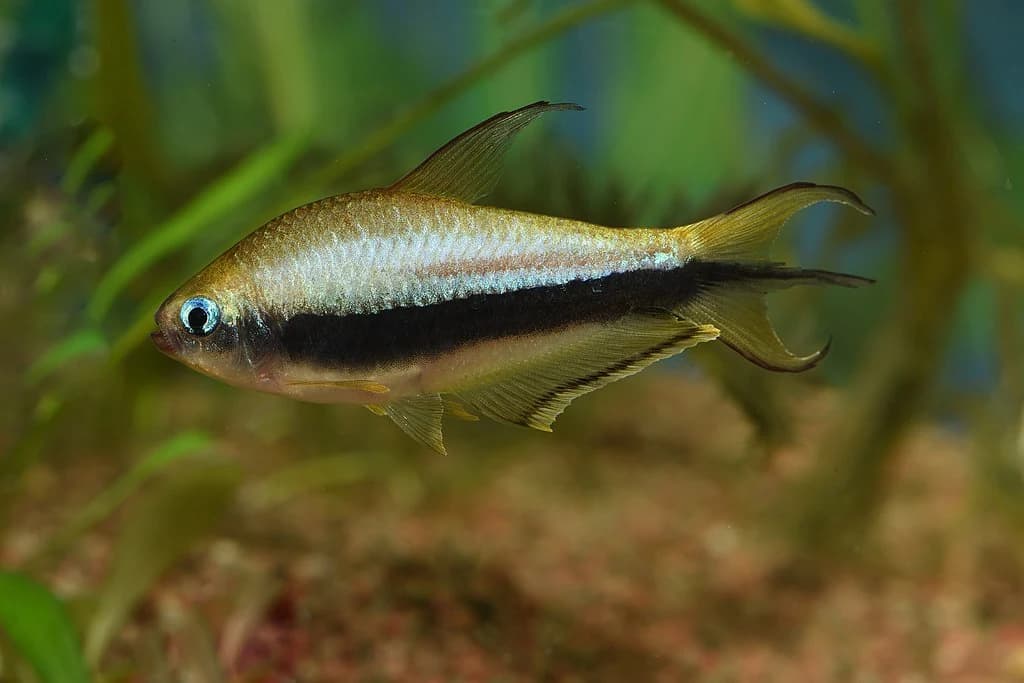
The emperor tetra's most distinctive feature is its unique trident-shaped caudal fin: the central rays of the tail are elongated, forming a characteristic three-pronged silhouette found in virtually no other aquarium fish. The body is adorned with a deep blue-purple iridescence that looks especially striking under subdued lighting. A broad dark band runs along the lateral line, and the eyes gleam with a vivid blue-green hue. Males are larger, more vibrantly colored, and have a more pronounced trident on their tail.
This species reaches a size of 5-7 cm and lives 3-5 years with proper care. Despite their "royal" demeanor — males stake out territories and adopt majestic postures — they show virtually no real aggression, making them an excellent choice for community aquariums.
Tank Requirements
A comfortable school of emperor tetras requires a tank of at least 100 liters. Optimal water parameters are: temperature 24-28°C, pH 6.0-7.5, and hardness GH 4-10. These fish dislike bright light — dim lighting enhances their luxurious coloration and creates conditions closer to their natural habitat.
The aquarium is best set up with dense vegetation interspersed with open swimming areas. Floating plants work wonderfully for diffusing light. Driftwood and a dark substrate will intensify the blue-purple shimmer and create a natural South American biotope atmosphere. Be sure to include several sheltered spots — males enjoy claiming small territories among the decorations.
Water flow should be moderate to gentle, as Nematobrycon palmeri inhabit calm stretches of rivers and streams in the wild.
Feeding and Diet
Nematobrycon palmeri are omnivorous fish that feed on small insects, larvae, crustaceans, and plant detritus in the wild. In the aquarium they readily accept most foods, but a varied diet is what truly brings out their coloration.
The staple diet can consist of high-quality dry food in the form of small flakes or granules. Two to three times a week, I recommend supplementing with frozen or live foods: brine shrimp, daphnia, cyclops, or bloodworms. It is these protein-rich additions that make the fish's colors as vibrant as possible.
Feed twice daily in small portions that the fish consume within 2-3 minutes. Emperor tetras feed primarily in the middle water column but will readily take food from the surface as well. Overfeeding is the most common beginner mistake and leads to deteriorating water quality.
Care and Maintenance
The emperor tetra is an undemanding species with a care level accessible even to beginners. The cardinal rule is stability of water parameters. Weekly water changes of 20-25% of the volume will help maintain cleanliness and environmental stability.
Filtration should be effective but without creating a strong current. An internal or external filter with a gentle outflow is the optimal setup. A sponge filter works well for smaller tanks and does not produce excessive flow.
Regularly monitor water parameters with test kits: pH, ammonia, nitrites, and nitrates. Nematobrycon palmeri are sensitive to elevated nitrate levels, so do not allow concentrations to exceed 20-30 mg/l. Healthy fish are active during the daytime, display vivid coloration, and accept food eagerly.
Compatibility
The emperor tetra is an outstanding community aquarium resident. They are best kept in a group of at least 6 individuals, ideally with 2-3 females per male. Males establish small territories and periodically display their spread fins at one another, but these "duels" are purely ritualistic and never result in injuries.
Excellent tankmates include other peaceful tetras: neon tetras, black neon tetras, and black phantom tetras. They coexist beautifully with Congo tetras, small rasboras, and corydoras. Among dwarf cichlids, rams make great companions as they occupy the lower levels of the tank.
Avoid keeping them with large or aggressive fish, as well as fin-nipping species — the emperor tetra's splendid trident tail can become a target for such tankmates.
Breeding
Breeding Nematobrycon palmeri at home is quite achievable, though it requires some preparation. Breeding difficulty is considered moderate.
For spawning, prepare a separate tank of 20-30 liters with soft, slightly acidic water (pH 6.0-6.5, GH 2-4). Raise the temperature to 27-28°C. Place a mesh or fine-leaved plants on the bottom — Java moss works perfectly as a spawning substrate. Lighting should be minimal.
Select a well-fed female with a rounded belly and the most brightly colored male. Unlike many tetras, emperor tetras spawn in pairs rather than in groups. The female deposits eggs one at a time among the plants, and the process may extend over several days.
After spawning, be sure to remove the parents — they are prone to eating their own eggs. Larvae hatch in 24-36 hours, and after another 4-5 days the fry become free-swimming. First foods should be infusoria or newly hatched brine shrimp. Gradually transition the fry to larger foods as they grow.