Overview
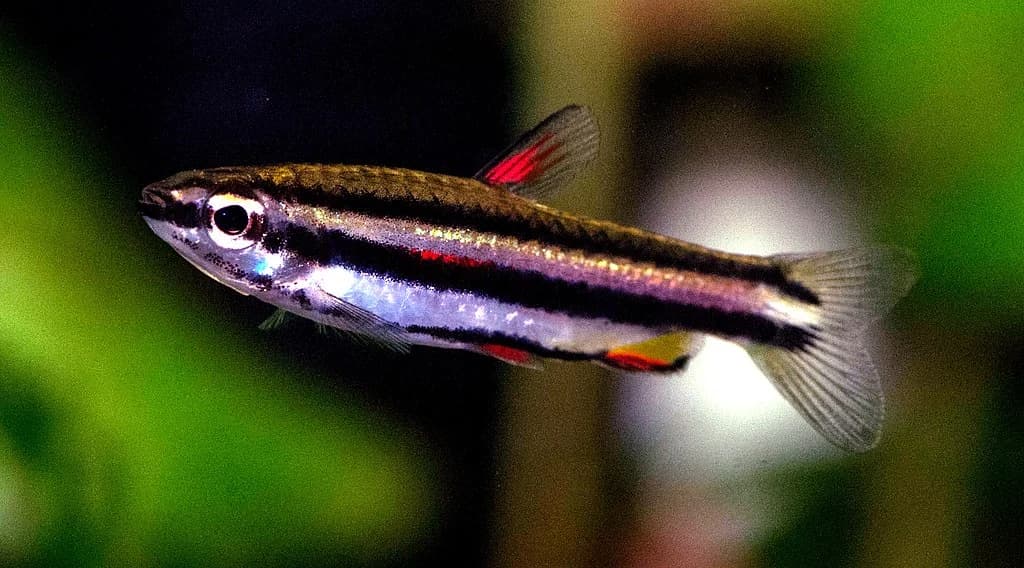
Nannostomus marginatus, commonly known as the Dwarf Pencilfish, is a miniature freshwater fish belonging to the family Lebiasinidae (pencilfish family). In the wild, this species inhabits slow-moving streams, tributaries, and swampy areas in Guyana, Suriname, and the western Amazon basin. Adults reach only 3-4 cm in length, making them one of the smallest representatives of the genus Nannostomus.
The body is elongated and adorned with three distinct horizontal stripes — black and golden — running along its entire length. One of the most fascinating features of this species is its dramatic nighttime color change: during the day, the horizontal stripes are clearly visible, but as darkness falls, they fade away and are replaced by vertical dark bars. This phenomenon is caused by pigment redistribution within chromatophores and serves as nighttime camouflage.
Like other members of the pencilfish family, Nannostomus marginatus has a characteristic habit of hovering in the water column at an oblique angle with its head slightly raised. This posture is a hallmark of pencilfish and easily distinguishes them from other small species.
Tank Requirements
A group of Dwarf Pencilfish requires an aquarium of at least 60 liters. Optimal water parameters are: temperature 24-28 °C, pH 5.0-7.0, and general hardness (GH) 4-12. These fish prefer soft, slightly acidic water that closely replicates their natural biotopes.
The aquarium should be densely planted with live vegetation, including floating plants that help diffuse light and create comfortable shading. Dark sand or fine gravel works well as substrate. Adding driftwood and dried leaf litter (such as Indian almond leaves) will tint the water and enrich it with humic substances, bringing conditions closer to the natural habitat.
Water flow should be gentle — strong currents cause stress in these small fish. Use a filter with adjustable flow or a sponge filter.
Feeding and Diet
In the wild, Nannostomus marginatus feeds on small invertebrates, insect larvae, and microorganisms. In the aquarium, offer a varied diet of high-quality micro-pellets, finely crushed flakes, and live or frozen foods such as daphnia, baby brine shrimp, micro-worms, and cyclops.
It is important to note that pencilfish have very small mouths, so food must be of an appropriately fine size. Feed 2-3 times daily in small portions so the fish can consume the food before it sinks to the bottom. A diverse diet helps maintain vibrant coloration and strengthens the immune system.
Care and Maintenance
The Dwarf Pencilfish is one of the most undemanding aquarium species, making it an excellent choice for both beginners and experienced aquarists. The key principle of care is maintaining stable water parameters. Weekly water changes of 20-25% using conditioned water are recommended.
Keep the aquarium clean by promptly removing uneaten food and dead plant leaves. Regularly test water parameters, paying close attention to ammonia and nitrite levels, which should remain at zero.
You can observe the nighttime color change by carefully turning on a dim light some time after the main lighting has been switched off — you will see an entirely different pattern on the fish.
Compatibility
Nannostomus marginatus is an exceptionally peaceful fish, perfectly suited for a community aquarium with other small, calm species. Pencilfish should be kept in groups of 8-10 or more — in a school, the fish feel more confident and display more interesting behavior.
Excellent tankmates include other small characins such as the green neon tetra or cardinal tetra, small rasboras like the chili rasbora, and bottom-dwelling species such as the pygmy corydoras and otocinclus. Among close relatives, they coexist well with the coral red pencilfish and brown pencilfish.
Avoid keeping them with large, active, or aggressive fish that may intimidate the Dwarf Pencilfish or outcompete them for food.
Breeding
Breeding Nannostomus marginatus in the home aquarium is quite achievable when certain conditions are met. Prepare a separate breeding tank of 10-20 liters with very soft, acidic water (pH 5.5-6.5, GH 2-4) and a temperature of 26-27 °C. Place fine-leaved plants (Java moss, Cabomba) or synthetic spawning mops on the bottom.
Lighting in the breeding tank should be minimal. The female lays a small number of eggs (typically 30-50), scattering them among the plants. After spawning, the adults must be removed, as they may eat the eggs.
The eggs incubate for 24-36 hours. For the first few days, the fry feed on their yolk sacs, after which they should be offered infusoria and liquid fry food. After 7-10 days, baby brine shrimp can be introduced. The fry grow slowly, and maintaining clean water with regular small feedings is essential for their survival.