Overview
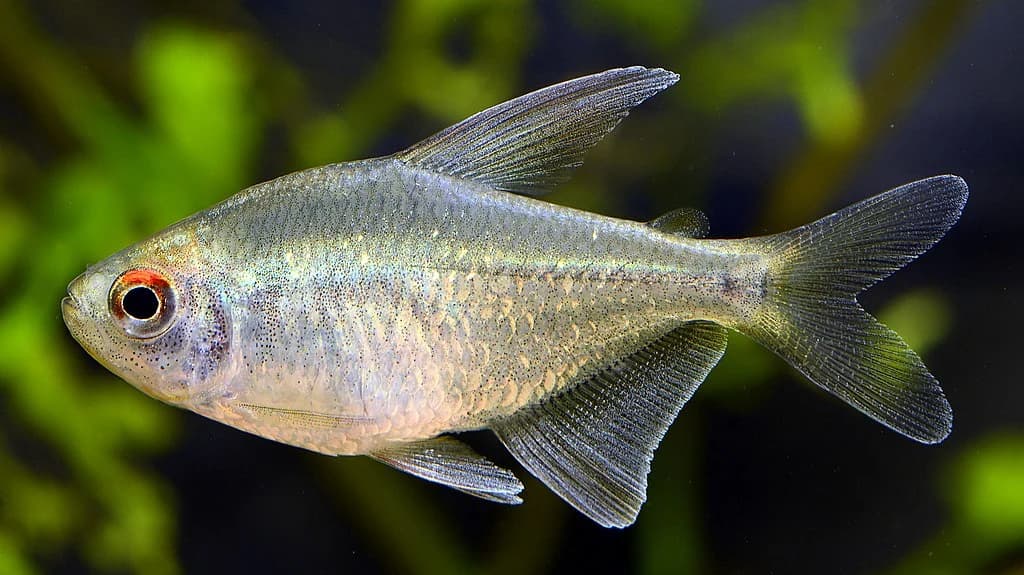
Moenkhausia pittieri is a freshwater fish from the family Characidae, endemic to the Lake Valencia basin in northern Venezuela. It earned the name "Diamond Tetra" thanks to its unique iridescent scales that create a stunning diamond-like shimmer under side lighting. This effect is particularly striking in mature specimens, whose scales reflect a full spectrum of colors.
Diamond Tetras reach a size of 5-6 cm and live for 3 to 5 years. Sexual dimorphism is clearly visible: males develop elongated dorsal and anal fins as they mature, which take on an impressive veil-like form. Females have more modest fins and a rounder body.
These are peaceful schooling fish that thrive best in groups of six or more. In a school, they display natural behavior and their most vibrant coloration, especially when males compete for the attention of females.
Tank Requirements
A group of Diamond Tetras requires an aquarium with a minimum volume of 75 liters. Optimal water parameters are: temperature 24-28°C, pH 6.0-7.5, and hardness (GH) 5-15 dGH. These fish prefer clean, well-filtered water with moderate flow.
To best showcase the beauty of their iridescent scales, a dark substrate and side lighting are recommended. The aquarium should be densely planted with live vegetation while leaving enough open space for swimming. Floating plants will help create subdued light, closer to their natural habitat conditions.
Driftwood and rocks provide additional shelter and help the fish feel more confident. A tight-fitting lid is essential, as tetras are prone to jumping.
Feeding and Diet
In the wild, Moenkhausia pittieri is an omnivorous species that feeds on small invertebrates, insects falling onto the water surface, and plant matter. In the aquarium, they readily accept a variety of foods.
The staple diet can consist of high-quality flakes and micro-pellets. To enhance coloration and maintain health, the diet should be regularly supplemented with live or frozen foods: brine shrimp, daphnia, bloodworms, and cyclops. Vegetable supplements such as spirulina are also beneficial.
Feed 2-3 times daily in small portions that the fish can consume within 2-3 minutes. A varied diet is the key to vibrant coloration and a strong immune system.
Care and Maintenance
Diamond Tetras are relatively undemanding fish with a below-average care difficulty level. Weekly water changes of 25-30% will help maintain stable parameters and a clean environment. Regular monitoring of ammonia, nitrite, and nitrate levels with test kits is important.
Filtration should be effective but not create an excessively strong current. An external canister filter or an internal filter with adjustable flow is recommended.
With proper care, these fish rarely fall ill. However, deteriorating water quality may make them susceptible to ich and bacterial infections. Quarantining new fish and maintaining stable conditions are the best preventive measures.
Compatibility
Moenkhausia pittieri is a peaceful species that makes an excellent addition to a community aquarium with other non-aggressive fish of comparable size. Outstanding tank mates include other South American tetras: neon tetras, cardinal tetras, black neon tetras, and Congo tetras.
Among bottom-dwelling fish, good companions include bronze corydoras, panda corydoras, and bristlenose plecos. Calm rasboras such as harlequin rasboras also coexist beautifully with Diamond Tetras.
Avoid keeping them with large or aggressive species, as well as fin-nipping fish — the males' long fins may become targets. Keeping them in a school of at least six reduces stress and minimizes intraspecific competition.
Breeding
Breeding Moenkhausia pittieri in the aquarium is achievable, though it requires some preparation. Set up a separate breeding tank of 20-30 liters with soft, slightly acidic water (pH 6.0-6.5) and a temperature of 26-28°C. Place fine-leaved plants such as Java moss or a synthetic spawning mop on the bottom.
Selecting a breeding pair is straightforward: males are distinguished by their elongated dorsal and anal fins and a more slender body. Before spawning, condition the breeders with generous live food feedings for 1-2 weeks.
Spawning typically occurs in the morning. The female scatters eggs among the plants, after which the adults must be removed to prevent egg predation. Incubation lasts 24-36 hours. During the first days, fry feed on infusoria, then transition to newly hatched brine shrimp. The fry tank should be kept dark, as eggs and larvae are sensitive to light.