Overview
Metriaclima lombardoi (synonym — Maylandia lombardoi), commonly known as the Kenyi Cichlid or Lombardoi Cichlid, is one of the most striking and memorable Mbuna cichlids from Lake Malawi. In the wild, this species inhabits rocky biotopes around Mbenji Island, clinging to rocky substrates at shallow depths.
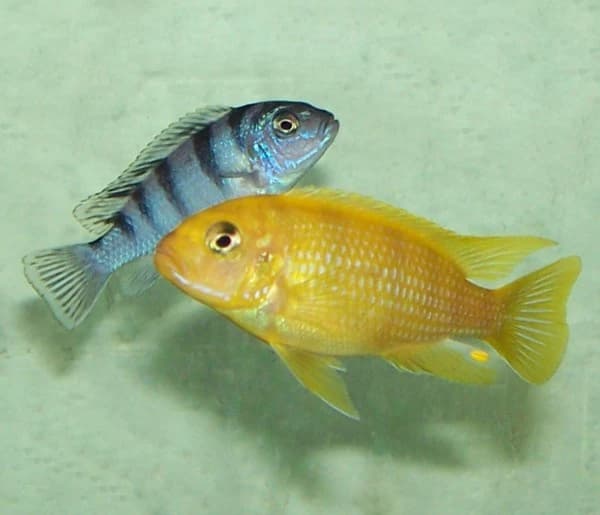
The most distinctive feature of this species is its unique reverse sexual dimorphism. Unlike most cichlids where males are more colorful, Metriaclima lombardoi is the opposite: females display a rich blue coloration with dark vertical bars, while males develop a solid bright yellow color as they mature. This frequently confuses beginner aquarists who mistake the blue females for males.
The fish grows to 12–15 cm in length and lives 7–10 years with proper care. This is an extremely territorial and aggressive species that is categorically not recommended for beginner aquarists.
Tank Requirements
Metriaclima lombardoi requires a tank of at least 200 liters. Optimal water parameters are: temperature 24–28 °C, pH 7.8–8.6, and hardness (GH) 10–18. These parameters replicate the conditions of Lake Malawi, and maintaining their stability is critically important for the fish's health.
The aquarium should be decorated with a large number of rocks and stone formations creating numerous caves and hiding spots. Each fish seeks to claim its own territory, so the more shelters available, the fewer conflicts will arise. A sandy substrate is recommended to mimic the natural biotope. Live plants generally do not fare well with Mbuna, as the fish tend to uproot and eat them.
Feeding and Diet
In the wild, Metriaclima lombardoi is a predominantly herbivorous species that feeds on algal growth on rocks. In the aquarium, the diet should consist primarily of spirulina-based foods, vegetable flakes, and pellets designed for herbivorous cichlids. High-quality dry foods with plant-based ingredients may be offered periodically.
Important: Metriaclima lombardoi is extremely susceptible to Malawi bloat — a dangerous condition that often develops when too much protein is included in the diet. Feeding bloodworms and tubifex should be avoided entirely. Brine shrimp and other protein-rich foods should only be given rarely and in minimal amounts. A balanced plant-based diet is the key to maintaining the health and vibrant coloration of these fish.
Care and Maintenance
Metriaclima lombardoi requires stable water parameters and diligent care. Weekly water changes of 25–30 % are mandatory, as the fish are sensitive to nitrate accumulation and organic pollution. A powerful filtration system with effective biological and mechanical filtration is essential.
Regularly test water parameters, maintaining pH at 7.8–8.6 and temperature at 24–28 °C. Overstocking is undesirable, though a moderately dense population of Mbuna helps to disperse aggression from the dominant male. Monitor the fish closely — abdominal swelling, refusal to eat, or fading coloration may indicate Malawi bloat and require immediate intervention.
Compatibility
Metriaclima lombardoi is one of the most aggressive members of the Mbuna group. Keeping it with peaceful species is absolutely out of the question. Males are extremely territorial and may harass not only tankmates but also females of their own species.
The optimal stocking arrangement is one male to 3–4 females, which helps distribute aggression. Keeping two or more males in the same tank is only feasible with a very large volume and an abundance of hiding spots. Suitable tankmates include other large and hardy Mbuna cichlids, such as Pseudotropheus zebra, Yellow Lab, or Blue Dolphin Cichlid. Avoid housing the Kenyi Cichlid with peaceful species from other regions, as well as similarly colored Mbuna, to prevent heightened intraspecific aggression.
Breeding
Breeding Metriaclima lombardoi is not particularly difficult given suitable conditions. This is a maternal mouthbrooder — the female incubates the fertilized eggs in her mouth for 18–21 days, after which she releases fully formed fry.
Spawning typically takes place on a flat rock or in a depression in the substrate. The male attracts the female with his bright coloration and a characteristic courtship dance. After fertilization, the female collects the eggs in her mouth and retreats into seclusion. During this period she refuses food, so it is important to provide her with a calm hiding spot, protected from aggression by the male and other tank inhabitants.
The fry are relatively large upon release and immediately accept crushed spirulina flakes and artemia nauplii. To improve survival rates, it is recommended to move the brooding female to a separate tank.