Overview
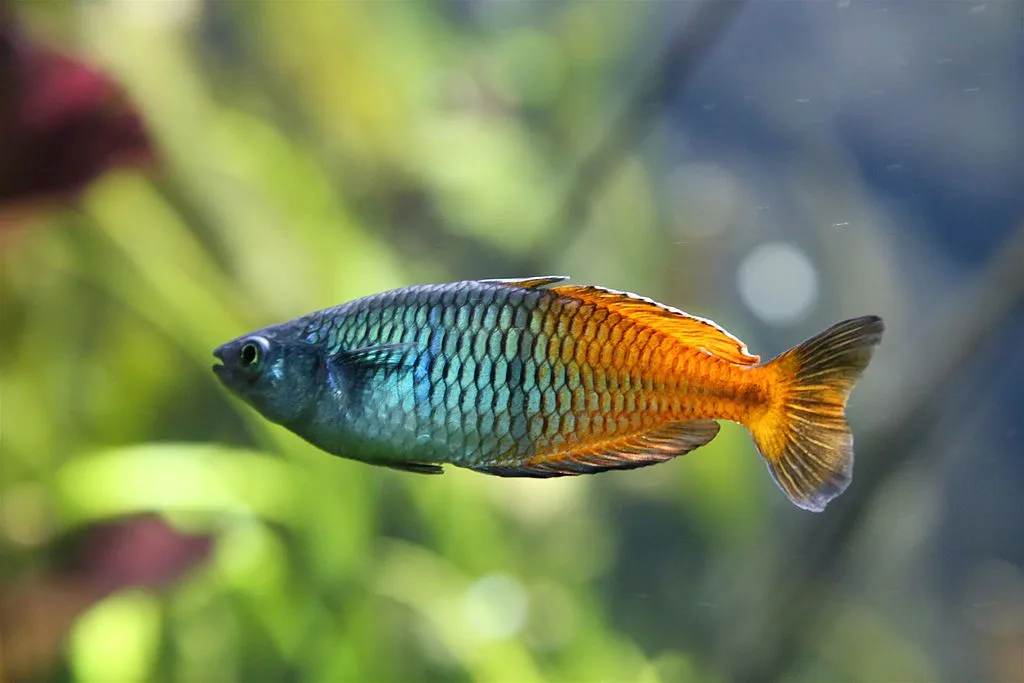
Melanotaenia boesemani, commonly known as Boeseman's Rainbowfish, is one of the most beautiful freshwater fish available to aquarists. The defining feature of this species is its breathtaking bicolored appearance: the front half of the body is painted in a deep blue-grey that gradually transitions into a vivid orange-red toward the tail. This striking gradient makes Boeseman's Rainbowfish truly unique among aquarium fish. Males display significantly more vibrant colors than females, and the intensity of their coloration deepens with age and proper care.
In the wild, Melanotaenia boesemani is found exclusively in the Ajamaru Lakes region on the Vogelkop Peninsula of West Papua, Indonesia. The species is listed as Endangered on the IUCN Red List due to habitat destruction. These fish belong to the family Melanotaeniidae and reach a size of 8-10 cm. Their lifespan in captivity is 5-7 years with proper care.
Tank Requirements
Boeseman's Rainbowfish require an aquarium with a minimum volume of 150 liters, as they are active schooling fish that need ample swimming space. The tank should be well-planted with live plants along the sides and back, while keeping the central area open for the school to move freely.
Optimal water parameters are: temperature 24-28°C, pH 6.5-7.5, and general hardness (GH) 8-15. Boeseman's Rainbowfish prefer moderately hard water with good aeration. An efficient filtration system that creates a gentle current is essential, mimicking conditions of their natural lake habitat. Weekly water changes of 25-30% will help maintain stable water quality. Fine gravel or sand works well as a substrate. Moderate lighting is preferred, as it showcases the fish's coloration to its best effect.
Feeding and Diet
Melanotaenia boesemani is an omnivorous species with no particularly demanding dietary requirements. The staple diet can consist of high-quality flakes or small pellets for tropical fish. To maintain vibrant coloration and overall health, it is recommended to regularly supplement the diet with live and frozen foods such as brine shrimp, daphnia, bloodworms, and cyclops.
A vegetable component is also important — spirulina or blanched spinach leaves make good options. Feeding should be done 2-3 times a day in small portions that the fish can consume within 2-3 minutes. A varied and balanced diet directly influences the intensity of these fish's famous bicolored appearance.
Care and Maintenance
Boeseman's Rainbowfish is a relatively undemanding species with a care level of 2 out of 5, making it suitable even for beginner aquarists. The primary focus should be on maintaining stable water parameters, as sudden fluctuations in temperature or pH can cause stress.
Test the water weekly and perform 25-30% water changes. Monitor the filter's condition and clean it regularly. Boeseman's Rainbowfish are diurnal, being most active during daylight hours. They should be kept in schools of at least 6 or more individuals, ideally with a female-to-male ratio of 2-3:1. Under these conditions, males display their most vibrant colors as they compete for the attention of females. With proper care, these fish rarely fall ill, though it is important to watch for signs of ich and fin rot.
Compatibility
Melanotaenia boesemani is an exceptionally peaceful fish (aggression level 1 out of 5), making it an excellent choice for community aquariums. The best tank mates include other rainbowfish such as the Dwarf Neon Rainbowfish, as well as peaceful species of similar size. Good companions include Congo Tetras, Neon Tetras, and Corydoras as bottom-dwelling inhabitants.
Avoid housing them with large aggressive species, as well as very small fish that may become stressed by the active behavior of rainbowfish. Slow-moving, long-finned species are also not recommended as tank mates, since rainbowfish may nip at their fins. Keeping a school of at least 6-10 individuals reduces intraspecific competition and allows you to observe the natural behavior of these magnificent fish.
Breeding
Breeding Melanotaenia boesemani in a home aquarium is achievable, though it requires some preparation (breeding difficulty 3 out of 5). A separate breeding tank of 50-80 liters is recommended, with a water temperature of 26-28°C and fine-leaved plants or dedicated spawning mops where the female deposits her eggs.
Prior to spawning, condition the breeding pair with generous live food feedings for 1-2 weeks. Spawning typically occurs in the morning hours with the first rays of light. The female lays several adhesive eggs daily over the course of several days, attaching them to plants with thin threads. Parents may eat the eggs, so it is advisable to regularly transfer the spawning substrate to a separate container. Incubation takes 7-12 days depending on the temperature. Fry should be fed infusoria and baby brine shrimp. Juveniles grow relatively slowly, and the characteristic bicolored pattern develops as they mature.