Overview
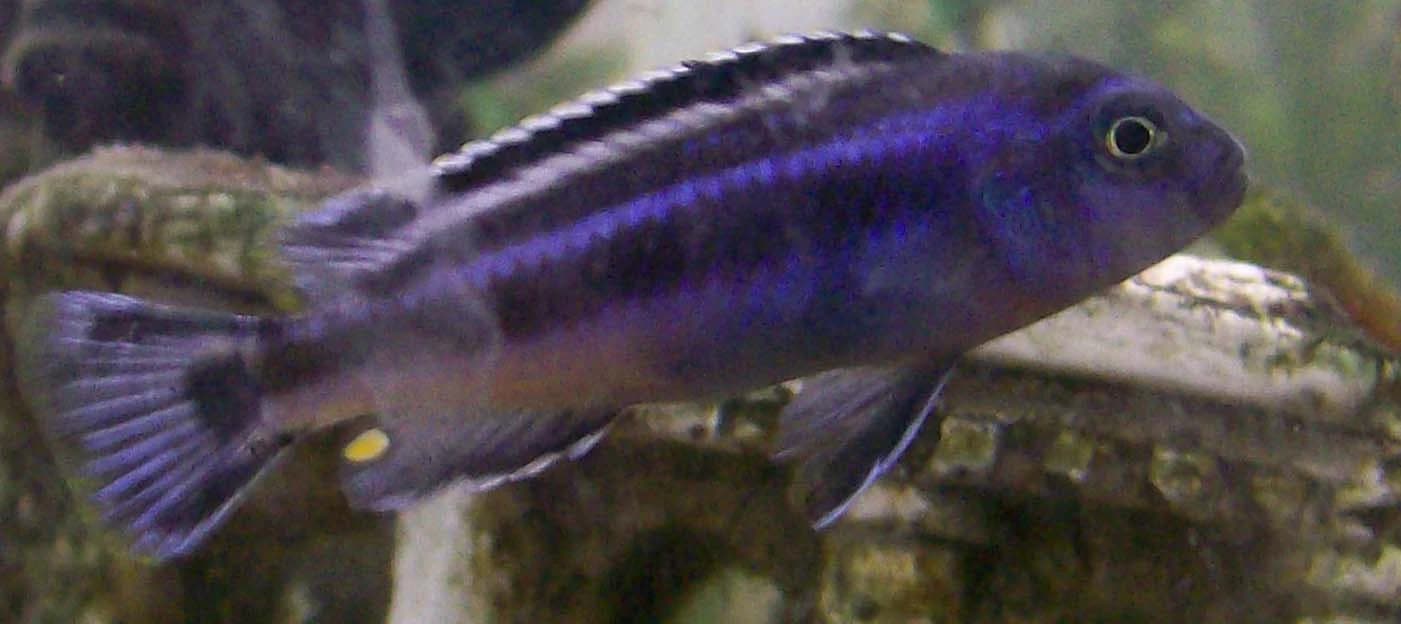
Melanochromis johannii is one of the most visually striking mbuna from Lake Malawi, thanks to its remarkably pronounced sexual dimorphism. Males display a deep electric blue coloration with dark horizontal stripes, while females and juveniles are bright orange or golden-yellow. This contrast within a single tank creates a spectacular display and often confuses beginners, who mistake males and females for different species.
Adults reach 8–12 cm. In the wild, M. johannii inhabits rocky coastal zones along the eastern shore of Lake Malawi (Mozambique), living at depths of 3 to 10 meters among rock piles. Like other mbuna, this species feeds on algal biofilm (aufwuchs), scraping it from rock surfaces.
Despite its relatively compact size, Melanochromis johannii is a highly aggressive fish, especially the males. The genus Melanochromis as a whole is considered one of the most combative among mbuna, and johannii is no exception. This must be factored into aquarium planning.
Tank Requirements
A group of Melanochromis johannii requires a tank of at least 150 liters. The optimal ratio is one male to three or four females, which distributes the dominant male's attention and reduces pressure on individual fish.
Optimal water parameters:
- Temperature: 24–28 °C
- pH: 7.5–8.5
- GH: 10–20
The setup should follow the classic rocky Lake Malawi biotope. Rocks should be arranged to form numerous caves, crevices, and hiding spots. Each fish needs its own refuge where it can escape the dominant male's aggression. The more hiding spots available, the calmer the atmosphere in the tank.
Substrate should be medium-grade sand. The fish occasionally dig through it but not as actively as some other mbuna. Live plants typically do not survive in a mbuna tank — they will be eaten and uprooted.
Filtration must be powerful: mbuna create a significant bioload, and efficient filtration is key to fish health. Good aeration is also essential.
Feeding and Diet
Melanochromis johannii is a predominantly herbivorous mbuna. In the wild, the diet consists mainly of algal biofilm with small invertebrates.
In the aquarium, the diet should be based on plant-based foods:
- High-quality spirulina-based pellets and flakes — the dietary staple
- Frozen cyclops, daphnia — as supplements
- Blanched vegetables: zucchini, cucumber, spinach
- Spirulina tablets
Important: avoid foods high in animal protein (bloodworms, tubifex). Like other mbuna, Melanochromis johannii has a long intestinal tract adapted to plant-based nutrition. Excess protein can lead to Malawi bloat — a dangerous and often fatal condition.
Feed 2–3 times daily in small portions. It is better to underfeed than overfeed.
Care and Maintenance
Keeping Melanochromis johannii requires experience with aggressive cichlids. The water parameters themselves are not difficult to maintain, but managing the social dynamics in the tank is not a task for beginners.
Weekly water changes of 25–30% are mandatory. Mbuna are sensitive to elevated nitrate levels — monitor them regularly. Ammonia and nitrites must always be at zero.
Watch fish behavior closely. The dominant male can aggressively pursue subdominant males and unwanted females. Signs of excessive stress include faded coloration, clamped fins, constant hiding, and refusal to eat. If the situation becomes critical, the victim must be removed.
Tip: keeping a group with a female majority (1 male to 3–4 females) significantly reduces intraspecific aggression. Having multiple males in one tank is only viable in very large volumes (300+ liters) with abundant hiding spots.
Compatibility
Melanochromis johannii is an aggressive mbuna, and selecting tank mates requires careful consideration.
Suitable companions:
- Mbuna of similar size and temperament: Pseudotropheus zebra, Maylandia callainos, Cynotilapia afra
- Labidochromis caeruleus — a more peaceful mbuna, but agile enough to avoid conflicts
Not recommended:
- Species with similar coloration, especially blue: Chindongo demasoni, Sciaenochromis fryeri — color similarity provokes heightened aggression
- The related species Melanochromis auratus — competition between closely related species can be particularly fierce
- Peaceful and slow-moving fish — they will become constant targets
- Small shell-dwelling and dwarf cichlids — too vulnerable
When stocking a mbuna tank, the "overstocking" principle is important: moderately increasing the number of fish helps disperse aggression, preventing dominant individuals from fixating on a single target. Filtration must, of course, match the increased bioload.
Breeding
Melanochromis johannii is a maternal mouthbrooder, and breeding this species is straightforward. Under suitable conditions, the fish reproduce regularly with virtually no intervention from the aquarist.
Spawning follows the typical mbuna pattern. The male selects a flat rock surface and begins intensely displaying his coloration to attract a female. The female lays small batches of eggs, picks them up in her mouth, and approaches the male's anal fin, where bright egg spots (ocelli) trigger fertilization.
The female carries 10 to 30 fertilized eggs in her mouth for 18–21 days. During this period she does not eat, and is easily identified by her characteristically swollen buccal pouch. After releasing the fry, the female may continue to take them back into her mouth when danger threatens.
In a community tank, fry have a chance of survival if there are sufficient small hiding spots among the rocks. To increase fry yield, the brooding female can be moved to a separate tank a few days before release.
Fry accept crushed spirulina flakes and baby brine shrimp from the first days. Juveniles are colored orange like the females; males begin developing their blue coloration as they mature — typically by 6–8 months of age.