Overview
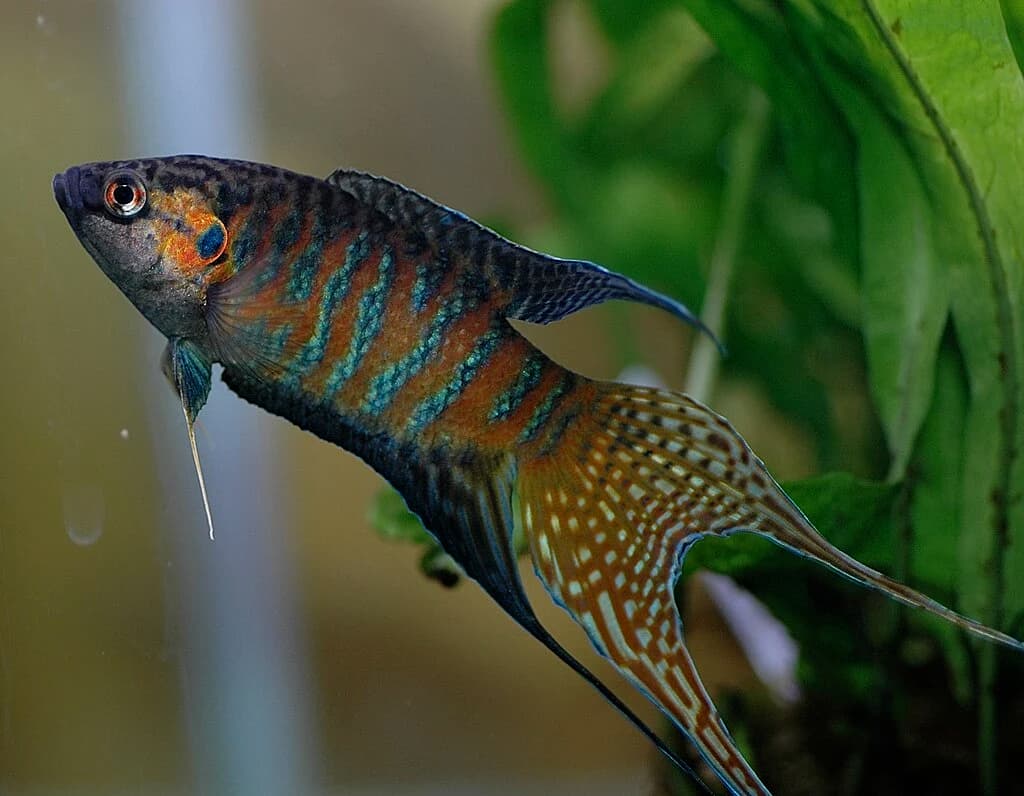
The Paradise Fish (Macropodus opercularis) is a legendary aquarium species from the family Osphronemidae and one of the first tropical fish to be kept in European aquariums, dating back to 1869. It was the Paradise Fish that sparked the aquarium hobby across Europe, making it a truly historically significant species.
Native to East Asia — China, Taiwan, Vietnam, and Korea — the Paradise Fish inhabits rice paddies, ponds, ditches, and slow-moving streams, often with murky, oxygen-poor water. Like other labyrinth fish, such as the Siamese fighting fish, the Paradise Fish possesses a specialized labyrinth organ that allows it to breathe atmospheric air. This adaptation enables it to survive in conditions unsuitable for most other fish.
Males display a stunning appearance with elongated, flowing fins and vibrant coloration featuring alternating red and blue stripes. Females are more modestly colored. The fish reaches a size of 6-8 cm and lives for 4-6 years with proper care.
Tank Requirements
A tank of at least 60 liters is suitable for keeping Paradise Fish. One of the greatest advantages of this species is its remarkable cold tolerance — the Paradise Fish can withstand temperatures as low as 16°C, making it one of the hardiest aquarium fish available. The optimal water temperature ranges from 20-26°C, with a pH of 6.0-8.0 and hardness (GH) of 5-19.
The aquarium should be densely planted with live vegetation, including floating plants that the male will need for nest building. It is important to provide ample hiding spots — driftwood, rocks, and caves — so the fish can establish territories. Water flow should be gentle to moderate, as Paradise Fish naturally inhabit still or slow-moving waters. A secure lid is essential, as Paradise Fish are excellent jumpers.
Feeding and Diet
Paradise Fish are omnivores with a hearty appetite. In the wild, they feed on insects and their larvae, small crustaceans, and algae. In the aquarium, high-quality flakes or pellets can form the staple diet, but regular offerings of live and frozen foods — bloodworms, brine shrimp, daphnia, and tubifex — are essential for maintaining health and vibrant coloration.
Paradise Fish also eagerly consume small snails and planaria, making them useful allies in controlling unwanted tank inhabitants. Feed 1-2 times daily in small portions that can be consumed within 2-3 minutes. Avoid overfeeding, as this can lead to obesity and deteriorating water quality.
Care and Maintenance
Paradise Fish are among the most undemanding aquarium fish. Their care level is rated as low, making them an excellent choice for beginner aquarists. Weekly water changes of 20-25% will help maintain optimal water quality. Test water parameters regularly to ensure stable conditions.
Thanks to their labyrinth organ, Paradise Fish are less demanding of aeration than most fish, though good filtration remains necessary. Monitor the condition of their fins — damage or white patches may indicate bacterial or fungal infections. With proper care, Paradise Fish rarely fall ill and will reward their keeper with lively activity and brilliant colors throughout their lives.
Compatibility
Paradise Fish have a semi-aggressive temperament. Males are highly territorial and aggressive toward one another, so it is recommended to keep only one male per tank. Cohabitation with other labyrinth fish, such as bettas or dwarf gouramis, should also be avoided, as conflicts between them are inevitable.
Good tank mates for Paradise Fish include active, medium-sized species: zebra danios, tiger barbs, or bronze corydoras as bottom dwellers. Avoid slow-moving fish with long fins, as Paradise Fish may nip at them. Small shrimp and fry may become prey.
Breeding
Breeding Paradise Fish is not particularly difficult and is accessible even to beginner aquarists. Like other labyrinth fish, Paradise Fish build bubble nests on the water surface. The male constructs a nest among floating plants and then actively courts the female.
To stimulate spawning, raise the water temperature to 24-26°C and provide generous feedings of live foods. During spawning, the male wraps around the female, and the eggs float up to the nest. After spawning, the female should be removed, as the male becomes aggressively protective of the clutch. The father diligently tends to the eggs and larvae, returning any fallen eggs to the nest.
The fry begin free-swimming 3-4 days after hatching. At this point, the male should also be removed. Infusoria and baby brine shrimp serve as suitable first foods. The fry grow quickly, and with good feeding, they begin to develop the characteristic adult coloration within a few months.