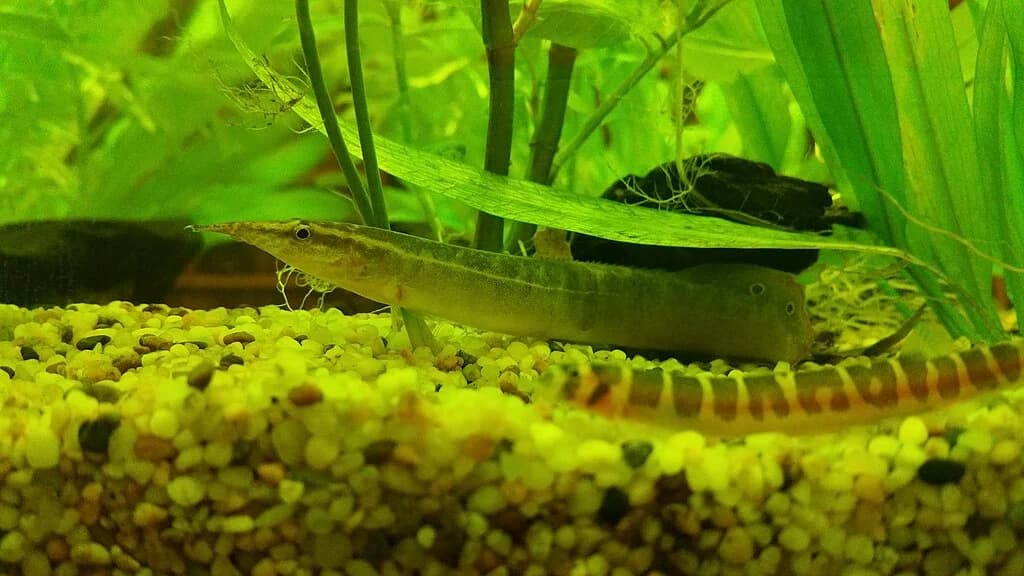
Overview
Macrognathus siamensis, commonly known as the Peacock Eel or Siamese Spiny Eel, belongs to the family Mastacembelidae. This unusual species inhabits freshwater bodies of Thailand, Cambodia, Vietnam, and surrounding regions of Southeast Asia, where it dwells in slow-moving rivers, canals, and swampy areas with soft substrate.
The defining feature of Macrognathus siamensis is the series of distinctive eyespot markings (ocelli) on its dorsal fin, resembling the pattern on peacock feathers — which is how the fish earned its common name. Its elongated, snake-like body is covered in fine scales and reaches 20–30 cm in aquarium conditions. With proper care, this species lives 8–12 years, making it a long-term aquarium resident.
This is a strictly nocturnal species: during the day, the fish prefers to hide in shelters or burrow into the substrate, becoming active primarily after dark. Despite its predatory nature, Macrognathus siamensis has a fairly calm temperament and shows no aggression toward similarly sized tank mates.
Tank Requirements
Keeping a Peacock Eel requires an aquarium of at least 200 liters. Fine sandy substrate is an absolute necessity — the fish regularly burrows into the substrate, and coarse gravel can damage its delicate skin and sensitive snout. The sand layer should be at least 5–7 cm deep.
Optimal water parameters are: temperature 22–28°C, pH 6.0–7.5, general hardness (GH) 5–15. Maintaining stability of these parameters is crucial, as sudden fluctuations negatively affect the fish's health.
The aquarium should be densely planted and equipped with numerous hiding spots: driftwood, ceramic tubes, and rock caves. Subdued lighting will help the fish feel more comfortable and become active earlier in the evening.
Critically important: Macrognathus siamensis is a notorious escape artist. The aquarium must be fitted with a tightly sealed lid with no gaps. All equipment openings and cable entry points must be carefully sealed — these eels can squeeze through the narrowest of spaces.
Feeding and Diet
Macrognathus siamensis is a predator whose diet consists primarily of live and frozen foods: bloodworms, tubifex, brine shrimp, small shrimp, and earthworms. Over time, some individuals may accept high-quality sinking pellets designed for carnivorous fish, though switching them entirely to dry foods is not recommended.
Feeding should be done in the evening or after the aquarium lights are turned off, as the fish typically ignores food during daylight hours. Using tweezers to deliver food directly to the fish's hiding spot is a practical approach — this ensures the eel receives its meal rather than more active daytime tank mates.
Dietary variety plays a key role in maintaining health and vibrant coloration. Rotating between different food types throughout the week is recommended.
Care and Maintenance
Keeping a Peacock Eel requires some experience and attentiveness. Weekly water changes of 20–30% are essential to maintain high water quality. An efficient filtration system is necessary, though the current should not be too strong — in nature, this species inhabits calm waters.
Macrognathus siamensis is sensitive to nitrogenous compounds in the water and is prone to skin parasitic infections, particularly ich (white spot disease). Regular monitoring of water parameters with test kits will help prevent issues. It is worth noting that these eels tolerate many copper-based medications poorly, so treatment requires a cautious approach.
When performing tank maintenance and gravel vacuuming, exercise caution — the fish may be hiding within the sand, and it can be easily injured. Before cleaning, make sure you know the location of all inhabitants.
Compatibility
The Peacock Eel has a peaceful temperament and coexists well with most non-aggressive, medium-sized fish. Suitable tank mates include gouramis, large tetras, corydoras, peaceful cichlids, and other calm species with similar water requirements.
It is strongly advised against keeping Macrognathus siamensis with small fish (neons, guppies, danios) and small invertebrates — they will be perceived as prey. Aggressive and territorial species that could intimidate the secretive eel and deny it access to food should also be avoided.
Multiple Macrognathus siamensis can be kept together provided the aquarium volume is sufficient and plenty of hiding spots are available. In such setups, interesting social behavior can be observed — the fish often share the same hiding spot as a group.
Breeding
Breeding Macrognathus siamensis in home aquariums is an extremely challenging task, rated at difficulty level 4 out of 5. Successful spawning events in captivity are rarely documented, and most specimens available for sale are wild-caught or bred on farms using hormonal stimulation.
For a breeding attempt, a separate spawning tank with soft, slightly acidic water, abundant fine-leaved floating plants, and subdued lighting is required. Conditioning the breeders involves intensive feeding with live foods over several weeks.
Macrognathus siamensis is a phytophilous species that lays eggs among plants. The eggs are small and adhesive. After spawning, the parents must be removed, as they tend to consume their own eggs. Larvae hatch within 3–4 days and begin feeding on infusoria and brine shrimp nauplii.