Overview
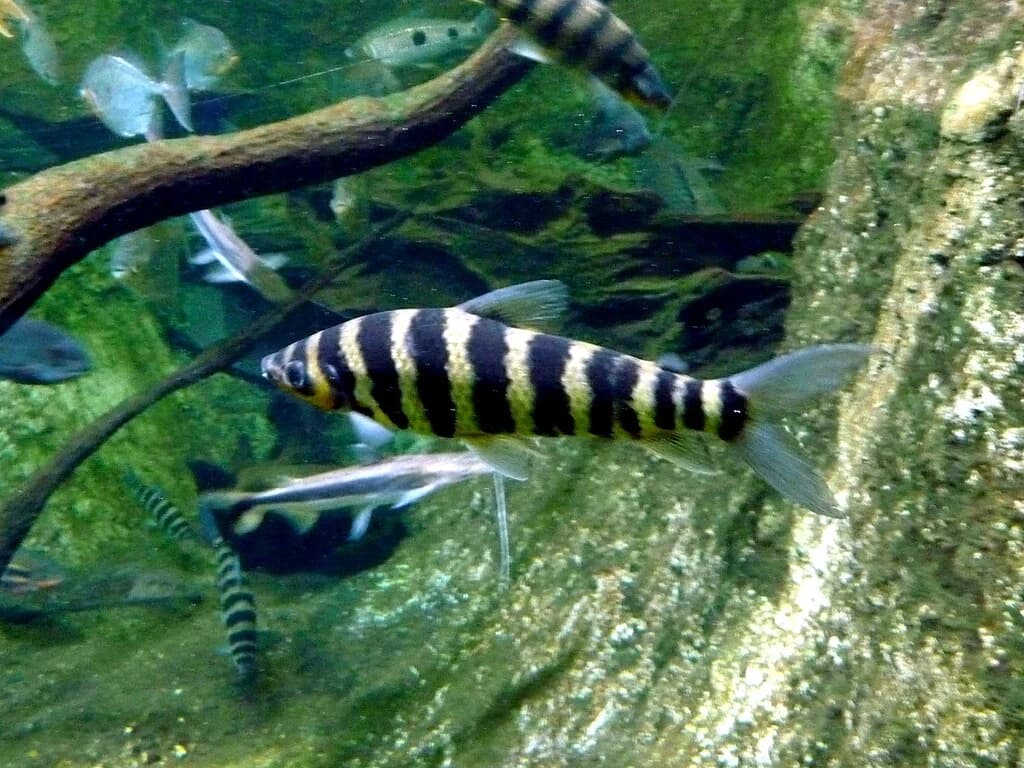
The Banded Leporinus (Leporinus fasciatus) is a striking freshwater fish from the Anostomidae family, native to the Amazon and Orinoco river basins. This species captivates with its vibrant coloration: an elongated, torpedo-shaped body adorned with alternating black and yellow vertical bands. A fascinating feature of this species is that the number of bands increases with age — juveniles have around 5 bands, while adults develop up to 10 distinct vertical stripes.
In the wild, Leporinus fasciatus inhabits fast-flowing rivers and tributaries with rocky bottoms and abundant vegetation. In an aquarium, this fish reaches 15–30 cm in length and lives 5 to 10 years with proper care. It is an active and energetic species that requires a spacious tank and is not recommended for beginners due to its size and behavioral traits.
Like its close relative, the Marbled Headstander, the Banded Leporinus belongs to the Anostomidae family and has a tendency to consume aquarium plants.
Tank Requirements
Keeping Leporinus fasciatus requires a tank of at least 200 liters, though a larger aquarium is preferable for adult specimens. Optimal water parameters include:
- Temperature: 23–28°C
- pH: 6.0–7.5
- Hardness (dGH): 5–15
The tank must be equipped with a tightly fitting lid, as Banded Leporinus are excellent jumpers. The decor should include driftwood, large rocks, and gravel to create hiding spots. Water flow should be moderate to strong, mimicking their natural habitat conditions.
It is important to note that Leporinus fasciatus actively consumes soft aquarium plants. For greenery, choose hardy species such as Anubias and Java moss, or use artificial plants.
Feeding and Diet
Leporinus fasciatus is an omnivorous species with a strong preference for plant matter. The core diet should include:
- High-quality pellets and flakes with plant-based ingredients
- Vegetables: spinach, zucchini, cucumber, green peas
- Algae wafers and spirulina
The protein component can be provided by:
- Live or frozen bloodworms
- Brine shrimp and daphnia
- Small pieces of shrimp
Feed 2–3 times daily in small portions. Providing sufficient plant-based food in the diet helps reduce the fish's tendency to eat aquarium plants.
Care and Maintenance
Keeping the Banded Leporinus requires regular care and attention. Weekly water changes of 25–30% are essential, along with a powerful filtration system. These fish produce significant waste due to their size and appetite, making a quality external filter a necessity.
Lighting should be moderate. A sandy or fine gravel substrate is preferred, approximating the natural biotope conditions. Regular monitoring of water parameters and fish condition is important — stressed fish may lose color vibrancy.
It should be noted that Leporinus fasciatus can become more assertive and pushy in behavior as it matures, so it is essential to provide adequate space and hiding places for all tank inhabitants.
Compatibility
The Banded Leporinus can be kept in a community tank, but tankmates should be chosen carefully. Suitable companions include:
- Large cichlids such as the Oscar
- Large catfish: Sailfin Pleco, Featherfin Synodontis
- Fast-moving fish of comparable size
Leporinus fasciatus should not be kept with:
- Small fish that may be perceived as prey
- Slow-moving species with long fins
- Small invertebrates (shrimp, snails)
When keeping multiple Banded Leporinus in the same tank, a group of 5 or more is recommended to diffuse intraspecies aggression. A pair may exhibit confrontational behavior.
Breeding
Breeding Leporinus fasciatus in a home aquarium is a challenging task and is rarely successful. In the wild, these fish spawn during the rainy season in large rivers, when water levels rise and water parameters shift.
Sexual dimorphism is minimal: females are generally slightly larger and fuller-bodied than males, particularly when carrying eggs. To stimulate spawning in an aquarium, the following conditions are needed:
- A very large breeding tank (at least 500 liters)
- Gradual reduction in water hardness and increase in temperature
- Simulating the rainy season through frequent water changes with soft water
Most specimens available in the trade are wild-caught or bred on specialized farms in Southeast Asia and South America using hormonal stimulation.