Overview
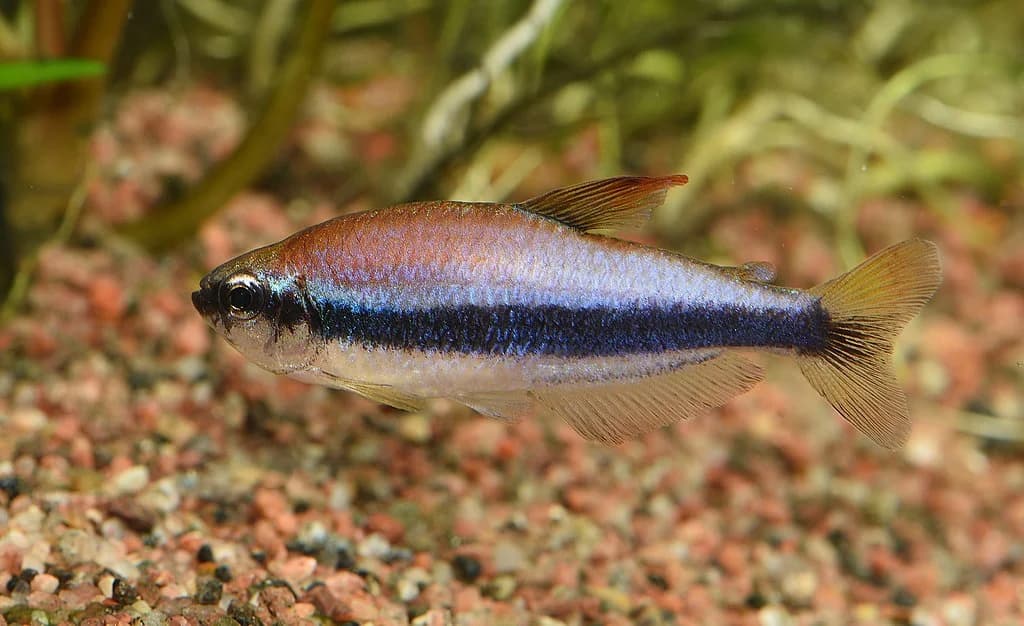
Inpaichthys kerri, commonly known as the Blue Emperor Tetra or Purple Emperor Tetra, is a small freshwater fish from the family Characidae. In the wild, it inhabits the upper Aripuana River basin in Mato Grosso, Brazil, where it is found in shaded forest streams with slow-flowing water. Adults reach a size of 3-4 cm and live 3 to 5 years with proper care.
One of the most striking features of this species is its pronounced sexual dimorphism. Males display an impressive purple-blue coloration with a broad dark longitudinal stripe running from the snout to the tail. The adipose fin of males has a blue hue. Females are more modestly colored in brownish-beige tones, and their adipose fin is reddish. A school of Blue Emperor Tetras, with the alternation of vivid males and subtler females, creates a stunning display in the aquarium.
Tank Requirements
A school of Inpaichthys kerri requires an aquarium with a minimum volume of 60 liters. Recommended water parameters are: temperature 22-26 °C, pH 6.0-7.5, and general hardness (GH) 5-15. The tank should be densely planted with live vegetation while leaving enough open swimming space in the midwater layers.
In nature, Blue Emperor Tetras live among tree roots and fallen leaves, so the addition of driftwood, dark substrate, and subdued lighting will help the fish feel comfortable and display their most vibrant coloration. Adding dried leaves (such as Indian almond leaves) will give the water a slight amber tint, creating conditions closer to their natural habitat. Good filtration and weekly water changes are essential.
Feeding and Diet
Inpaichthys kerri is an omnivorous species with micro-predatory tendencies. In the wild, the diet consists primarily of small invertebrates, insect larvae, and zooplankton. In the aquarium, these fish readily accept high-quality dry foods such as flakes and micro-pellets. To maintain health and vibrant coloration, especially in males, the diet should be supplemented with live or frozen foods: brine shrimp, daphnia, cyclops, and bloodworms.
Feed 2-3 times daily in small portions that the fish can consume within a few minutes. It is important not to overfeed, as excess food quickly degrades water quality in a small aquarium.
Care and Maintenance
The Blue Emperor Tetra is a relatively undemanding species suitable for aquarists with some experience. The key to successful care is maintaining stable water parameters. Weekly water changes of 20-25 % and regular monitoring of parameters will help keep the school healthy. The tank should have a secure lid, as tetras occasionally jump out of the water.
Blue Emperor Tetras should be kept in groups of 8-10 or more. In a group, the fish behave more confidently, and males display brighter coloration as they compete for female attention. When kept in small numbers, the fish may become shy and pale. Watch closely for signs of illness: at the first indication of ich or fin rot, treatment should be started immediately.
Compatibility
Inpaichthys kerri is a peaceful fish that is well suited for community aquariums. Ideal tankmates include other small characins such as neon tetras or cardinal tetras, as well as harlequin rasboras, small corydoras, and peaceful dwarf cichlids like ram cichlids. They also get along well with small catfish and shrimp.
Avoid keeping them with large or aggressive fish that may bully or prey on these small tetras. Housing with fin-nipping species such as tiger barbs is also not recommended.
Breeding
Breeding Inpaichthys kerri at home is quite achievable, though it requires some preparation. For spawning, set up a separate tank of 15-20 liters with soft water (GH 2-6), slightly acidic pH (around 6.0-6.5), and a temperature of 25-26 °C. Place fine-leaved plants or synthetic spawning mops on the bottom.
The selected pair or small group of breeders should be conditioned with live foods for 1-2 weeks before spawning. Spawning typically occurs in the morning hours. The fish scatter adhesive eggs among the plants. After spawning, the parents must be removed as they will eat the eggs.
The eggs incubate for approximately 24-36 hours. The larvae feed on their yolk sac for the first few days, after which they can be transitioned to infusoria and brine shrimp nauplii. The fry grow relatively quickly and begin developing adult coloration at 2-3 months of age.