Overview
Hypseleotris compressa, commonly known as the Empire Gudgeon, is a member of the Eleotridae family found in freshwater rivers and streams of Australia and New Guinea. Unlike many popular aquarium fish, this is not a tetra or a cichlid but a true gudgeon — a bottom-dwelling species with a distinctive body shape and behavior.
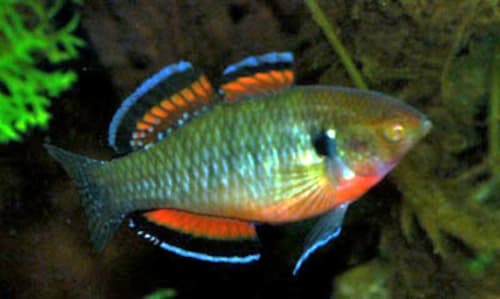
Adults reach a size of 7-9 cm. Males develop an impressive coloration during the breeding season: their bodies become covered with vivid red and blue iridescence, and their fins grow particularly striking. Females are more modestly colored but still display pleasant silvery-olive tones. In the wild, these fish inhabit calm sections of rivers with rocky or sandy bottoms, hiding among stones and driftwood.
Lifespan in an aquarium is 2-5 years with proper care. The Empire Gudgeon is a relatively peaceful species with a low aggression level, making it a good candidate for a community aquarium.
Tank Requirements
A group of Empire Gudgeons requires an aquarium of at least 80 liters. Optimal water parameters are: temperature 22-28°C, pH 6.5-7.5, and general hardness (GH) 5-12. These values correspond to conditions found in the species' natural habitats.
Fine substrate is preferable — sand or fine gravel — since gudgeons spend a significant amount of time near the bottom. The aquarium should be furnished with plenty of hiding spots: rocks, driftwood, ceramic tubes, and small caves will create a comfortable environment. Live plants are welcome, but hiding places are especially important as they help the fish feel secure.
Filtration should be effective but without excessively strong flow. Moderate water movement with good aeration is optimal for this species. Lighting can be moderate — overly bright light causes gudgeons to hide.
Feeding and Diet
In the wild, Hypseleotris compressa feeds on small invertebrates, insect larvae, microscopic crustaceans, and plant debris. In the aquarium, this species is omnivorous and accepts a wide variety of foods.
The staple diet can consist of high-quality sinking pellets and flakes, as gudgeons prefer to pick up food from the bottom. Be sure to supplement their diet with frozen and live foods: bloodworms, brine shrimp, daphnia, and tubifex worms. Protein-rich animal foods are what enhance the vibrancy of coloration, especially in males.
Feed 1-2 times daily in small portions. Keep in mind that gudgeons are unhurried eaters and may lose the competition for food to more active tankmates. Ensure that food reaches the bottom and is actually consumed by them.
Care and Maintenance
The care difficulty of Hypseleotris compressa is rated as low — this is a hardy and adaptable species suitable even for aquarists with limited experience. Nevertheless, stability of water parameters remains the key factor for their health.
Weekly water changes of 20-30% are necessary to maintain water quality. Regularly test ammonia, nitrite, and nitrate levels. Clean the substrate with a siphon, paying attention to areas around hiding spots where food debris accumulates.
Gudgeons are generally resistant to diseases, but deteriorating water quality can make them vulnerable to ich and bacterial infections. Monitor the fish's behavior: healthy individuals are active during the daytime, eat with appetite, and display rich coloration.
Compatibility
The Empire Gudgeon is a peaceful fish that coexists well with non-aggressive species of similar size. Excellent tankmates include harlequin rasboras, Boeseman's rainbowfish, dwarf neon rainbowfish, and small peaceful barbs such as cherry barbs.
Avoid housing them with large or aggressive fish that might view the gudgeon as prey. It is also not recommended to keep them with very active surface-dwelling species that consume all the food before it sinks to the bottom.
During the breeding season, males become territorial and may conflict with one another. Abundant hiding spots and visual barriers in the aquarium help reduce tension. It is optimal to keep one male with several females or to provide enough space for multiple males.
Breeding
Breeding Hypseleotris compressa in the aquarium is a task of moderate difficulty, entirely achievable when suitable conditions are provided. To stimulate spawning, maintain the temperature at the upper end of the acceptable range (26-28°C) and provide plenty of small caves and hiding spots.
Spawning occurs in secluded locations — under rocks, in caves, or on the underside of driftwood. The female lays eggs on a hard surface, after which the male takes over guarding the clutch. He fans the eggs with his fins and chases other fish away from the nest. This period of parental care is one of the most fascinating behavioral traits of the species.
Fry hatch after several days and initially require the finest foods: infusoria, rotifers, or newly hatched brine shrimp nauplii. As they grow, they can be transitioned to larger foods. To improve fry survival rates, it is recommended to move them to a separate rearing tank.