Overview
Hyphessobrycon roseus is a small yet highly attractive tetra of the family Characidae, found in shallow forest streams and swampy areas of rivers in Guyana and Suriname. In the wild, these fish inhabit shaded waters with soft, slightly acidic conditions tinted by tannins from fallen leaves.
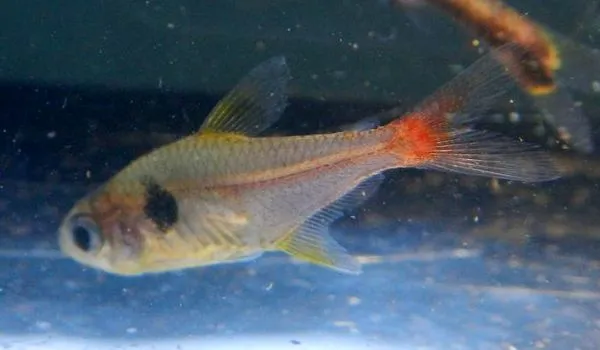
Adults reach 3–4 cm in size and live 3–5 years with proper care. The body is semi-transparent with a delicate pinkish-coral hue that intensifies under good nutrition and comfortable conditions. The dorsal fin is tall, with contrasting black and white edging that gives the fish an elegant appearance. Males are more vividly colored than females and have more prominent fins.
Hyphessobrycon roseus is often confused with the closely related Bentosi Tetra, which is even called the False Rosy Tetra. The Rosy Tetra is distinguished by its more compact size and less elongated fins. The behavior rating is 2 out of 5 — a peaceful, social fish that is perfectly suited for community tanks with other calm species.
Tank Requirements
A school of Rosy Tetras requires an aquarium of at least 40 liters. Optimal water parameters are: temperature 22–28 °C, pH 5.5–7.5, and general hardness GH 2–12. Despite the wide range of acceptable parameters, the fish display their best coloration in soft, slightly acidic water — conditions that match their natural biotope.
The tank is best decorated in a South American forest stream style: dark substrate, driftwood and branches, fallen Indian almond or oak leaves. Plant densely along the sides and back wall, leaving the central zone open for swimming. Floating plants will create diffused lighting in which Rosy Tetras feel more confident and show richer coloration.
Water flow should be gentle — in nature, Hyphessobrycon roseus inhabits virtually still waters. Use a soft sponge filter or adjust the output of an external filter to avoid a strong current.
Feeding and Diet
Hyphessobrycon roseus is an omnivorous fish with a moderate appetite. In the wild, the diet consists primarily of small insects, larvae, planktonic crustaceans, and detritus. In the aquarium, high-quality flakes or small pellets for tropical fish should form the staple diet.
Be sure to supplement dry food with live and frozen offerings: daphnia, brine shrimp, cyclops, and small bloodworms. Live food is particularly important for maintaining the intensity of the pink and red tones in their coloration. A small amount of vegetable supplementation — spirulina flakes and blanched spinach leaves — is also beneficial.
Feed 1–2 times daily in small portions consumed within 2–3 minutes. Overfeeding should be strictly avoided: small tetras are prone to obesity, which negatively affects their health and breeding ability.
Care and Maintenance
The care level for Hyphessobrycon roseus is rated 2 out of 5 — an undemanding species well suited for beginning aquarists. Nevertheless, stability of conditions remains the key factor for health and longevity.
Weekly water changes of 20–25% are mandatory. Standard filtration for a tank of this size is sufficient: a sponge filter or small external filter. Monitor parameters: ammonia and nitrites at zero, nitrates below 25 mg/l.
Keep Rosy Tetras in a school of at least 6–8 individuals. In a group, the fish behave far more confidently, males display their vivid coloration and spread fins to one another, and the overall tank picture becomes much more impressive. Solitary or paired specimens become nervous, pale, and tend to hide.
Rosy Tetras are hardy, but prolonged stress or poor water quality can lead to ich and fungal infections. Clean water, a varied diet, and the absence of aggressive tankmates are the best prevention.
Compatibility
Hyphessobrycon roseus is an ideal inhabitant for a peaceful community aquarium. When kept in a school, these fish show no aggression whatsoever and do not disturb their tankmates.
Excellent companions include other peaceful tetras of similar size: Neon Tetras, Black Neon Tetras, Glowlight Tetras, and Bentosi Tetras. Together with closely related species, Rosy Tetras create an exquisite palette of pink and red tones in the aquarium.
Good tankmates also include Harlequin Rasboras, Panda Corydoras, Pygmy Corydoras, and peaceful dwarf cichlids such as Cockatoo Apistogramma and Bolivian Rams. Small peaceful catfish and shrimp will also coexist perfectly with Rosy Tetras.
Avoid housing with large or aggressive fish, as well as active fin nippers like Tiger Barbs. Large cichlids and predatory species are also unsuitable.
Breeding
The breeding difficulty for Hyphessobrycon roseus is rated 3 out of 5 — an achievable task for an aquarist with basic experience. These are egg-scattering fish with no subsequent parental care.
Prepare a breeding tank of 10–15 liters with soft, slightly acidic water: temperature 26–28 °C, pH 5.5–6.5, GH 2–4. Line the bottom with fine-leaved plants — Java moss, Cabomba — or a spawning grid to protect the eggs. Lighting should be minimal, as the eggs are light-sensitive.
For 1–2 weeks before spawning, generously feed the breeders with live foods. Select a pair: a male with the most vivid coloration and a female with a noticeably rounded belly. Transfer them to the breeding tank in the evening — spawning typically occurs at dawn. The female scatters small, semi-transparent eggs among the plants.
Remove the adults immediately after spawning, or they will consume their own eggs. The larvae hatch within 24–36 hours and become free-swimming by day 4–5. First food should be infusoria and liquid fry food. After 7–10 days, transition to baby brine shrimp. Fry grow at a moderate pace and begin developing their characteristic pink hue by 2–3 months of age.