Overview
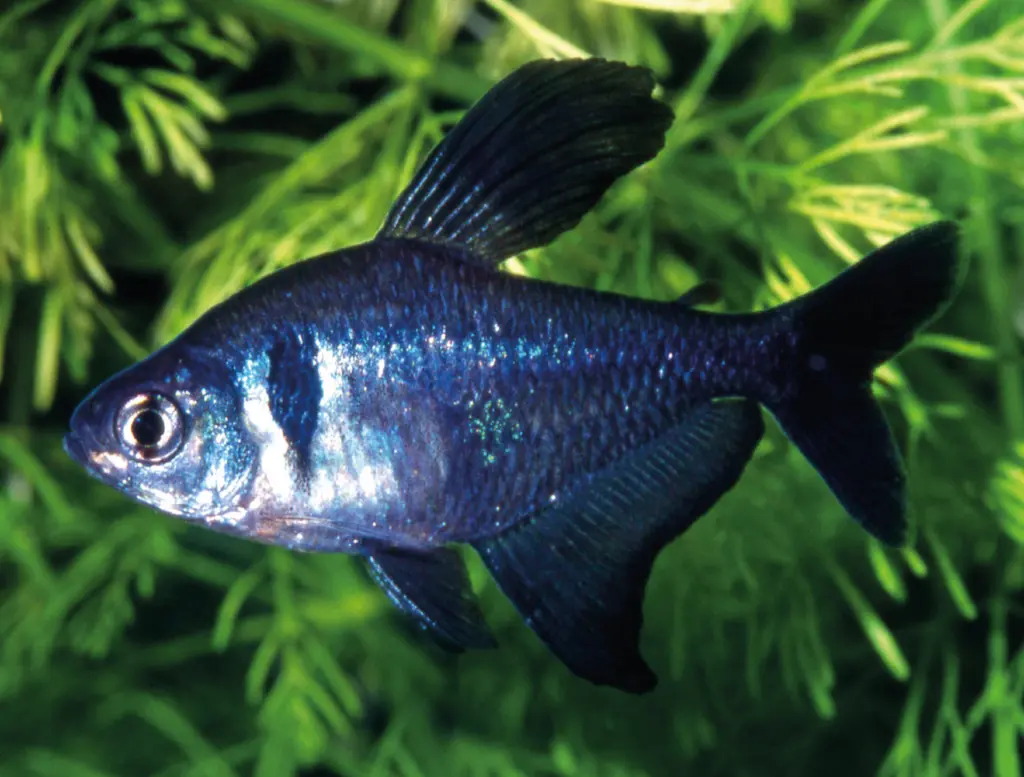
Hyphessobrycon megalopterus, commonly known as the Black Phantom Tetra, is one of the most visually distinctive tetras in the aquarium hobby. This small fish, growing to 4-5 cm in length, originates from slow-moving rivers and tributaries of the Paraguay River basin in Bolivia and Brazil. It belongs to the family Characidae and captivates aquarists with its unique appearance.
Males have a smoky-gray body with a prominent black patch behind the gill cover and an impressively long dorsal fin, which they dramatically spread during ritualized "sparring matches" with other males. Females look quite different — their bodies have a reddish hue with red-brown fins. This sexual dimorphism makes a school of Black Phantoms especially decorative.
By temperament, this is a calm schooling fish that works beautifully in a community aquarium. With proper care, they live for 3-5 years.
Tank Requirements
A group of 6-8 Black Phantom Tetras requires an aquarium of at least 70 liters (about 20 gallons). These fish are a schooling species, and keeping them alone or in pairs causes stress, so a group of six or more is essential.
Optimal water parameters are: temperature 22-28°C (72-82°F), pH 6.0-7.5, and general hardness (GH) 4-18. In practice, these fish display their best coloration in soft, slightly acidic water with a pH around 6.5 and GH no higher than 10.
The aquarium setup should mimic their natural habitat: dense plantings of live plants along the sides and back, driftwood, and a few Indian almond leaves for gentle tannin-stained shading. Leave the center of the tank open for swimming. A dark substrate and subdued lighting will enhance the fish's contrasting colors and reduce stress. Under bright light, Phantoms become pale and behave timidly.
Feeding and Diet
Hyphessobrycon megalopterus is an omnivorous species with no special dietary demands. The staple diet should consist of high-quality flakes or small granules formulated for tropical fish. However, to maintain good health and vibrant coloration, supplement their diet regularly with live and frozen foods such as daphnia, bloodworms, brine shrimp, and cyclops.
I recommend feeding twice daily in small portions that the fish consume within 2-3 minutes. Overfeeding is one of the most common mistakes, leading to deteriorating water quality. A weekly fasting day is beneficial. Dietary variety stimulates natural foraging behavior and strengthens the fish's immune system.
Care and Maintenance
The Black Phantom Tetra is a hardy and undemanding fish with a care level of 2 out of 5, making it an excellent choice for beginner aquarists. Nevertheless, stability of water parameters matters more than their exact values.
Weekly water changes of 20-25% are the bare minimum. The aquarium should be equipped with a filter providing moderate flow and a heater with a thermostat. Regularly test ammonia, nitrite, and nitrate levels — the first two should read zero, while nitrates should not exceed 20 mg/l.
Watch the condition of their fins: frayed or whitened edges may signal a bacterial infection or stress. When kept in clean water with stable conditions, Phantoms rarely fall ill.
Compatibility
Black Phantom Tetras are peaceful fish with an aggression level of 2 out of 5. They coexist beautifully with other calm species of similar size. Excellent tankmates include Neon Tetras, Black Neon Tetras, Flame Tetras, Serpae Tetras, Emperor Tetras, and Silver-tipped Tetras. For bottom dwellers, Corydoras make ideal companions.
Male Black Phantoms regularly engage in ritualized "sparring matches," spreading their fins and circling each other. This is completely normal behavior that does not result in injuries and is quite spectacular to watch.
Avoid housing them with large or aggressive species, as well as fish prone to fin nipping. The long fins of male Phantoms can become targets for such tankmates.
Breeding
Breeding Hyphessobrycon megalopterus at home is entirely achievable with the right conditions. The breeding difficulty is rated as moderate (3 out of 5).
Prepare a separate breeding tank of 20-30 liters (5-8 gallons) with soft water (GH 2-6), slightly acidic pH (6.0-6.5), and a temperature of 26-27°C (79-81°F). Place a spawning grid or fine-leaved plants on the bottom — Java moss works excellently. Lighting should be minimal.
For 1-2 weeks before spawning, feed the breeders generously with live foods. Select a pair with clearly pronounced sexual differences: a male with long fins and dark coloration, and a female with a rounded belly. Introduce them to the breeding tank in the evening — spawning typically occurs the following morning.
The male performs a courtship dance before the female, after which they scatter eggs among the plants. Remove the parents immediately after spawning, as they will readily eat their own eggs. Larvae hatch within 24-36 hours, and fry become free-swimming by day 3-4. Initial food should be infusoria and microworms, with baby brine shrimp introduced after about a week.