Overview
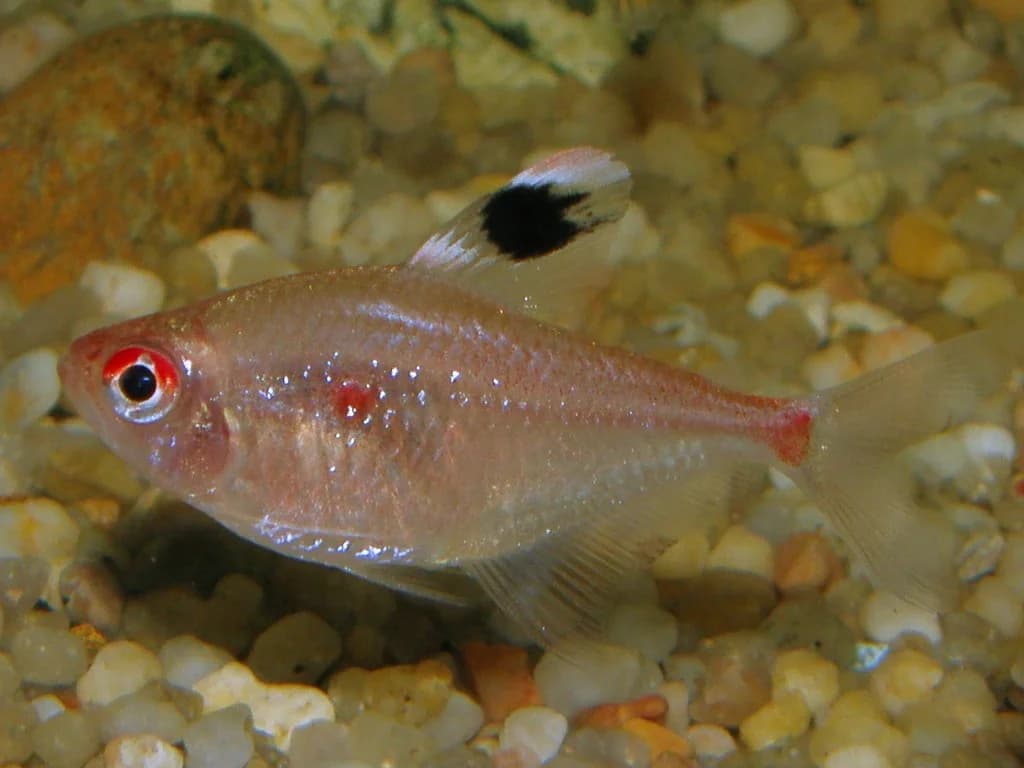
Hyphessobrycon erythrostigma is one of the most recognizable tetras in the family Characidae, named after the vivid crimson spot on its flank that resembles a bleeding heart. In the wild, this species inhabits slow-flowing rivers and flooded forests of the upper Amazon basin in Peru and Colombia, where it favors soft, slightly acidic water stained with tannins.
The fish reaches a size of 4–5 cm and lives 3–5 years with proper care. The body is tall and laterally compressed, with a silvery-pink base coloration. Its defining feature is a large red-crimson spot in the center of the body that gives the species its common name. Males sport an elongated, sickle-shaped dorsal fin with elegant white tips. Females are more rounded with less developed finnage but still display the characteristic spot.
Hyphessobrycon erythrostigma is often confused with its close relative, the ornate tetra, which lacks the prominent red spot on its flank. Another similar species is the rosy tetra, whose spot is less vivid and smaller.
Tank Requirements
A school of Hyphessobrycon erythrostigma requires an aquarium of at least 80 liters. Optimal water parameters are: temperature 22–28 °C, pH 6.0–7.5, and GH 6–12. The species is fairly adaptable, but thrives best in soft, slightly acidic water.
The tank setup should mimic the natural biotope: dark substrate, driftwood, Indian almond leaves, and dense vegetation along the perimeter. Leave the central area open — Bleeding Heart Tetras are active swimmers and need room to maneuver. Floating plants will create diffused lighting, under which the fish display their most vivid coloration.
Keep this species in a school of at least 6–8 individuals. In a group the fish feel more confident, males compete by displaying their impressive fins, and stress-related behavior is minimized. Water flow should be gentle to moderate.
Feeding and Diet
Hyphessobrycon erythrostigma is an omnivore with a moderate appetite. In nature, its diet consists of small insects and larvae, zooplankton, and plant detritus. In the aquarium, the staple diet should be high-quality flakes or small granules for tropical fish.
Regularly supplement with live and frozen foods: daphnia, brine shrimp, cyclops, and small bloodworms. Live foods in particular help maintain the intense coloration of the red spot and overall body brightness. Occasional plant-based supplements — spirulina flakes or blanched spinach — are also beneficial.
Feed 1–2 times daily in small portions consumed within 2–3 minutes. Bleeding Heart Tetras actively take food in the water column and at the surface. Avoid overfeeding — small tetras are prone to obesity on a monotonous diet of dry foods alone.
Care and Maintenance
The care level for Hyphessobrycon erythrostigma is rated 2 out of 5 — this is an undemanding species suitable for aquarists with minimal experience. That said, stable conditions remain the key to health and longevity.
Weekly water changes of 20–25 % are essential. Use an internal or small external filter appropriate for the tank volume. Monitor parameters: ammonia and nitrites should be at zero, nitrates below 25 mg/l.
Bleeding Heart Tetras are fairly hardy, but under stress or in poorly maintained water they can be susceptible to ich and fungal fin infections. The best prevention is clean water, a varied diet, and keeping them in a proper school. If fins are damaged, they regenerate within a few weeks under good conditions.
Pay attention to lighting: under overly bright light, the fish appear paler and tend to seek shelter. Subdued, diffused lighting will bring out their natural beauty.
Compatibility
Hyphessobrycon erythrostigma is a peaceful fish (2 out of 5 on the aggression scale), perfectly suited for a tranquil community aquarium. Within the school, harmless hierarchical sparring may occur between males, but aggression toward other species is absent.
Excellent tankmates include other peaceful tetras of similar size: neon tetras, black neon tetras, ornate tetras, emperor tetras, and glowlight tetras. The closely related rosy tetra is also perfectly compatible and together with the Bleeding Heart Tetra creates a striking color combination.
They coexist well with harlequin rasboras, panda corydoras, pygmy corydoras, and dwarf cichlids such as cockatoo cichlids and ram cichlids.
Avoid housing them with large or aggressive species, as well as active fin-nippers. The sickle-shaped fins of males are a frequent target for tiger barbs, so such combinations are best avoided.
Breeding
Breeding Hyphessobrycon erythrostigma is rated 3 out of 5 in difficulty — a task well within reach for aquarists with basic experience. This is an egg-scattering species with no parental care.
Prepare a breeding tank of 15–20 liters with soft, acidic water: temperature 26–28 °C, pH 5.5–6.5, GH 2–6. Place fine-leaved plants on the bottom — Java moss or cabomba — or use a spawning grid to protect the eggs. Lighting should be minimal, as the eggs are light-sensitive.
For 1–2 weeks before spawning, feed the breeders generously with live foods. Select a male with the brightest coloration and most prominent sickle-shaped fin, and a female with a noticeably rounded belly. Transfer the pair to the breeding tank in the evening. Spawning typically occurs in the morning: the male performs a courtship dance, after which the female scatters small, semi-transparent eggs among the plants.
Remove the adults immediately after spawning — they are prone to eating their own eggs. Larvae hatch within 24–36 hours and begin free-swimming on the 3rd–4th day. Initial food should be infusoria and liquid fry food; after 7–10 days, transition to baby brine shrimp. Fry grow at a moderate pace, and the characteristic red spot begins to appear at 2–3 months of age.