Overview
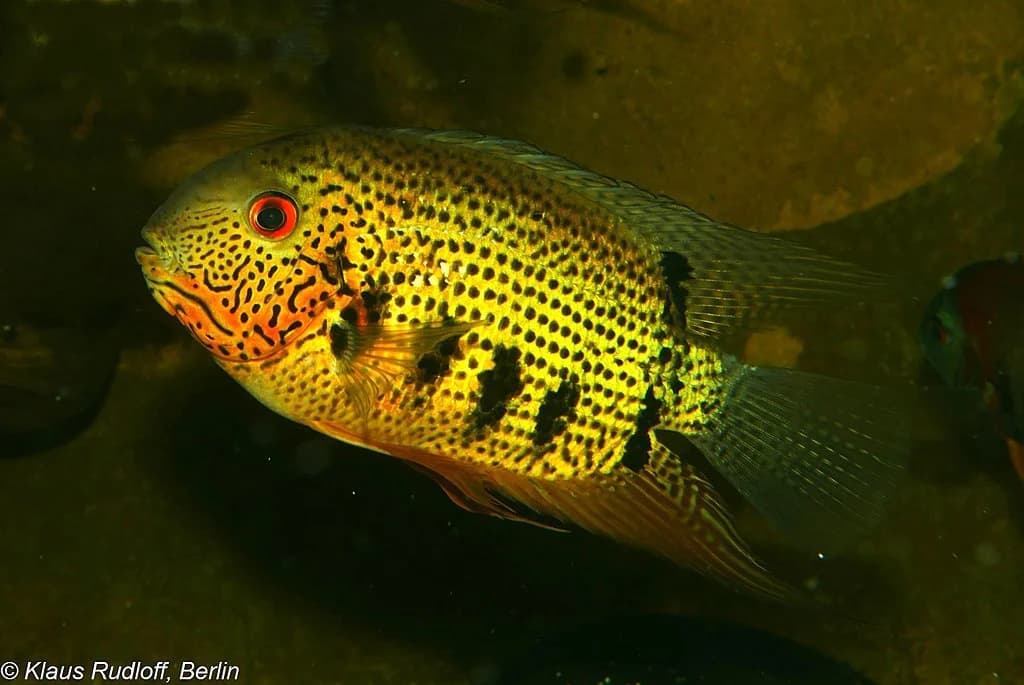
Heros notatus is a large South American cichlid from the family Cichlidae, inhabiting slow-moving rivers, side channels, and flooded forests of the Amazon and Orinoco basins. The Spotted Severum is closely related to the well-known Green Severum and Red Spotted Severum, but stands out with its distinctive contrasting spotted pattern.
The fish grows to 20–25 cm and lives 10–15 years with good care — a true long-lived species that demands a responsible approach. The body is deep and disc-shaped, typical of the genus Heros. The base coloration ranges from olive-gold to greenish, adorned with large dark spots and vertical bars whose intensity varies with the fish's mood and condition. During the breeding season, coloration intensifies significantly.
The behavior rating is 3 out of 5 — a moderately territorial cichlid, considerably calmer than most large cichlids. The Spotted Severum is not particularly aggressive, though it may actively defend its chosen territory during breeding. This is an intelligent fish that quickly bonds with its owner and demonstrates conscious, individual behavior.
Tank Requirements
A pair of Spotted Severums requires an aquarium of at least 250 liters. For a group or a community tank with other species — 350–400 liters or more. Optimal water parameters are: temperature 24–28 °C, pH 6.0–7.5, and general hardness GH 5–15.
The setup should include large driftwood, rocks, and sturdy plants that create hiding spots and visual barriers — this is critically important for reducing territorial conflicts. Choose tough-leaved plant species: Anubias attached to driftwood, large Echinodorus, and Java fern. Soft-leaved plants will be eaten — this is a well-known trait of the genus Heros.
Substrate should be fine sand or smooth gravel. Severums occasionally dig in the substrate, so sharp materials are unsuitable. Leave ample open space for swimming in the central area of the tank. Water flow should be gentle to moderate.
Feeding and Diet
Heros notatus is an omnivorous cichlid with a significant proportion of plant matter in its diet. In the wild, it feeds on algae, fallen fruit, seeds, small invertebrates, and detritus.
In the aquarium, the staple diet should be high-quality pellets for large cichlids with a high vegetable content. Supplementation with plant-based foods is essential: blanched spinach, peas, zucchini, and cucumber slices. Without adequate plant matter, Severums will actively graze on aquarium plants.
Live and frozen foods — bloodworms, brine shrimp, daphnia, and shrimp — should be offered 2–3 times per week as a supplement, not as the dietary staple. Overfeeding protein-rich foods leads to digestive issues.
Feed 1–2 times daily in moderate portions. Adult Severums eat at a leisurely pace, which should be considered when keeping them with more active feeders — ensure food reaches everyone.
Care and Maintenance
The care level for Heros notatus is rated 3 out of 5. This is not the most demanding cichlid, but it requires stable conditions and a spacious tank.
Weekly water changes of 25–30% are mandatory. Filtration should be robust — an external canister filter with a turnover rate of at least 4–5 tank volumes per hour. A large cichlid creates a significant biological load. Monitor parameters: ammonia and nitrites must be strictly at zero, nitrates below 30 mg/l.
Spotted Severums are sensitive to water quality: elevated nitrate levels or unstable parameters cause them to fade, become skittish, and become susceptible to bacterial infections. Hole-in-the-Head disease (HITH), common in large cichlids, can appear with poor water quality and vitamin deficiencies. A varied diet rich in plant matter is the best prevention.
Periodically rearranging decorations helps reduce territorial attachment and minimize conflicts in a community setup.
Compatibility
Heros notatus is one of the most peaceful large cichlids, making it a valuable addition to a community tank. However, a behavior rating of 3 out of 5 means territoriality is present, especially during spawning.
Excellent companions include other calm South American cichlids of comparable size: Green Severums, Flag Cichlids, Eartheaters, and Blue Acaras. They coexist well with large catfish: Sailfin Plecos, Striped Raphael Catfish, and large Sterbai Corydoras.
Medium-sized characins — Black Skirt Tetras, Congo Tetras — can be kept with Severums, but only in schools of at least 8 and in a spacious tank.
Avoid small fish: Neon Tetras, rasboras, and small tetras — Severums may accidentally swallow any fish that fits in their mouth. Housing with overly aggressive cichlids like Oscars is also inadvisable, as they will dominate the calmer Severum.
Breeding
Breeding Heros notatus is rated 3 out of 5 in difficulty — a realistic goal for an aquarist with moderate experience. Spotted Severums are substrate spawners with pronounced parental care.
Severums form stable pairs. The best way to obtain a compatible pair is to raise a group of 5–6 juveniles and let them pair off naturally. Forcing pairs together often results in conflict.
To trigger spawning, maintain temperature at 26–28 °C, pH 6.0–6.5, GH 5–10. Increase the proportion of live food in the diet. The female lays 200–800 eggs on a pre-cleaned flat surface — a broad stone, an Echinodorus leaf, or the wall of a clay pot.
Both parents actively guard the clutch, fanning the eggs with their fins and removing unfertilized ones. The larvae hatch in 3–4 days and become free-swimming after about a week. First food should be baby brine shrimp and finely crushed pellets.
Parental instinct in Spotted Severums is usually well developed. During brood care, the pair becomes noticeably more aggressive toward tankmates, so a dedicated breeding tank is preferable. Fry grow fairly quickly and reach 3–4 cm by three months of age.