Overview
Herichthys carpintis is a large and striking cichlid from the family Cichlidae, native to the rivers and lakes of northeastern Mexico, particularly the Laguna de Carpintero basin, which gave the species its name. In the wild, this fish inhabits slow-moving river sections with rocky and sandy bottoms, where it shelters among rocks and submerged driftwood.
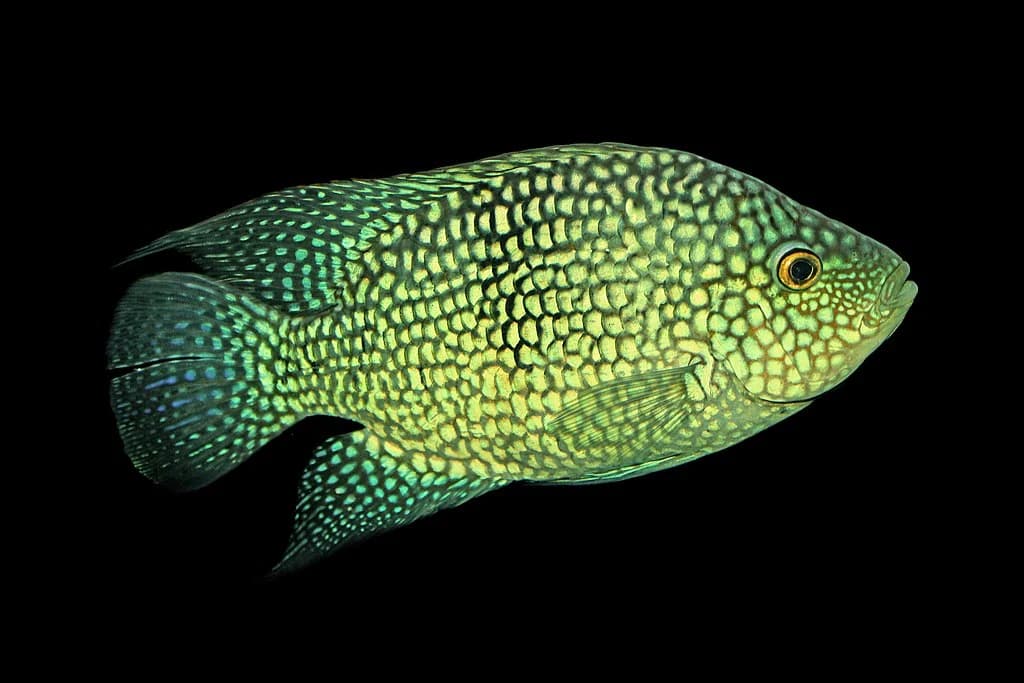
The Pearlscale Cichlid grows to 15–30 cm, with males being noticeably larger than females and developing a more massive head with a pronounced nuchal hump in mature specimens. The species' most distinctive feature is a scattering of iridescent turquoise-green and blue spots across the entire body, resembling pearls — hence the popular name. The base coloration ranges from grey-green to olive and darkens significantly during spawning.
With proper care, Herichthys carpintis lives 10–12 years, rewarding its owner with fascinating behavior and vibrant appearance. The fish has a pronounced personality: it is curious, recognizes its keeper, and actively responds to activity outside the aquarium. The care level is 3 out of 5, making it suitable for aquarists with some experience.
Tank Requirements
Keeping Herichthys carpintis requires an aquarium of at least 300 liters, and for a pair, 400 liters or more is recommended. This is an active and territorial fish that needs ample space. Optimal water parameters are: temperature 24–28 °C, pH 6.5–8.0, and hardness GH 8–20. The species is undemanding regarding hardness and tolerates moderately hard to hard water well.
Coarse sand or fine gravel works well as substrate — the Pearlscale Cichlid actively digs in the bottom, rearranging the landscape to its liking. Decorations should be heavy and stable: large rocks and solid driftwood. Be sure to include several hiding spots and visual barriers — these help fish establish territories and reduce aggression levels.
Live plants rarely survive in an aquarium with Herichthys carpintis: the fish uproots and destroys them. If you want greenery, use hardy species such as anubias and java fern attached to rocks or driftwood. The tank should be equipped with a tight-fitting lid, as the fish may jump when stressed.
Feeding and Diet
Herichthys carpintis is an omnivorous fish with an excellent appetite. In the wild, its diet consists of insects, small crustaceans, worms, algae, and plant matter. In the aquarium, the foundation of the diet should be high-quality pellets for large cichlids, which provide a balanced mix of proteins, fats, and vitamins.
Regularly supplement the diet with live and frozen foods: bloodworms, shrimp, squid pieces, and earthworms. Vegetable matter is also essential — blanched spinach leaves, peas, and pieces of zucchini or cucumber. This variety maintains vibrant coloration and strengthens the immune system.
Feed adult fish 1–2 times daily in portions that are consumed within 2–3 minutes. One fasting day per week benefits digestion. Avoid overfeeding — this is a common mistake that leads to obesity and water quality deterioration.
Care and Maintenance
The Pearlscale Cichlid is a hardy fish, but stable care is essential for a long and healthy life. Powerful filtration is a must: an external canister filter with a turnover rate of at least 4–5 times the tank volume per hour will handle the high biological load produced by this large fish.
Weekly water changes of 25–30 % are mandatory. Monitor water parameters with test kits: ammonia and nitrites should be at zero, nitrates below 30 mg/l. The Pearlscale Cichlid can tolerate brief parameter fluctuations, but consistently poor water quality leads to disease.
Be prepared for Herichthys carpintis to constantly rearrange the aquarium: digging pits in the substrate, moving lightweight decorations, and uprooting plants. All equipment (heater, thermometer, air stones) must be securely fastened. Regularly inspect the fish for signs of illness — loss of appetite, faded coloration, or unusual behavior.
Compatibility
Herichthys carpintis is a territorial fish with a behavior rating of 3 out of 5. It is not suited for community tanks with small and peaceful species. Anything that fits in the Pearlscale Cichlid's mouth will be treated as food.
Suitable tankmates include large, robust fish: Oscars, Red Terror Cichlids, Convict Cichlids (given sufficient tank volume), Synodontis catfish, and Sailfin Plecos. Cohabitation with Firemouth Cichlids is possible only in spacious tanks with plenty of hiding spots.
Small fish such as tetras, rasboras, and livebearers must never be kept with this species. Housing with Angelfish and other delicate cichlids is not recommended. The aggression of Herichthys carpintis increases significantly during spawning — at this time, the pair may terrorize all other tank inhabitants.
The ideal setup is a species-only tank with a pair of Pearlscale Cichlids and a couple of large companion catfish, such as Sailfin Plecos.
Breeding
Breeding Herichthys carpintis is achievable with proper preparation — the difficulty is rated 3 out of 5. The fish form stable pairs, and the best way to obtain a compatible pair is to raise a group of 5–6 juveniles and allow them to choose their own partners.
To stimulate spawning, raise the temperature to 26–28 °C and provide abundant live food. Water changes with slightly cooler water simulate the rainy season and can also trigger breeding. The tank must contain flat rocks or ceramic tiles — Pearlscale Cichlids lay their eggs on smooth, hard surfaces.
The female lays 500 to 1,000 eggs, after which both parents begin guarding the clutch. They carefully fan the eggs with their fins, remove unfertilized eggs, and aggressively chase away any fish from the nest. The eggs incubate for 2–4 days depending on temperature. After hatching, the larvae feed on their yolk sacs for another 3–4 days before becoming free-swimming.
Starter food for fry includes baby brine shrimp and finely ground pellets. The parents actively tend to their offspring, escorting the school of fry around the tank. Young pairs may eat their first clutches — this is normal behavior, and the parental instinct fully develops with experience. The fry grow quickly and reach 2–3 cm by two months of age.